Industrial Applications of Bottle-Derived Polyester Resins in Modern Textiles

The question Indian manufacturers are now working through is how far recycled PET resin can substitute for those same lines that run on virgin PET without changing the process, the specification, or the output quality.
The short answer for mechanically recycled material is: partially, and with caveats. The short answer for chemically recycled PET resin is: fully, at the right grade specification, and with certification that survives brand audits.
What makes bottle-derived feedstock worth understanding in detail is that post-consumer PET bottles are consistent, certifiable, and readily available recycled polyester input. The collection infrastructure exists. The sorting technology exists. The chemistry to convert bottles back into resin that behaves like virgin material exists. What is still catching up is the supply chain knowledge on the buying side: which grade for which process, what certifications actually require, and where the regulatory pressure is heading.
Read on to understand at length.

What "Bottle-Derived" Actually Means for Resin Quality
Post-consumer PET bottles are used as feedstock for recycled polyester resin production. The reasons are straightforward: bottles are manufactured to a narrow specification (food-contact grade), collected through relatively organized post-consumer streams, sorted with decent consistency, and their previous use history is predictable.
The bottle-to-textile pathway begins with collection and sorting, followed by mechanical cleaning to produce hot-washed PET flakes, and from there the route splits.
Mechanical recycling melts and re-extrudes the flakes into a usable polymer. The IV of mechanically recycled material typically sits in the 0.60-0.70 dl/g range, which covers the specification window for a wide range of fibre applications. For filament yarn production, particularly POY and FDY, processors generally work with resin-grade material where IV is set at the repolymerization stage rather than inherited from the flake input.
Chemical recycling (also called advanced recycling) breaks the polymer all the way back to its monomer constituents: BHET (bis-hydroxyethyl terephthalate), TPA (purified terephthalic acid), or MEG (monoethylene glycol) depending on the depolymerization route chosen. These monomers are then repolymerized under controlled conditions, producing a resin with IV specification, colour (b* value), and contaminant levels comparable to virgin PET. This is the distinction that matters for filament-grade textile applications.
JB rPET Industries manufactures C-rPET resin from post-consumer PET bottles through a depolymerization and repolymerization process. The resin is produced to target IV specifications across grades.
Applications by Textile Segment
POY and FDY Filament Production
Partially Oriented Yarn (POY) and Fully Drawn Yarn (FDY) production are viscosity-sensitive textile extrusion processes. Melt flow consistency directly affects yarn uniformity, draw ratio stability, and downstream tenacity.
Chemically recycled PET resin behaves like virgin resin at the extruder because it essentially is a freshly made polymer, just from monomer feedstock that was recovered rather than synthesised from petrochemicals. Filament manufacturers need raw material that performs identically across lots. C-rPET at defined IV (typically 0.64-0.68 dl/g for textile grade POY) delivers that.
Polyester Staple Fibre (PSF)
The tolerances of polyester staple fibre are wider than filament: IV in the 0.60-0.67 dl/g range works for standard PSF, and both hot-washed flakes and C-rPET resin feed into production depending on the target denier and application.
For hollow conjugate fibre and standard 1.4D to 3D staple for blending with cotton, hot-washed PET flakes are a suitable input and chosen across PSF production in India. For finer denier PSF (below 1.0D) used in high-loft nonwovens and filtration media, resin-grade material with consistent IV is preferable.
The one thing worth flagging to PSF producers: colour specification matters more in bottle-derived material than it does in virgin. Bottle feedstock with high b* (yellowness) values will produce off-white fibre that needs more TiO2 or optical brightener correction. Hot-washed flakes from well-sorted, clear bottle streams have b* values low enough for most PSF applications. C-rPET resin from chemical recycling allows b* control at the repolymerization stage, which gives better downstream colour consistency.
Nonwoven Fabrics
Nonwoven production lines running spunbond or meltblown processes use resin as direct input, not flakes. The reason is that spunbond extrusion requires precise melt viscosity control to maintain fibre diameter consistency, particularly for lighter grammage fabrics (15-30 gsm) used in hygiene, geotextile, and filtration applications.
For spunbond nonwovens, C-rPET resin with IV in the 0.64-0.66 dl/g range performs comparably to virgin resin.
The process requires low viscosity (IV around 0.50-0.55 dl/g) and very tight contaminant control. Not all C-rPET grades are suitable here. It depends on filtration quality at the repolymerization stage and whether the IV can be consistently held at that lower target.

Technical and Industrial Textiles
Seat belt webbing, geotextile straps, safety harnesses, and industrial belting all use high-tenacity polyester yarn. These are the applications where resin specification is non-negotiable.
High-tenacity yarn production requires IV in the 0.78-0.85 dl/g range. Reaching this from recycled feedstock requires either solid-state polymerization (SSP) of standard-IV resin to build molecular weight, or repolymerization directly to the target IV. C-rPET produced through controlled repolymerization can be specified to this range with the lot-to-lot consistency that technical yarn producers require.
This is a smaller volume market than commodity staple or filament, but it is a high-value one, and it is where the argument for chemical recycling over mechanical recycling is most clearly visible in performance terms.
Bottle-to-Textile and Textile-to-Textile Recycling
The challenge for the next few years is that as post-consumer textile collection infrastructure develops, the share of textile-derived feedstock in recycled polyester supply chains will grow.
Chemical recycling handles the mixed, coloured, and multi-component waste streams that come from post-consumer textiles.
Bottle-derived C-rPET resin remains one of the cleaner, consistent, and certifiable form of recycled polyester available today, and will continue to be the benchmark against which textile-derived rPET is measured.
Certifications That Procurement Teams Are Now Treating as Prerequisites
Previously, certifications on rPET were a differentiator. Today, for export-oriented textile manufacturers supplying to European, US, and Japanese brands, they are a procurement prerequisite.
ISCC PLUS (International Sustainability and Carbon Certification) uses a mass balance accounting approach. It certifies that recycled content is introduced at the feedstock level and tracked through the chain of custody. For rPET resin, ISCC PLUS allows manufacturers to make recycled content claims that brands can pass through to their own sustainability reporting. Without ISCC certification on the resin input, the recycled content claim does not survive third-party audit.
GRS (Global Recycled Standard) certifies the physical chain of custody: that the recycled content in a finished product can be traced back to verified post-consumer or pre-consumer waste inputs. For bottle-derived resin, GRS certification means the bottle collection source, the recycling process, and each subsequent processing step is audited. Brands sourcing through GRS-certified supply chains use this to substantiate recycled content claims in product labelling.
OEKO-TEX STANDARD 100 certifies the absence of harmful substances in finished textile products. For recycled polyester, this matters because poorly processed rPET can carry contaminants from the original use or the recycling process. Resin produced through chemical recycling with proper purification at the monomer stage can meet OEKO-TEX limits more consistently than mechanically recycled material.
FDA compliance is relevant for any textile application involving food contact or medical end uses, and for rPET resin used in applications where it may be processed alongside food-contact materials.
JB rPET Industries holds ISCC PLUS and GRS certifications on its C-rPET resin, which means manufacturers purchasing from us can pass these certifications directly through to their own supply chain documentation.
What EPR Is Changing for Indian Textile Manufacturers
India's Extended Producer Responsibility framework for plastic packaging under the Plastic Waste Management Rules (amended 2022) created mandatory recycled content targets for producers, importers, and brand owners. These obligations do not directly apply to textile manufacturers, but they apply to the brand owners and packaging converters who buy from textile supply chains.
What this is doing in practice: large domestic FMCG companies and export brands are pushing recycled content requirements down their supply chains. A garment exporter supplying to a European retailer now faces recycled content specifications in the technical brief. The retailer is under pressure from the EU Strategy for Sustainable and Circular Textiles (2022) and the forthcoming mandatory Green Claims Directive, which requires substantiated, verified environmental claims on products sold in EU markets.
The Green Claims Directive will require that recycled content claims be backed by a third-party verified certification. Generic "made from recycled PET" marketing language without certification will not be sufficient for products sold in EU markets. This makes the supply chain traceability that ISCC PLUS and GRS provide a commercial necessity, not just a preference.
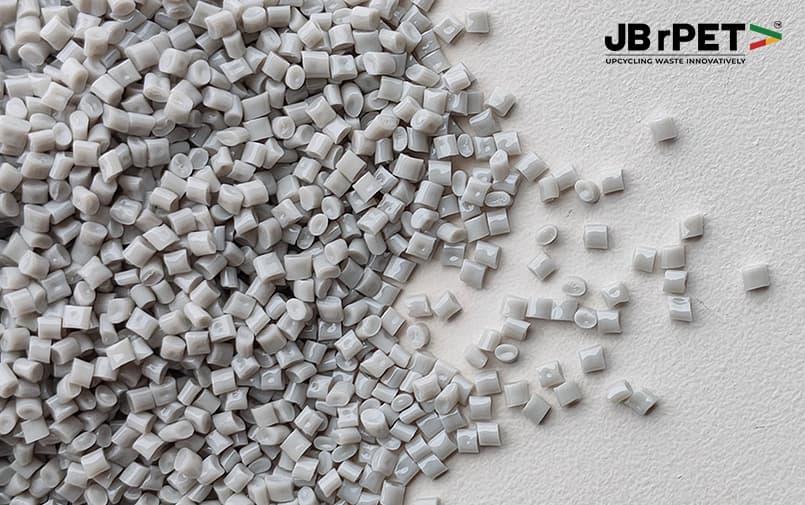
Performance Comparison: C-rPET vs Virgin PET in Textile Processing
The default assumption in the market is that recycled material is a compromise on performance. For chemically recycled PET resin, this does not hold at the right grade specification.
Intrinsic Viscosity: Chemically recycled PET can be produced to any target IV within the capability of the repolymerization reactor. JB rPET produces grades at standard textile IV targets, including fibre grade (0.64-0.68 dl/g) and bottle grade specifications for high-end applications. There is no inherent IV penalty with C-rPET.
Colour (b* value): Virgin PET typically comes in at b* below 2. Well-produced C-rPET from sorted bottle feedstock can achieve b* below 3, which is within specification for undyed fibre and dyed fibre applications where the base colour difference is removed during dyeing. For optical white or very light shade applications, b* specification requires attention.
Melt Flow Rate and Processing Stability: Processing stability through extrusion is determined largely by IV consistency and the absence of contaminants that cause foaming, pressure fluctuations, or die-face build-up. C-rPET produced through a properly controlled repolymerization process has equivalent processing stability to virgin resin. Contamination from bottle labels, adhesives, or coloured PET in the feedstock is handled at the depolymerization and purification stages, not at the extrusion stage.
Tenacity and Elongation: Yarn tenacity from C-rPET resin is equivalent to yarn tenacity from virgin PET at the same IV and spinning conditions. The tenacity difference between a 0.64 dl/g C-rPET and a 0.64 dl/g virgin resin spun under identical conditions is not distinguishable in standard yarn testing.
Buying Decisions: What Textile Manufacturers Should Be Evaluating
If you are a textile manufacturer currently evaluating
rPET resin as a raw material input, the evaluation should cover these specific
points rather than generalized sustainability positioning:
IV specification and lot-to-lot consistency. Ask for
the IV distribution across the last 10 production lots, not just the nominal
IV. For filament applications, the standard deviation matters as much as the
mean.
Certification scope. Check whether the certification covers just the resin production facility or extends to the bottle feedstock sourcing. ISCC PLUS certification on the resin without chain of custody back to the bale is a weaker claim than full feedstock-to-resin certification.
Colour specification. Get the b* data sheet, not just a verbal assurance on colour. If you are producing light-shade or optical-white fibre, b* above 3 will require correction and will add processing cost.
Contaminant profile. The relevant contaminants in bottle-derived rPET are PVC (from cap liners), polyolefins (from labels), and residual adhesive. Ask what detection and removal steps are in place and what the rejection thresholds are.
Supply continuity. Bottle feedstock supply is more regionally constrained than virgin PET feedstock. Understand where the bottles come from, what the collection radius looks like, and whether the processor has any formal offtake agreements with collection partners.
JB rPET Industries operates in the Gujarat cluster. Our C-rPET resin production uses post-consumer PET bottle feedstock, and the material carries both ISCC PLUS and GRS certifications. If you are a textile manufacturer with specific IV, colour, or certification requirements, we are set up to discuss grade specifications and supply terms directly. Get in touch through jbrpet.in.

The chemistry of bottle-derived polyester resin is not new. What is new is the commercial and regulatory context that is making certified, traceable C-rPET a supply chain requirement rather than an optional upgrade. The textile manufacturers who are working through the qualification process now, rather than waiting for a customer ultimatum, will have a material advantage.
JB rPET Industries manufactures chemically recycled PET resin (C-rPET) from post-consumer PET bottles. The facility is located in Gujarat, near Surat, and production carries ISCC PLUS, GRS, OEKO-TEX, and FDA certifications. For technical specifications and supply enquiries, visit jbrpet.in or contact the sales team directly.