PET Strap Manufacturing Today: Why Resin Consistency Defines Polyester Strap Roll Performance
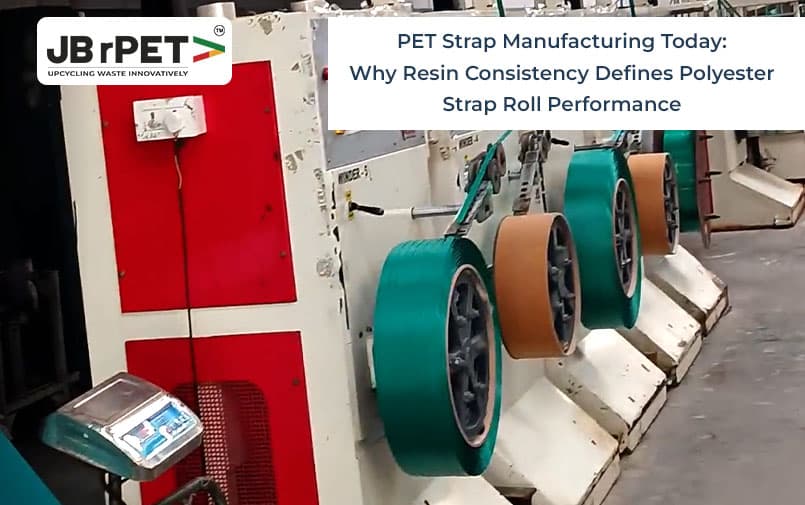
If you manufacture polyester strap roll or supply PET packaging strap to steel plants, paper mills, textile exporters, or logistics companies, you are not looking for theory.
You are looking for:
- Stable line performance
- Predictable break load
- Lower orientation breaks
- Fewer parameter corrections
- Better yield per shift
In PET strap manufacturing, these outcomes are not achieved at the die or the stretching oven. They are determined at the hopper.
We are not here to tell you about how PET works. You already know that.
This is about how raw material format influences production stability, and why more manufacturers are evaluating resin-based input instead of flake-based input for PET packaging strap manufacturing.

What Is PET Packaging Strap and Where Is It Used?
PET packaging strap is a high-strength plastic strapping material made from polyethylene terephthalate and used for securing industrial loads.
It is commonly supplied in the form of a polyester strap roll, wound and ready for automatic or semi-automatic strapping machines.
PET packaging strap is used in:
- Steel coil bundling
- Brick and construction material strapping
- Textile bale compression
- Paper reel securing
- FMCG palletization
- Heavy-duty export packaging
Compared to PP strap, PET packaging strap offers:
- Higher tensile strength
- Better elongation recovery
- Superior load retention
- Improved resistance to shock during transit
For medium to heavy load applications, polyester strap roll has increasingly replaced steel strapping due to safety and handling advantages.
What PET Strap Manufacturing Actually Demands from Raw Material
A finished polyester strap roll is expected to deliver:
- High tensile strength
- Controlled elongation
- Consistent break load
- Reliable weldability
- Performance stability across rolls
The process to achieve this typically includes
- Drying
- Extrusion
- Quenching
- Multi-stage stretching
- Heat setting
- Embossing
- Winding
The most sensitive stage is stretching. During orientation, the strap is drawn multiple times its original length to align polymer chains and increase strength
This stage does not tolerate variability well
Small differences in molecular weight distribution or melt flow behavior show up as:
- Necking irregularities
- Edge breaks
- Sudden snapping under draw
- Variation in final mechanical properties
So the real question becomes:
How consistent is the raw material entering your extruder?
PET Strap Manufacturing Process and Where Variability Enters
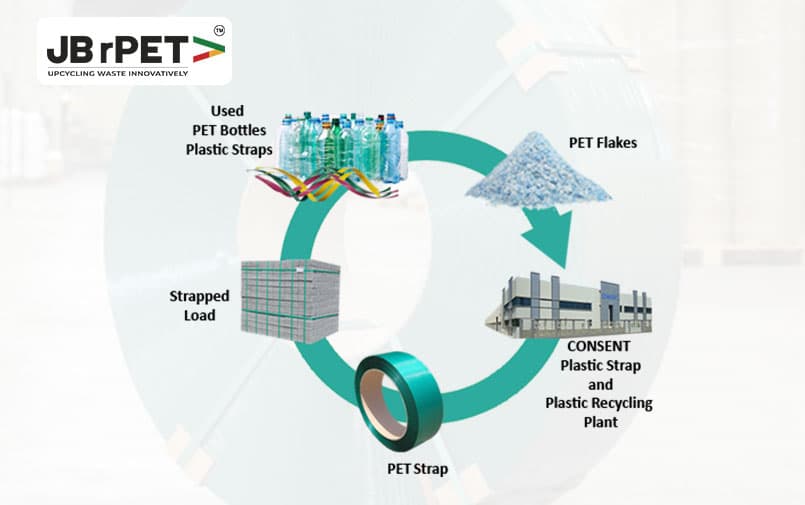
In PET packaging strap production, the manufacturing stages are well known. The real discussion is not about the stages themselves, but about where process variability enters the system.
In a typical polyester strap roll line:
- Drying influences IV stability
- Extrusion determines melt uniformity
- Filtration controls particulate load
- Stretching amplifies molecular inconsistencies
- Heat setting locks final mechanical properties
Among these, stretching is the stage where upstream variability becomes visible.
If the melt entering the die is inconsistent in molecular weight distribution or carries undetected inclusions, the stretching zone exposes it immediately.
For manufacturers focused on production efficiency, the question is not how to stretch harder but how to feed more stable material into the system.
Common Production Challenges in Polyester Strap Roll Manufacturing
Manufacturers of PET packaging strap typically manage one or more of the following:
- Variation in break load across rolls
- Increased orientation breaks during high draw ratios
- Frequent minor extrusion parameter adjustments
- Higher-than-expected filter pack change frequency
- Inconsistent strap thickness across production runs
These challenges are rarely caused by a single factor.
They often result from how raw material behavior interacts with line settings.
Even small fluctuations in melt behavior can influence stretching response, especially in higher-tensile polyester strap roll applications.
For manufacturers operating at scale, incremental instability compounds into measurable production cost.
Choosing Raw Material for PET Strap Manufacturing
When selecting raw material for PET packaging strap production, manufacturers typically evaluate:
- Process consistency across batches
- Compatibility with existing extrusion lines
- Stability during high draw ratios
- Long-term supply reliability
- Sustainability documentation requirements
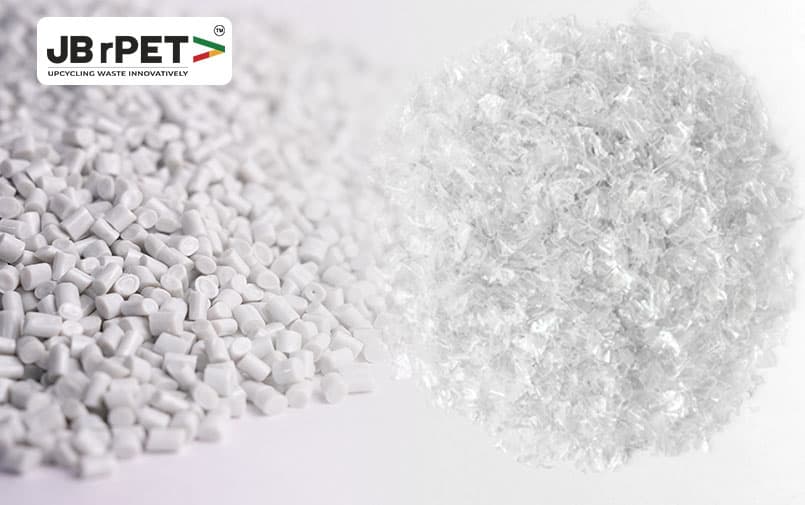
For some manufacturers, PET flakes align well with operational goals. For others targeting high-tensile polyester strap roll applications or export markets, resin-based input becomes part of a broader quality strategy
Material selection is not only about cost per kilogram. It is about how consistently that kilogram converts into finished, saleable strap.
Polyester Strap Roll Performance Begins at Molecular Level
For PET packaging strap manufacturing, three material characteristics directly influence process stability:
- Intrinsic Viscosity
- Melt uniformity
- Contamination control
Intrinsic Viscosity (IV)
IV influences melt strength and draw behavior. If IV fluctuates significantly between batches, extrusion pressure and stretching response change accordingly.
Manufacturers compensate by adjusting:
- Barrel temperatures
- Screw speed
- Draw ratios
- Line speed
These adjustments are normal. Constant adjustment is not ideal.
Melt Uniformity
When material entering the extruder has uniform molecular structure, melt flow becomes predictable.
Predictable melt flow means:
- Stable die output
- Consistent strap thickness
- Reduced thickness variation
Which translates into more reliable polyester strap roll performance
Contamination Control
In PET packaging strap manufacturing, small inclusions can act as stress concentration points during stretching.
Even microscopic contaminants may not affect extrusion, but they can influence orientation behavior.
Clean melt reduces the probability of such interruptions.
This is not a criticism of any material type. It is simply a reflection of how sensitive the stretching zone is.
PET Flakes in Strap Manufacturing: The Industry Standard
For years, PET flakes have enabled large-scale production of recycled PET packaging strap
- Collects post-consumer PET
- Washes and sorts it
- Converts it into flakes
This made recycled polyester strap roll commercially viable and widely adopted.
Flake-based production remains common and established in the industry.
However, flakes are fragments from multiple sources. That means molecular history varies across input material. Even within specification ranges, batch-to-batch differences can occur.
Manufacturers are accustomed to managing this variability through process optimization.
For some operations, this works efficiently.
For others aiming for tighter control and premium-grade performance, they begin evaluating alternatives.
Chemically Recycled Resin: A Different Starting Point
Chemical recycling differs structurally from mechanical recycling.
Instead of cleaning and reshaping existing polymer chains, the process:
- Depolymerizes PET to monomer level
- Purifies it
- Re-polymerizes under controlled conditions
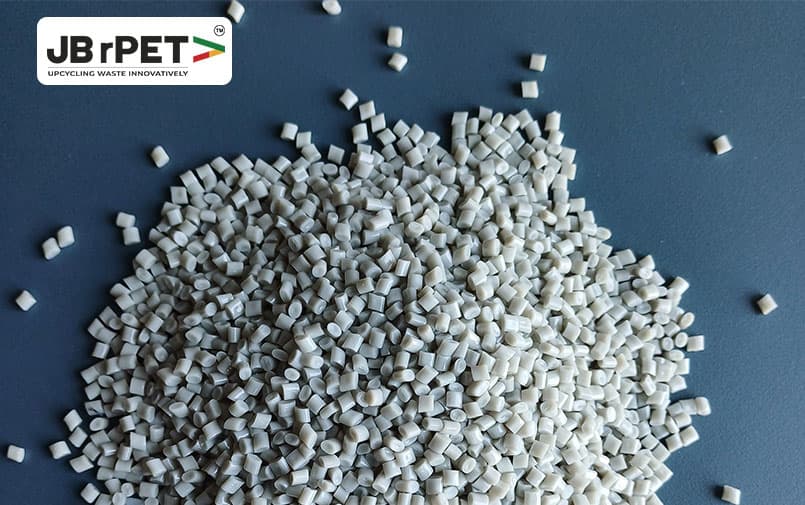
This produces resin granules with controlled molecular weight distribution and IV targets.
For PET packaging strap manufacturers, the practical difference lies in:
- Tighter IV management
- More uniform granule structure
- Melt behavior closer to virgin-grade consistency
The outcome is not theoretical. It is visible on the line.
Where Resin-Based Input Changes the Line Behavior
1. IV as a Controlled Output
In resin-based production, IV is typically managed as a process parameter during polymerization rather than accepted as a range across input batches.
For manufacturers, this means:
- Reduced IV-related variability
- More stable extrusion pressure
- More predictable stretching response
Parameter setting becomes calibration rather than correction.
2. Cleaner Melt Profile
Chemically recycled resins undergo purification during processing.
This typically results in:
- Reduced particulate presence
- Smoother melt filtration
- Lower stress concentration during orientation
The benefit is seen in reduced unexpected line interruptions.
3. More Stable Orientation Behavior
Stretching in PET packaging strap manufacturing amplifies material inconsistencies.
When input material is uniform, the orientation zone behaves more consistently.
This can influence:
- Break frequency
- Draw ratio stability
- Final tensile consistency
For high-performance polyester strap roll applications, this consistency matters.
Resin vs Flake Input Strategy in PET Packaging Strap Production
Both PET flakes and PET resins are used in PET packaging strap manufacturing.
The difference lies not in recyclability, but in starting material format and process control.
Flake-based production begins with mechanically recycled fragments from multiple sources. Resin-based production begins with controlled polymerization following depolymerization and purification.
From a processing standpoint, this affects:
- IV consistency management
- Melt flow predictability
- Uniformity of granule structure
- Stretching behavior under draw stress
Manufacturers evaluate material format based on:
- Target tensile grade
- Production volume
- Yield expectations
- Sustainability positioning
- Process stability requirements
For operations targeting tighter mechanical consistency, resin-based input can provide greater uniformity in polymer structure entering the extruder.
This is a strategic decision rather than a replacement narrative
Process Economics Beyond Raw Material Cost
Raw material cost per kilogram is visible.
Process cost per ton is often hidden.
When evaluating material format for PET packaging strap manufacturing, manufacturers consider:
- Rejection rate
- Scrap percentage
- Line downtime
- Operator supervision intensity
- Filter pack change frequency
- Energy consumption per ton
If raw material variability increases intervention frequency, that impact accumulates over time.
Resin-based input does not eliminate process optimization. But it can reduce the need for constant micro-adjustments.
Market Expectations Are Evolving
Industrial buyers increasingly evaluate:
- Performance reliability
- Sustainability positioning
- Recycled content transparency
For export-oriented polyester strap roll applications, documentation and traceability are becoming procurement parameters.
Chemical recycling enables:
- Documented recycled origin
- Process traceability
- Alignment with circular economy frameworks
This is particularly relevant for manufacturers supplying multinational buyers or export markets.
Is Switching Disruptive?
Manufacturers often ask:
Will switching from flakes to resin require a full process redesign?
In most cases:
- Drying remains critical
- Extrusion parameters remain within familiar ranges
- Orientation systems function similarly
The difference is typically seen in stability, not in hardware requirements.
Initial parameter optimization may be required. Ongoing adjustments may reduce over time.
When Does Resin Make Strategic Sense?
Resin-based input becomes particularly relevant when:
- You target premium-grade PET packaging strap
- You require tighter break load consistency
- You supply high-load applications
- You export to markets demanding traceable recycled content
- You aim to reduce production variability
It is not about replacing what works. It is about upgrading when performance expectations increase.
A Note on Material Strategy
Flakes remain a valid input material in the industry.
Resin represents a different input strategy focused on:
- Molecular reset
- Controlled polymerization
- Uniform granule structure
- Stable IV output
For some manufacturers, this difference translates into measurable production stability.
For others, it becomes part of long-term positioning in a competitive market.
The Direction of PET Packaging Strap Manufacturing
The PET packaging strap industry continues to evolve alongside:
- Higher performance expectations
- Export-driven quality benchmarks
- Increasing sustainability documentation requirements
- Demand for production efficiency at scale
As performance demands tighten, manufacturers evaluate not just machinery upgrades, but raw material strategy.
Polyester strap roll production today is no longer only about recycling capability. It is about achieving structural consistency at industrial scale.
About JBrPET’s Chemically Recycled CrPET Resins
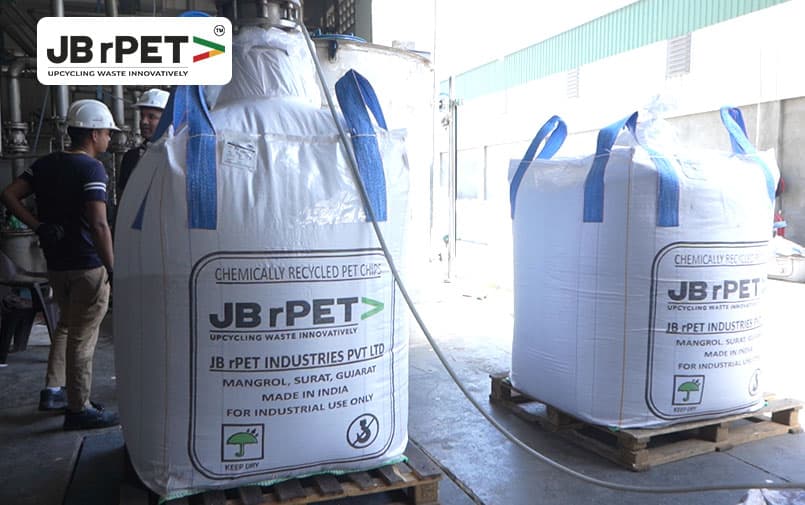
At JBrPET, chemically recycled CrPET resins are produced through depolymerization and controlled repolymerization processes at our facility in Gujarat.
Our resins are:
- IV controlled
- Suitable for extrusion applications including PET packaging strap
- Designed for consistency in processing
- Produced through a certified chemical recycling process
We work with manufacturers who use our CrPET resins in polyester strap roll production and other industrial extrusion applications.
In PET strap manufacturing, machinery precision matters. Operator skill matters.
Process design matter.
But molecular consistency matters first.
When evaluating how to improve polyester strap roll performance, the most impactful decision is often the one made before material reaches the extruder.
If your objective is higher stability, tighter mechanical consistency, and documented recycled origin in PET packaging strap manufacturing, resin-based input from JB rPET is worth evaluating as part of your material strategy.
FAQs on PET Strap Manufacturing and Raw Material Selection
What raw material is typically used for PET packaging strap manufacturing?
PET packaging strap is commonly produced using either mechanically recycled PET flakes or polymerized PET resin granules. The choice depends on process control requirements, target tensile grade, production stability expectations, and sustainability positioning.
Does raw material consistency affect polyester strap roll performance?
Yes. In PET strap manufacturing, molecular consistency influences extrusion stability, stretching behavior, and final break load uniformity. More consistent input material generally supports more predictable production performance.
Why does PET strap sometimes break during stretching?
Stretching amplifies upstream material variability. Breaks can occur due to fluctuations in intrinsic viscosity, uneven melt behavior, contamination presence, or inconsistent drying conditions. The orientation stage is highly sensitive to these factors.
Is resin-based input compatible with existing PET strap extrusion lines?
Most PET strap lines designed for polyester strap roll production can process resin granules without structural modification. Parameter optimization may be required initially, but the processing fundamentals remain similar.
How do manufacturers decide between flakes and resin for PET packaging strap?
Manufacturers evaluate:
- Desired tensile grade
- Process stability expectations
- Scrap tolerance levels
- Sustainability documentation needs
- Long-term supply reliability
The decision is typically strategic and production-driven rather than purely cost-driven
Does IV consistency matter in PET strap production?
Intrinsic Viscosity influences melt strength and orientation behavior. Consistency within a targeted IV band supports predictable stretching and uniform mechanical properties across polyester strap roll batches.
What should buyers evaluate when sourcing PET strap raw material?
Buyers typically review:
- IV control methodolog
- Purification or contamination management process
- Batch-to-batch consistency
- Processing compatibility
- Recycled content traceability
These factors impact long-term production stability.
Is chemically recycled PET suitable for industrial strap applications?
Chemically recycled PET resin is used in extrusion applications including PET packaging strap, depending on IV target and processing compatibility. It offers controlled polymerization following depolymerization and purification.
Does recycled origin impact mechanical performance of polyester strap roll?
Mechanical performance depends on molecular structure, IV control, and processing consistency. Recycled origin alone does not determine strength; material processing quality and polymer consistency are more influential.
Can PET packaging strap manufacturers improve yield by optimizing raw material strategy?
Yield improvements are often linked to reduced line interruptions, lower scrap generation, and more stable extrusion behavior. Raw material consistency plays a role in supporting these outcomes.