Polyester Raw Material for PET Strap Manufacturing
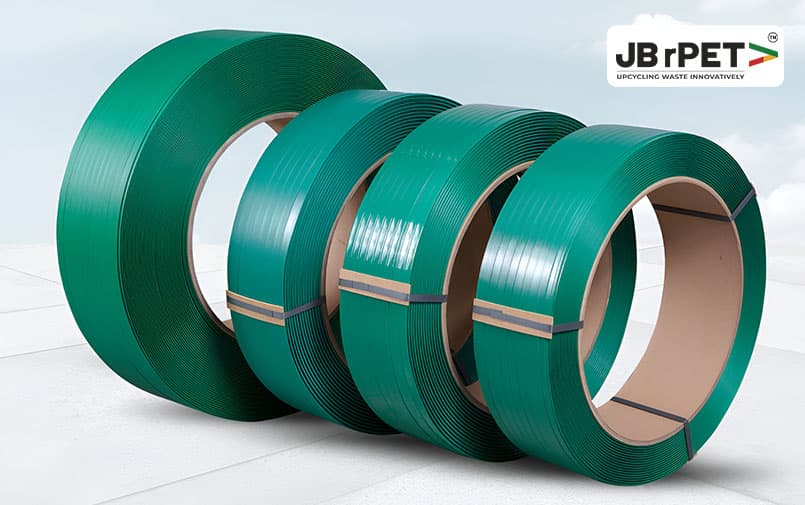
PET strap is one of the more unforgiving extrusion applications. The strap gets stretched, sometimes up to 6–8x its extruded length, which means any instability in the raw material shows up fast: as strap breaks, thickness variation, or poor tensile retention under load.
At JBrPET, we supply PET resin for strap manufacturing produced through a chemical recycling process that rebuilds polymer chains from the molecular level up. The output behaves closer to virgin-grade material in extrusion than standard mechanical rPET, which matters when you're running continuous lines with tight output targets.
This page covers how PET raw material affects strap production, what to look for when selecting a resin grade, and how our material aligns with extrusion-based manufacturing.
What Raw Material Does PET Strap Need?
PET strap is made from polyester resin, the same base polymer used in bottles and film, but selected or processed for specific extrusion characteristics.
The resin enters the production line in solid form. What that solid is called depends mostly on where you are and who your supplier is: granules, chips, and pellets all refer to the same material, small solid pieces of PET polymer used as feedstock in extrusion. The geometry varies slightly by how the resin was cut or formed during production, but all three behave the same way in a dryer and extruder barrel.
A fourth form worth noting is PET flakes, crushed or shredded post-consumer PET (typically from bottles) that hasn't been re-pelletised. Flakes are used in some strap manufacturing setups, usually where cost is the primary driver, but they introduce more variability in bulk density and moisture behavior than re-processed granules. Lines optimised for granules sometimes need adjustment to run flakes consistently.
What matters more than the physical form is the polymer itself: its intrinsic viscosity (IV), moisture content after drying, and how consistently it behaves from batch to batch.
How PET Resin Behaves During Strap Extrusion
Understanding what happens inside the extruder helps in choosing the right material.
PET is hygroscopic, meaning, it absorbs moisture from the air. If resin enters the extruder without adequate drying (typically to below 50 ppm moisture), hydrolytic degradation breaks down the polymer chains. This reduces IV, which translates directly to weaker straps and more frequent line breaks.
Once dried and melted, PET flows through the die as a flat sheet or rope, depending on the strap width being produced. The melt must have consistent viscosity at the processing temperature, usually between 270°C and 290°C for standard strap grades. If viscosity fluctuates batch to batch, the die pressure changes, and strap thickness drifts.
After extrusion and cooling, the strap goes through a stretching (orientation) stage. This is where tensile strength is built. The material must have enough elongation potential to undergo this without breaking. Resins with inconsistent molecular weight distribution tend to create "weak spots" that snap during stretching — the most common complaint in strap manufacturing.
PET Granules vs. PET Chips vs. rPET — What Actually Differs
A frequent question from strap manufacturers moving to recycled input: does rPET for strap manufacturing actually work?
The honest answer: it depends on how the rPET was produced.
Mechanically recycled PET (ground from bottles, washed, re-pelletized) often has reduced and variable IV, contamination risk from mixed-source streams, and inconsistent colour. Some lines run it fine in blends with virgin; others see too much variability to use it as a primary feedstock.
Chemically recycled PET, what JBrPET produces, involves breaking the polymer back to its monomer components and rebuilding it. This removes contamination, restores IV to target levels, and produces a resin that behaves predictably in extrusion. For strap applications, this means the same drying protocol, the same processing window, and the same output consistency you'd expect from virgin resin.
This is why rPET granules for strap making from a chemical recycling source are not the same product as mechanically recycled PET, even if both carry an "rPET" label.
Key Technical Specifications to Ask About When Sourcing PET Strap Raw Material
When evaluating any PET strap raw material supplier, these are the parameters that matter most:
Intrinsic Viscosity (IV): For standard strap, IV typically falls between 0.72–0.82 dL/g. Higher IV supports higher tensile strength but may require higher processing temperatures. Ask for the target IV and acceptable variance range.
Moisture content (post-drying): Should reach below 50 ppm before entering the extruder. If the supplier's resin is packaged in standard bags rather than moisture-barrier packaging, you will likely need longer drying cycles.
Melting point: Typically 250–265°C for standard PET strap grades. Deviations suggest contamination or copolymer content.
Colour and clarity: For clear or light-coloured straps, resin colour consistency matters. For black straps (carbon-loaded), it matters less.
Batch-to-batch consistency (CoV): This is rarely advertised but worth asking about. Consistent melt flow means predictable die pressures and fewer adjustments between batches.
Why PET Raw Material Quality Shows Up in Strap Production — Not Just in the Lab
A quality issue in PET strap raw material rarely announces itself in a datasheet. It shows up on the line:
- Strap breaks during stretching are the clearest sign of IV inconsistency or contamination. If a new batch produces more breaks than the previous one, the material has changed — even if the certificate shows the same IV value.
- Thickness variation across the strap width usually points to die pressure fluctuation, which often traces back to melt viscosity inconsistency.
- Poor tensile retention under load — where straps break below their rated strength in field use — can indicate inadequate orientation, which often results from processing a resin outside its optimal window
- Colour shift between production runs matters for manufacturers supplying branded customers or light-coloured strap products.
These are not hypothetical scenarios. They are the most common quality complaints we hear from strap manufacturers when they contact us about switching raw material suppliers.
rPET for PET Strap Manufacturing — What JBrPET Supplies
JBrPET produces PET resin through chemical recycling, depolymerization and repolymerization, which allows us to control IV, remove contamination, and produce material that matches virgin processing behavior. Our rPET for PET strap manufacturing is supplied as:
- Recycled PET granules for standard extrusion lines
- rPET granules for strap making — supplied to IV targets aligned with strap extrusion
- Recycled PET resin for strapping — documentation including CoA available
This is not blended or diluted virgin-rPET mix. It is chemically processed rPET rebuilt to extrusion-grade polymer specifications.
Industries Where PET Strap Performance Is Non-Negotiable
PET straps fail in the field under load. That's the real consequence of raw material inconsistency.
Industries where this matters most:
Export packaging and palletising: Straps are expected to hold load across temperature changes, humidity variation, and handling stress through ocean freight. Strap failure means product damage and liability.
Steel and heavy industrial: PET straps are used to secure coil steel, pipes, and heavy fabricated goods. The tensile and elongation specs are tight, and the consequences of failure are serious.
Paper and board: Paper reels and board stacks are typically strapped under high tension. Any inconsistency in strap width or strength affects the uniformity of the bundle.
FMCG and logistics: High-speed automatic strapping machines require consistent strap geometry. Width variation or surface inconsistency causes machine jams and downtime.
In each case, the strap is only as reliable as the resin it was made from.
How Chemical Recycling Supports Consistent PET Resin for Strapping
Standard mechanical recycling preserves the physical form of PET but cannot fully correct the degradation that happened during the material's first use or during processing.
Chemical recycling — the process JBrPET uses — breaks PET down to its constituent monomers (PTA and MEG) before repolymerising. This means:
- Contamination introduced during the collection and sorting of post-consumer PET is removed
- IV is set during repolymerisation, not inherited from degraded feedstock
- Additive and colourant content is controlled from the start
For a strap manufacturer, this translates to resin that dries, melts, and orients consistently, because the polymer structure is consistent, not just the bulk spec on the CoA.
Who Sources PET Strap Raw Material from JBrPET
Our materials are used by:
- PET strap manufacturers running continuous extrusion lines (both flat and embossed strap profiles)
- Industrial packaging producers supplying heavy-duty strapping for steel, paper, and export applications
- Compounders producing PET-based materials where consistent IV is required
We work with manufacturers in India and export markets who need reliable supply with consistent quality documentation. Monthly volumes range from a few tonnes for smaller lines to bulk supply for larger facilities.
What to Share When You Enquire
To align the right material for your application, it helps to know:
- What strap dimensions are you producing (width, thickness, profile)?
- What is your current raw material — virgin, mechanical rPET, or blend?
- What are your processing temperatures and line speed?
- What tensile strength and elongation specs does your strap need to meet?
- What is your approximate monthly volume?
The more specific you are, the faster we can identify whether our material is a fit and what drying and processing parameters to expect.
Related PET Resin Applications
As a rPET manufacturer in India, JBrPET also supplies PET resin for:
- Monofilament production
- Masterbatch manufacturing
- Other extrusion-based polymer processing
Each application has different IV and flow requirements. If you are evaluating resin for a non-strap application, share your processing setup and we can advise on material alignment.
PET Strap Raw Material — Frequently Asked Questions
What raw material is used for PET strap manufacturing?
PET strap is made from polyester resin — supplied as granules, chips, or pellets. The resin is dried, melted, extruded into a flat or embossed profile, cooled, and then stretched to build tensile strength. The IV of the resin, its moisture level going into the extruder, and its batch-to-batch consistency are the three factors that most affect strap quality and production stability.
What is intrinsic viscosity and why does it matter for strap resin?
Intrinsic viscosity (IV) is a measure of the polymer chain length in PET resin. Higher IV means longer chains, higher melt strength, and generally better tensile performance in the finished strap. For standard PET strap, IV typically targets 0.72–0.82 dL/g. Resin with inconsistent IV produces straps with inconsistent strength, and makes it harder to maintain stable extrusion conditions.
Can recycled PET be used for PET strap production?
Yes — but the quality of the recycled PET matters significantly. Mechanically recycled PET often has reduced or variable IV and can contain contamination from mixed feedstocks. Chemically recycled PET, like the material JBrPET produces, is rebuilt to target IV levels with contamination removed, which makes it suitable for extrusion-grade strap applications.
What causes strap breaks during the stretching stage?
Strap breaks during orientation (stretching) are most commonly caused by IV inconsistency, contamination in the resin, or insufficient drying before extrusion. If the polymer chain length varies within a batch, the strap develops weak points that snap under the tension of the stretching roll. This is one of the clearest signals that raw material quality has changed.
What is PET strap extrusion?
PET strap extrusion is the process of melting PET resin in a screw extruder and shaping it into a flat strap profile through a die. The extruded strap is cooled in a water bath, then passed through stretching rolls that orient the polymer chains longitudinally — this orientation is what gives PET strap its tensile strength. The quality of the raw material determines how consistently this process runs.
What is the difference between PET granules and PET chips?
Both are forms of solid PET resin used as feedstock in extrusion. The difference is primarily in geometry: granules are typically cylindrical or spherical, while chips are flatter and more irregular. The functional difference in extrusion is minimal — most lines run both. Suppliers use the terms interchangeably depending on production method.
Who supplies PET raw material for PET straps in India?
JBrPET supplies PET raw material for strap production in India, including chemically recycled rPET granules and resin aligned with extrusion-grade strap manufacturing. We supply with standard documentation including CoA, and work with manufacturers across a range of monthly volumes.
Enquire for PET Strap Raw Material
Share your strap application, extrusion setup, and monthly volume. We will respond with material options, processing guidance, and availability.
Share Your Requirements