Applications of Chemically Recycled PET Resin Across Industries
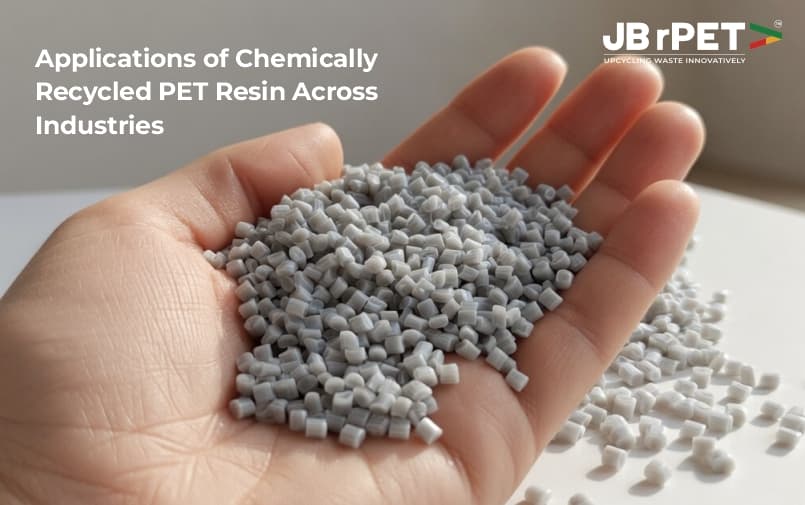
We want to shed some light on chemically recycled PET resin and the range of products manufacturers build from it. Chemically recycled PET resin, referred to as C-rPET, comes from post-consumer PET that passes through controlled depolymerisation into monomers and then rebuilds into fresh resin. The result is a polymer input that carries defined technical parameters and reaches a broad field of downstream applications.
Buyers evaluating recycled PET resin tend to raise a handful of questions before they specify it. They ask whether batch consistency holds from one order to the next. They ask which grade fits their process and their equipment. They ask what documentation supports certification audits and EPR filings. They ask how recycled content maps to the compliance obligations they already carry. These questions deserve clear answers, and each one connects to how the resin performs in a specific application.
The sections here walk through where C-rPET applies across packaging, automotive interiors, geotextiles, construction insulation, strapping, industrial filtration, home goods, and carrier systems for colour and additives. Each application ties back to a grade, and each grade ties back to the parameters a converter needs. Reading that link the right way helps procurement teams specify with confidence and helps brand owners stand behind the recycled content they report.
Understanding Chemically Recycled PET Resin
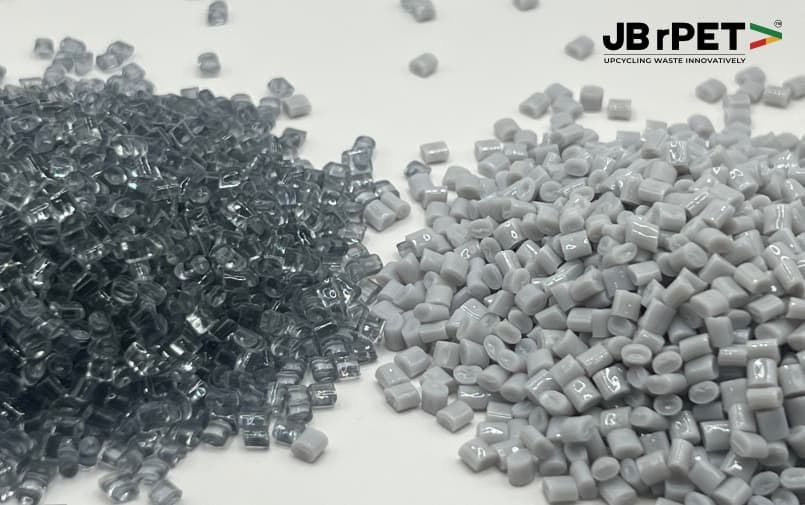
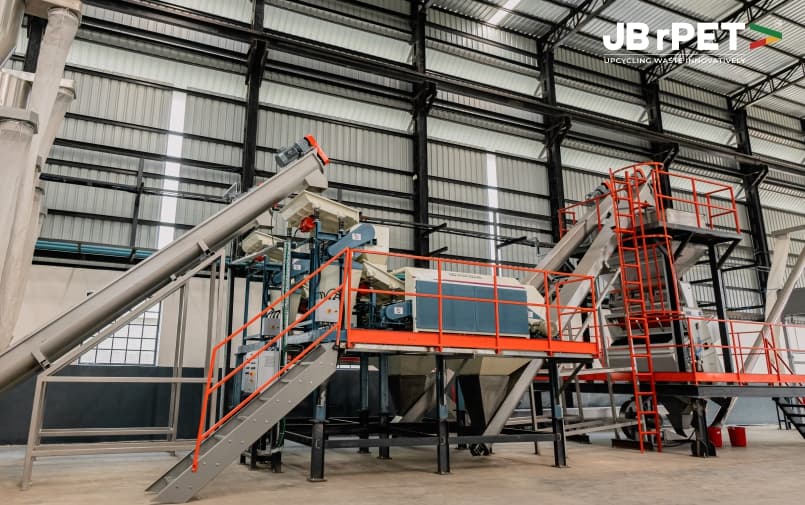
C-rPET starts as post-consumer PET, collected, sorted, and cleaned before it enters the recycling line. The chemical recycling route breaks the polymer chains down into monomers and oligomers, then rebuilds them into resin through repolymerisation. This route reaches complex and lower-grade PET streams and produces resin to a specified intrinsic viscosity and controlled colour parameters.
Production yields several grades, each tuned to a downstream process. Fiber-grade resin spins into staple fibre and filament. Strap-grade resin carries the higher intrinsic viscosity that strapping demands. Other grades align with packaging, moulding, and carrier applications. Grade selection sits at the centre of every application decision, and the sections that follow make that link concrete.
For a procurement team, the value of C-rPET shows up at the point of use. A resin that arrives to a declared specification, with documentation that supports the compliance framework a business operates under, lets a converter fold recycled content into production while keeping output steady. The applications below trace how that plays out across industries.
Material Properties That Shape Where C-rPET Fits
The applications ahead trace back to a set of material properties that PET carries and that C-rPET production preserves through repolymerisation. Reading these properties helps a buyer see why the resin suits one product over another.
Intrinsic viscosity, or IV, reflects the molecular weight the resin holds, and it governs strength and processing behaviour. Higher IV grades suit applications such as strapping that call for mechanical strength through forming. Fibre applications call for their own IV range tuned to spinning. Producing resin to a declared IV gives converters a predictable starting point for their line.
Clarity and colour shape packaging and any application where appearance carries weight. C-rPET produced with controlled colour parameters gives packaging converters and fibre producers a consistent base to work from, and pigmented grades serve applications where a set shade applies across the run.
Thermal stability lets PET hold form across a range of processing and service temperatures. This property supports moulded automotive parts, filtration media that face warm air streams, and packaging that meets filling and storage conditions.
Strength-to-weight ratio and dimensional stability give PET its structural value at low mass. Geotextiles, strapping, and automotive components all draw on this combination, where a material carries load while keeping weight down. C-rPET produced to specified parameters brings these properties into recycled form, which lets converters specify recycled content without reworking a proven design.
The Two Chemically Recycled PET Resin Lines We Manufacture
JB rPET Industries manufactures two lines of chemically recycled PET resin. Both run on a proprietary chemical recycling process that shares the same core steps:
- Controlled low-temperature depolymerisation to minimise degradation
- Intrinsic viscosity reduced to zero to harmonise mixed inputs
- High-efficiency filtration at 2 to 4 microns to clear contaminants
- Controlled repolymerisation to restore polymer strength at a consistent IV
Premium line (higher purity and clarity applications):
- Developed to deliver virgin-equivalent quality
- Begins with advanced flake washing to remove surface impurities
- Grades: semi-dull, bright, super bright, SSP bottle-grade, and high-IV resins
- IV range from 0.64 to 1.10
Specialised conversion line (subsequent process applications):
- Grades: fibre-grade, masterbatch-grade, strap-grade, and monofilament-grade resins
- Matched to a range of downstream conversion processes
Packaging Applications
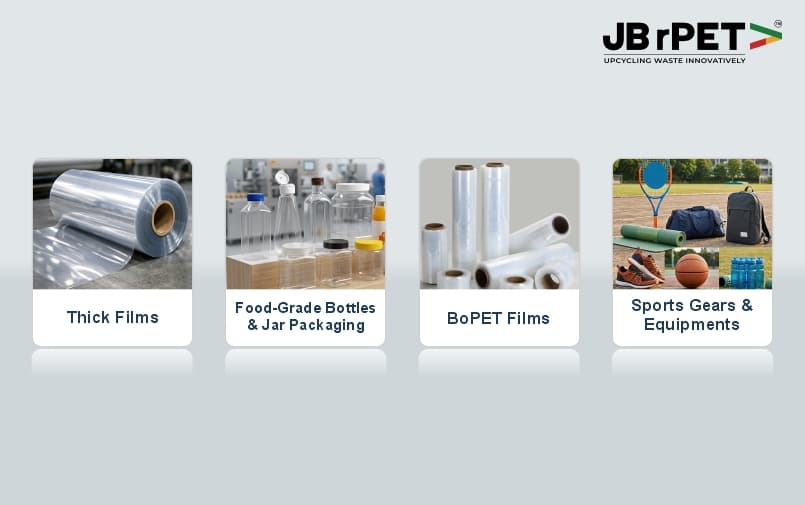
C-rPET supports rigid and flexible packaging formats. Rigid PET packaging covers bottles, jars, thermoformed trays, clamshells, and containers where clarity, stiffness, and barrier performance carry weight. Flexible PET packaging covers films and laminate layers used in pouches and wraps across consumer goods. Each format calls for its own grade and colour parameters, so a converter running clear rigid containers specifies a different resin from one running pigmented film.
India's regulatory framework gives packaging converters a direct reason to specify recycled resin. Under the Plastic Waste Management (Amendment) Rules, 2026, plastic packaging carries category-wise recycled-content requirements. Rigid Category I packaging starts at 30 percent recycled content in FY 2025-26 and steps up in the years that follow. Flexible Category II and multilayered Category III packaging carry their own stepped requirements. Producers, importers, and brand owners register and file through the CPCB EPR portal, and packaging that carries recycled content follows the labelling route set under IS 14534:2023.
The 2026 rules also list chemical recycling among the end-of-life management routes recognised for these obligations. For converters and brand owners working toward recycled-content targets, C-rPET offers a resin input that supports those targets while holding the technical parameters a packaging line requires. The documentation that travels with the resin matters as much as the resin here, since a brand owner filing an EPR return needs traceable evidence of the recycled content placed on the market.
Rigid and flexible formats place different demands on the resin. Rigid containers and thermoformed trays reward stiffness and clarity, so grade and colour selection follow the appearance and structure the pack requires. Films and laminate layers reward consistent thickness control and even extrusion across a web, so the fibre and film grades chosen here carry their own melt behaviour. A converter reads these demands into a grade specification, and C-rPET produced to declared parameters gives that specification a recycled input to build from across both format families.
Automotive Interior Components
Automotive interiors rely on polyester-based materials across a range of parts. Floor coverings, seat fabrics, door trims, parcel shelves, boot linings, and moulded acoustic components all draw on polyester fibre and moulded polymer. C-rPET fiber-grade resin provides a polyester input suited to nonwoven and moulded interior parts.
Interior components reward consistency. A moulded part or a nonwoven mat performs to design when the fibre feeding it holds steady properties across production. C-rPET produced to specified parameters supports that steadiness, which carries weight for converters supplying tiered automotive supply chains where documentation and material traceability shape supplier selection.
Weight reduction adds another reason polyester fibre features in vehicle interiors. Lighter interior assemblies contribute to overall vehicle efficiency, and polyester nonwovens deliver structural and acoustic function at low weight. Interior converters working toward recycled-content goals can specify C-rPET as the polyester input behind these parts, which lets them raise recycled content while holding the performance a vehicle programme demands.
Geotextiles and Construction Materials
Geotextiles use polyester fibre for a set of civil engineering functions. Soil stabilisation, drainage, filtration, erosion control, road sub-base separation, and ground reinforcement all rely on woven and nonwoven polyester fabrics. C-rPET fiber-grade resin spins into the staple fibre and filament that geotextile producers convert into these fabrics.
Geotextile performance depends on tensile strength, elongation behaviour, and resistance to the conditions a fabric faces underground or under a roadbed. Polyester delivers strength and dimensional stability across these settings.
Construction-adjacent applications extend into insulation. Recycled polyester fibre forms thermal and acoustic insulation in panels and batts used across buildings. The same fibre properties that suit geotextiles support insulation, where loft, resilience, and thermal behaviour shape performance. For builders and converters seeking recycled inputs, C-rPET fibre offers a route into both fields with a single feedstock behind it. Infrastructure and construction buyers increasingly ask for recycled content in their material specifications, which places recycled polyester fibre in a useful position for these projects.
Polyester Strapping
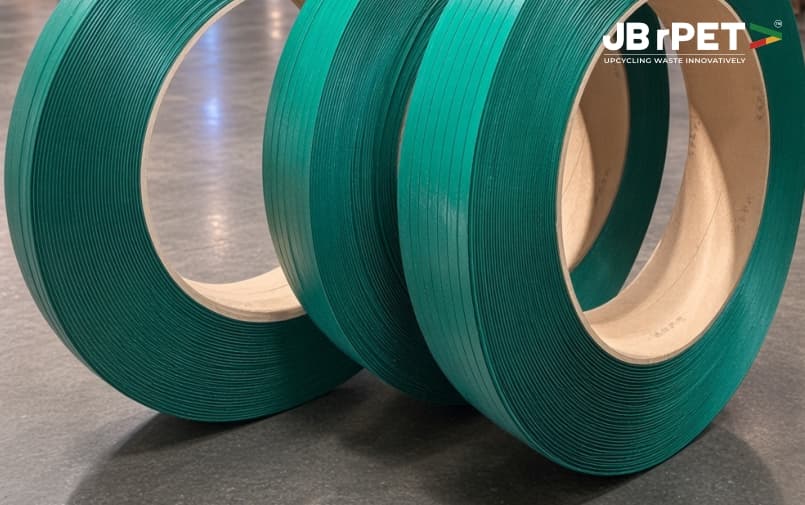
Strapping secures loads for transport and storage, and PET strapping has become a common choice for palletising and bundling. Bricks, cotton bales, timber, metal coils, and packaged goods travel under PET strap. The material draws on PET's strength-to-weight ratio and its elongation recovery, which lets a strap hold tension across a shifting load through transit.
C-rPET strap-grade resin supplies the input for strapping producers. Strap-grade calls for a controlled, higher intrinsic viscosity, since the extrusion and stretching that form a strap demand a resin that holds molecular weight through processing. C-rPET reaches that requirement through repolymerisation to a specified IV, which gives strapping producers a recycled input matched to the mechanical role the product plays.
Strapping also fits the recycled-content conversation directly. Logistics and packaging operations that track recycled inputs across their supply chain can specify strap made from recycled resin as part of that accounting, backed by the documentation the resin carries.
Industrial Filtration and Technical Fabrics
Filtration draws on polyester media across air and liquid applications. Industrial filters use polyester nonwovens and needle-punched felts to capture particulates in ventilation, dust collection, and process filtration. C-rPET fiber-grade resin feeds the staple fibre these filter media use.
Filter media reward fibre uniformity. Consistent denier and consistent fibre properties shape filtration efficiency and airflow resistance, so the fibre input carries direct influence over how a filter performs across its service life. C-rPET produced to specified parameters supports the uniformity filter producers look for across repeat orders.
Technical fabrics extend the field further. Conveyor components, agricultural fabrics, and reinforcement scrims use polyester fibre and yarn for durability under load and exposure. Across these technical applications, C-rPET fibre provides a recycled input that carries the mechanical properties the products depend on. Producers serving these segments gain a recycled option that folds into existing production while keeping the performance their customers expect.
Home and Consumer Goods
C-rPET fibre reaches a broad set of everyday products. Carpets and rugs use polyester pile for durability and stain resistance. Cushions, pillows, and quilts use polyester fill for loft and resilience. Curtains and upholstery fabrics use polyester yarn for drape and wear resistance. Soft toys use polyester fibre fill. Furniture uses polyester in webbing, padding, and covers.
Each of these products starts from fibre, and fibre starts from resin. C-rPET fiber-grade resin, spun into staple fibre, feeds the home and consumer goods field. The feedstock behind this fibre is post-consumer PET, which gives brands a recycled-content story they can document for their own sustainability reporting and their customer disclosures.
Sports goods draw on the same fibre base. Performance apparel, bags, footwear components, and equipment padding use polyester fibre for strength and moisture behaviour. C-rPET fibre supports these products with a recycled input produced to consistent parameters, which lets brands raise recycled content across their ranges while holding the feel and durability their products carry.
Carrier Resin For Masterbatch
Colour and additive systems depend on a carrier that disperses pigment and additives evenly through a polymer. C-rPET serves as a carrier resin in masterbatch production, where compatibility with downstream PET processing shapes dispersion, dosing stability, and shade control.
A carrier resin matched to the end polymer helps a formulation perform to design across batches. C-rPET produced to consistent parameters gives masterbatch producers a PET-compatible carrier for colour and additive concentrates aimed at PET applications. Compounders serving packaging, fibre, and moulding lines can specify C-rPET carrier resin as a recycled input inside their formulations, which extends recycled content one step further up the value chain.
Evaluating C-rPET For a Specific Application
Specifying recycled resin comes down to matching the material to the process and to the compliance framework a business operates under. A few considerations guide that match, and each one answers a question buyers raise before they commit.
Certification carries significant weight. Production backed by our certifications such as ISCC PLUS, GRS, and OEKO-TEX gives buyers documented assurance across sustainability, recycled content, and material safety. These certificates support customer audits, tender submissions, and EPR filings, so the documentation that travels with the resin carries as much weight as the resin itself for many procurement teams.
Batch consistency shapes downstream performance. A grade that holds steady intrinsic viscosity, colour, and contaminant levels across orders lets a converter run a stable process. Buyers evaluating a supplier look at how consistently the material meets its declared parameters over repeat orders, since consistency at the input keeps output predictable.
Traceability closes the loop. A chain of custody from feedstock through flake to resin supports the recycled-content claims a brand carries into its own reporting and its EPR obligations. Material that arrives with traceable documentation helps a buyer stand behind the recycled content they declare.
Process compatibility rounds out the picture. The right grade, with the IV, colour, and form a line requires, lets a converter fold recycled resin into production with minimal adjustment. Matching grade to process keeps output stable and keeps the recycled input working as designed across the run.
Taken together, these considerations turn the questions buyers raise at the start into a straightforward evaluation. A procurement team confirms the grade against its process, checks the certifications against its audit and filing needs, and reviews batch data against its consistency requirements. Once those three line up, recycled content moves from an open question to a specified input, and the applications above become available routes rather than open ones. That path holds across packaging, automotive, geotextiles, strapping, filtration, and the consumer goods field, since each rests on the same foundation of grade, specification, and documentation.
Frequently Asked Questions
What is chemically recycled PET resin used for?
Chemically recycled PET resin serves rigid and flexible packaging, automotive interior components, geotextiles, construction insulation, PET strapping, industrial filters, home and consumer goods, sports goods, and carrier resin for masterbatch. Grade selection determines the fit for each application.
What products are made from recycled PET resin?
Products include containers, trays, and films for packaging, automotive floor coverings and moulded interior parts, geotextile fabrics, insulation panels and batts, PET strapping, filter media, carpets, cushions, quilts, curtains, soft toys, furniture components, and sports goods.
Which grade of C-rPET suits my application?
Fiber-grade resin suits spinning into staple fibre and filament for geotextiles, filtration, insulation, and consumer goods. Strap-grade resin, produced to a higher intrinsic viscosity, suits PET strapping. Packaging and masterbatch applications follow their own grade and colour parameters. Confirming the grade against your process gives the closest match.
How does recycled PET resin support EPR compliance?
Under the Plastic Waste Management (Amendment) Rules, 2026, plastic packaging carries category-wise recycled-content requirements filed through the CPCB EPR portal. Specifying C-rPET as a recycled input, backed by traceable documentation, gives producers and brand owners a route toward the recycled-content share their category requires.
What certifications should a C-rPET supplier hold?
Certifications such as ISCC PLUS, GRS, and OEKO-TEX support sustainability, recycled content, and material safety. The certificates that travel with the resin support customer audits, tenders, and EPR filings, so buyers weigh certification alongside technical parameters when they select a supplier.
How does chemically recycled PET resin reach consistent quality?
C-rPET repolymerises from recovered monomers into resin produced to specified intrinsic viscosity and colour parameters. Producing to a declared specification, with batch testing behind it, gives converters a predictable input across repeat orders.