What to Look for in a Chemically Recycled PET Resin Manufacturer
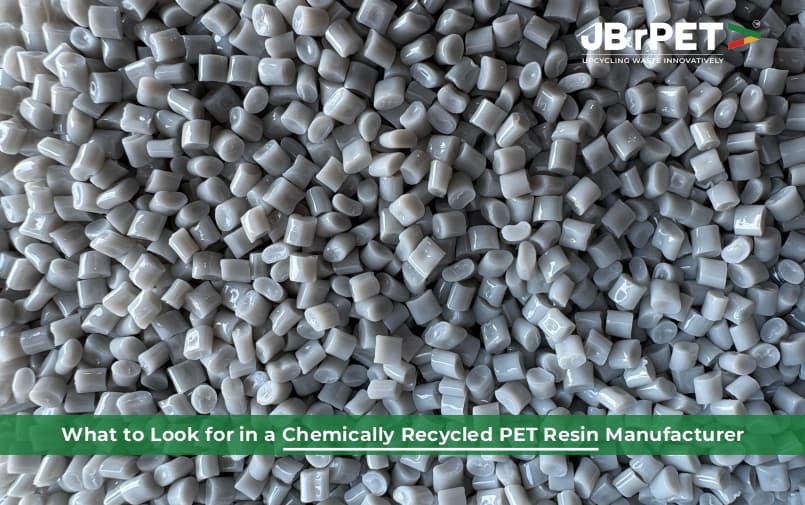
A procurement search for recycled PET rarely settles on a single term. A buyer types "PET resin manufacturer" one day, "rPET granules manufacturer" the next, "PET chips manufacturers in India" while shortlisting, and "recycled PET supplier" when comparing quotes. Behind every one of these searches sits the same decision: which producer to trust with a material that feeds a production line week after week.
The words carry differences worth reading. A manufacturer makes the resin. A supplier delivers it, and delivery alone leaves open whether the same company produced it. A producer sits alongside the manufacturer as the maker of the material. Telling these roles apart early saves a buyer effort later, because the role a company plays shapes what it can promise on specification, supply, and support.
JB rPET manufactures and sells chemically recycled rPET resins and rPET flakes. We produce the material we deliver, which places us on the manufacturer side of that line. What follows sets out the parameters a procurement team benefits from weighing when choosing a manufacturer, framed as the questions worth asking before a first order.
Manufacturer, Producer, Supplier: Reading the Roles
The three words appear across product listings almost interchangeably, and the overlap hides a distinction that matters to a buyer.
A manufacturer owns the process that turns waste into resin. The company controls the feedstock intake, the recycling route, the quality parameters, and the finished specification. When a question arises about intrinsic viscosity, colour, or contamination, a manufacturer can answer from its own process data and adjust within its own capability.
A producer describes the same maker role, common in polymer and chemicals language. A resin producer and a resin manufacturer point to the same function: the party that builds the material from raw input.
A supplier delivers material to a buyer. Some suppliers are manufacturers selling their own output. Others are traders and distributors who buy finished resin and resell it. Both have a place in the market, and a trader can serve a buyer well for spot needs. The difference surfaces when a buyer needs specification control, traceable origin, or steady supply across a long relationship. Sourcing from the party that made the resin shortens the distance between a converter's requirement and the process that can meet it.
The distinction has sharpened as recycled-content requirements have grown. Buyers now carry claims about the recycled origin of their products to their own customers and to regulators, and those claims rest on the evidence a supplier can provide. A maker that documents its process and feedstock gives a buyer claims that hold up under scrutiny. A resale chain with several handoffs makes the same evidence harder to assemble. The supply role a company plays, once a background detail, now sits close to the centre of a sourcing decision.
For a procurement team, reading the role behind the listing is the first filter. A company describing itself as a manufacturer or producer, and able to show the plant and the process behind that claim, offers a different footing than a reseller quoting the same tonnage.
Why Sourcing from the Maker Matters
The value of buying from a producer shows up in four places a converter feels directly.
Specification control comes first. A manufacturer holds the levers that set intrinsic viscosity, colour grade, and moisture behaviour. When a converter needs a resin tuned to a particular process window, the maker can work within its own grades to meet it. A chemical recycling process run in-house gives the producer that room to adjust.
Supply security follows. A manufacturer with installed capacity and a feedstock base can commit to a delivery schedule and hold to it. Supply that depends on reselling whatever finished material happens to be available carries more variability into a converter's planning. For a plant running continuous production, dependable scheduling is worth as much as the resin itself.
Traceability sits third. A producer can trace a batch back through its own process to the feedstock that entered the plant. That chain of custody supports the recycled-content claims a converter passes to brands and regulators, and it stands up to audit in a way that a resale chain with several handoffs finds harder to document.
Direct technical support closes the set. When a converter runs into a processing question, a manufacturer that knows its own material can advise from process knowledge. The conversation moves faster because the party answering built the resin in question.
Consistency underlies all four. A producer that controls its own process holds specification steadier from batch to batch, which lets a converter keep machine settings stable and reduces the trial runs a new lot might otherwise require. That steadiness carries a cost benefit alongside the quality one, because fewer rejects and fewer line stops lift the yield a plant draws from every tonne it feeds
Manufacturing Capability as a Buyer Signal
A claim to manufacture means more when capacity and a production record back it. For a buyer weighing suppliers, a few operational signals separate an active producer from a nameplate.
Installed capacity indicates the scale a producer can serve. JB rPET operates 28,800 MT per year of installed capacity for chemically recycled rPET resins and 18,600 MT per year for rPET flakes, for a combined 47,400 MT per year across both lines as on 31 March 2026. Capacity of this order signals a producer built to serve regular industrial volumes rather than occasional lots.
A feedstock base underpins both. JB rPET has drawn 258 crore PET bottles into its recycling stream from inception through fiscal 2026, alongside other PET and textile waste. Feedstock at that scale supports the steady input a continuous process depends on. The manufacturing base spans three land blocks totalling roughly 47,742 square metres, and the workforce grew to 593 people in fiscal 2026 from 408 the year before.
These are the markers a procurement team can ask any prospective manufacturer to demonstrate. Installed capacity, a multi-year production record, a feedstock base, and a physical plant with a workforce together describe a producer positioned to hold a supply commitment. A buyer weighing rPET manufacturers gains a clearer comparison by asking each candidate for the same signals.
Utilisation deserves a second read alongside capacity. A producer running near full utilisation demonstrates demand for its output, and it also signals limited headroom for new commitments. A producer carrying room to grow can take on fresh offtake and scale as a buyer's needs rise. Reading installed capacity together with current utilisation, rather than either figure alone, tells a buyer what a manufacturer can realistically commit to over the term of a relationship.
What "Chemically Recycled" Adds to the Manufacturer Question
Recycling route belongs on the checklist alongside capacity, because the route shapes what a manufacturer can produce and from what.
Chemical recycling rebuilds PET at the molecular level. The process breaks the polymer down into its building units and reassembles them, which allows mixed and coloured feedstock to yield resin with consistent properties. A manufacturer running this route can accept a wider range of input, including textile-derived PET waste that carries dyes and blended fibres, and harmonise it into resin with a defined specification.
For a buyer, the practical consequence is grade range and input flexibility. A producer able to process varied feedstock through molecular rebuilding can offer resin tuned across application grades from a broader raw-material base. Our chemically recycled resins span textile-to-textile, masterbatch, strap, and monofilament grades, each built from recovered PET and textile waste and set to its own specification.
Feedstock flexibility also affects supply resilience. A producer able to draw on both bottle and textile PET waste competes for a wider pool of raw material, which steadies input when any single stream tightens on availability or price. For a buyer, that breadth of feedstock translates into a supplier better placed to hold a schedule through market swings.
The route also connects to circularity. Because chemical recycling returns PET to its molecular units, resin built this way re-enters the recycling stream at end of life, supporting repeat recycling cycles. A converter building a circular sourcing story gains a pathway that keeps PET in circulation across successive uses. Asking a manufacturer which route it runs, and what feedstock that route accepts, tells a buyer a great deal about the material they will receive.
rPET Granules, Chips, and Serving Buyers at Home and Abroad
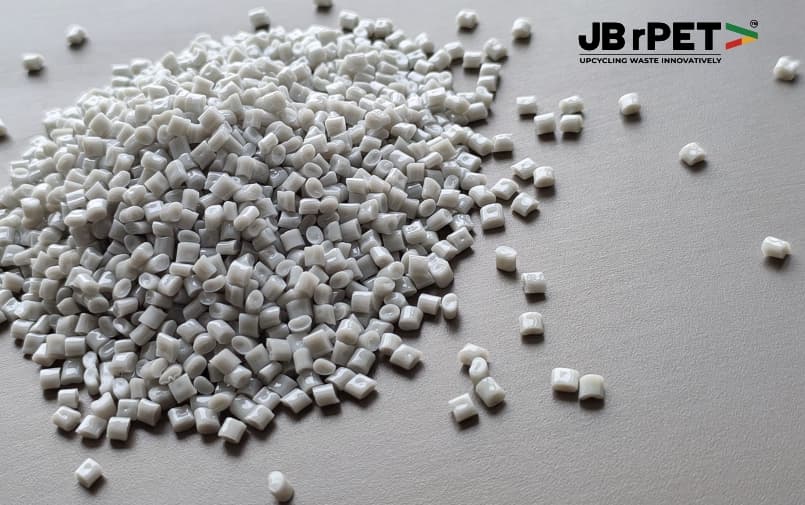
The cluster of search terms a buyer uses also spans the physical forms and the geography of supply. A manufacturer's product listing may read as rPET granules, rPET chips, PET chips, or polyester chips, and these describe the same solid resin under different regional conventions.
We covered this naming in detail on our recycled PET chips page: chips, pellets, granules, and dana all describe cut solid resin, and the specification behind the name carries the information a buyer needs. A manufacturer able to supply the form a converter's equipment expects, at the intrinsic viscosity and colour grade the process calls for, meets the requirement whichever noun appears on the purchase order.
Geography enters through the "in India" and "exporter" variants that buyers add to their searches. A manufacturer based in India serving domestic converters offers proximity, shorter lead times, and easier plant visits. The same manufacturer supplying buyers abroad extends that reliability across borders. JB rPET manufactures from its base in Gujarat and serves converters across domestic and international markets, supplying chemically recycled resin and washed flakes into the applications each buyer builds.
For a procurement team, the takeaway is to read past the form and the location tag to the producer behind them. A manufacturer that makes rPET granules, rPET chips, and hot-washed flakes from its own process, and supplies them to buyers at home and abroad, answers the range of search terms a buyer might have used to find it.
Lead time and support weigh alongside price for a converter planning production. A domestic manufacturer shortens the transit that a delivery schedule has to absorb, and it turns a plant visit into a day trip rather than an expedition. Proximity also eases the technical conversation, because a producer within reach can respond quickly when a processing question arises. Buyers sourcing across borders gain the same reliability at distance when the manufacturer documents each lot and holds its certifications current.
Matching the Manufacturer to Your Application
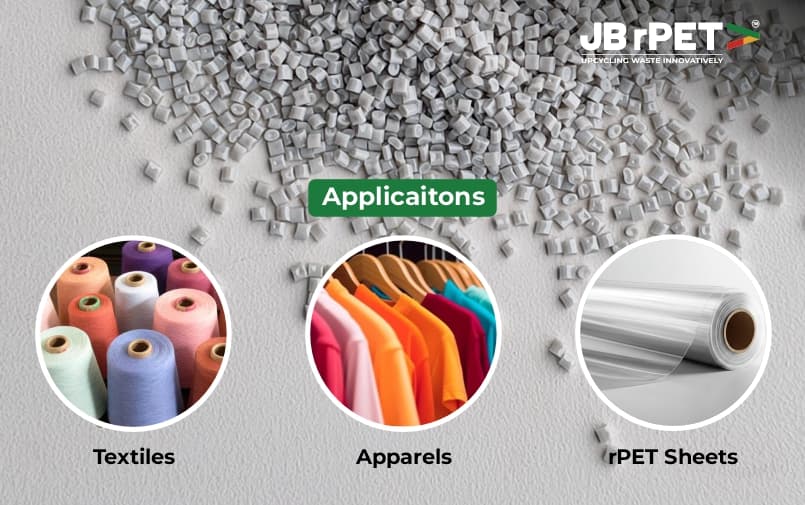
A manufacturer worth a long relationship fits the specific application a converter runs. Recycled PET resin feeds several distinct downstream processes, and each places its own demand on the producer.
Spinning mills and filament producers rely on resin with consistent intrinsic viscosity for stable extrusion and predictable colour behaviour. A manufacturer serving this segment carries textile-oriented grades and the process control to hold IV from batch to batch.
Strap manufacturers rely on higher intrinsic viscosity for the tensile strength that industrial bundling and palletising demand. A producer able to supply strap-grade resin at a dependable IV window serves this application directly.
Masterbatch producers prioritise clean dispersion and colour consistency, so the resin carrier behaves predictably when compounded with pigment and additive. A manufacturer offering masterbatch-grade resin built for this behaviour removes a variable from the compounder's process.
Monofilament producers look for uniform diameter behaviour through the die, which rests on consistent melt properties. A producer supplying monofilament-grade resin tuned for this use supports steady filament output.
Packaging converters working in flexible and rigid PET rely on resin that runs through existing forming equipment with predictable results. A manufacturer supplying documented, consistent resin lowers the trial effort a converter spends qualifying a new material.
Reading a manufacturer against your own application, rather than against a generic quality claim, sharpens the choice. The producer that carries the grade your process calls for, and can show the process control behind it, is the one worth a sample run.
What to Verify Before a First Order
A shortlist becomes a decision when a buyer confirms a short set of points with each candidate. Five checks do most of the work.
Verify the manufacturer status. Ask to see the plant, the process, and the capacity. A producer able to show its facility and walk a buyer through its recycling route substantiates the manufacturer's claim in a way a listing alone leaves open.
Confirm capacity against your requirement. Match the producer's installed capacity and current utilisation against the volume and regularity you need. A supplier running close to full utilisation may have limited room for new commitments, and one with headroom can take on steady offtake.
Check the certifications. Recycled-content and process certifications give a procurement team the documentary basis for its own claims. JB rPET holds ISCC PLUS, GRS, and OEKO-TEX certifications, and a manufacturer should be able to produce current certificates on request and tie them to the material it supplies.
Request a specification and a sample. A defined specification covering intrinsic viscosity, colour, moisture, and contamination lets a converter assess fit before committing. A sample run through the intended process confirms behaviour on the actual line rather than on paper.
Establish the documentation the manufacturer provides. Per-batch parameters and a traceable feedstock origin let a buyer specify recycled content with confidence and satisfy customer and regulatory requirements. A producer that documents each lot lowers the verification effort a buyer carries.
A candidate that clears these five gives a procurement team firm ground for a first order. The checks apply equally to any manufacturer, and running each prospective supplier through the same set produces a comparison a buyer can defend internally.
Working with JB rPET
Recycled PET reaches a buyer through many search terms and one decision: which producer to build a supply relationship on. Reading the role behind the listing, weighing manufacturing capability, checking the recycling route, and verifying capacity, certification, and documentation turn a broad search into a confident choice.
JB rPET manufactures and sells chemically recycled rPET resins and hot-washed rPET flakes from its base in Gujarat, tuned across grades for packaging, strapping, masterbatch, monofilament, and textile applications. Installed capacity, a rising production record across successive years, and certification under ISCC PLUS, GRS, and OEKO-TEX give converters the operational and documentary footing a supply relationship rests on. Buyers ready to move from research to a quote can reach our team through the rPET manufacturers page.
JB rPET. Upcycling waste, innovatively.