PET Flakes Manufacturer for Fiber, Resin and Packaging Applications
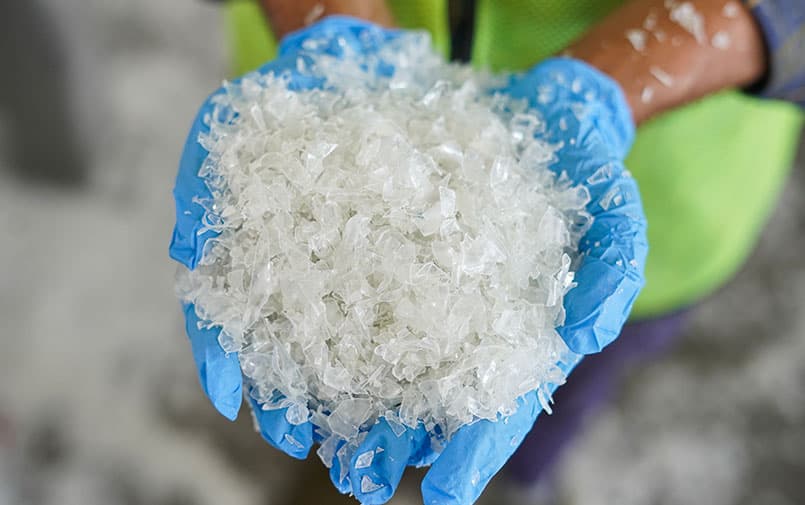
JB rPET Industries manufactures hot-washed recycled PET flakes from 100 per cent post-consumer PET bottles at our manufacturing facility. Every batch runs through optical sorting at two stages, multi-step hot washing with caustic soda, eddy current metal separation, and in-house lab testing before dispatch.
We supply fiber spinning mills, rPET resin producers, PET sheet and thermoforming converters, strap manufacturers, nonwoven converters, and granule producers across India and for export. ISCC PLUS and OEKO-TEX certified. If your production line runs on recycled PET flakes, our procurement team can confirm grade availability, supply volume, and dispatch timelines within one working day.
Supply Capacity and Logistics
A PET flakes manufacturer is only as reliable as their ability to supply consistently at your required volume. Production capacity, storage infrastructure, and dispatch reliability are the variables that separate a one-time order from a long-term supply partnership.
Production Capacity Our manufacturing facility produces washed rPET flakes across three grade streams, clear, green, and mixed colour, with the capacity to support ongoing bulk supply for fiber, sheet, resin, and strap applications. Current production capacity and grade-wise availability can be confirmed directly with our procurement team based on your volume requirement and scheduling.
Packaging Format Flakes are packed in jumbo bags. Each bag carries a lot identification tag with grade, batch number, and test reference. Domestic buyers can arrange direct truck dispatch from our facility. Export orders are loaded into containers, with full pre-shipment documentation including quality inspection reports, packing lists, and fumigation certification where required.
Lead Times Export orders are scheduled based on container booking and port clearance timelines. Trial order quantities are available for new buyers running QC evaluation before committing to regular supply.
Payment Terms We work with domestic buyers on standard trade credit terms and with export buyers on TT and LC arrangements. Contact our team to discuss the format that suits your procurement cycle.
PET Flakes Pricing — What Buyers Should Know
Recycled PET flakes are a commodity with prices that move in response to virgin PET resin prices, crude oil, seasonal collection volumes, and global demand from fiber and packaging markets.
Price alone should not drive sourcing decisions for industrial buyers. A lower-priced batch with inconsistent IV or elevated PVC will cost more on the production line, through screen changes, yield loss, and product rejections, than a properly priced, certified supply. The total cost of a raw material input includes its downstream performance, not just the per-kg rate at the gate.
We provide current pricing on request. Pricing is based on grade, confirmed specification, volume, and supply frequency. For buyers placing regular monthly volumes, we discuss structured supply agreements that provide price stability alongside consistent material quality.
How to Place a Trial Order or Request a Sample
Buyers evaluating a new PET flakes manufacturer for the first time should run their own QC before committing to bulk supply. We support this through a structured trial process.
Step 1: Share your specification Send us your target IV range, PVC threshold, moisture limit, colour grade, and application (fiber, sheet, strap, resin, or granule production). If you are sourcing to replace a current supplier, share their material data sheet. We will confirm whether our standard grade meets your specification or whether a custom run is required.
Step 2: Receive a sample with batch documentation We dispatch a representative sample from current production with the full batch test report showing PVC content, moisture, IV, metal contamination, bulk density, and flake size distribution on request. Your QC team can run its own verification against these figures.
Step 3: Confirm supply terms and place the trial order Once your lab clears the sample, we confirm a trial quantity, typically one to three jumbo bags, dispatched on standard lead time. Trial orders are treated with the same documentation and traceability as full bulk shipments.
The full specification sheet for our hot-washed rPET flakes is available on our product page. To request a sample or discuss your requirement, contact our procurement team.
What Separates a PET Flakes Manufacturer from a Trader
Most buyers searching for recycled PET flakes encounter a mix of manufacturers and traders on the same platforms. The difference matters when your production line depends on a consistent raw material.
A manufacturer controls the entire process: bottle collection, sorting, hot washing, drying, quality testing, and dispatch. When a parameter is off on a batch, a manufacturer can trace it, correct it, and document it. A trader cannot.
At JB rPET, every tonne of hot-washed rPET flakes is produced at our own facility. Batch records, contamination reports, IV consistency data, and moisture levels are available before dispatch. Procurement teams do not have to take our word for it. They get the data.
How We Manufacture Hot-Washed Recycled PET Flakes
The quality of recycled PET flakes is set at the manufacturing stage. Downstream processing issues in spinning mills, sheet extrusion lines, and resin reactors consistently trace back to upstream preparation.
Our process runs in this sequence:
Bottle Sorting and Pre-Selection Optical sorting removes degraded bottles, coloured non-targets, and PVC containers before shredding. This is where PVC contamination is controlled at the source, not treated as an afterthought.
Shredding Sorted bottles are shredded into uniform flake size. Controlled sizing at this stage directly influences melt consistency for customers converting flakes into granules or running direct extrusion.
Hot Washing Flakes are washed at elevated temperatures with caustic soda and detergent. This stage removes label adhesives, surface organics, and residual contamination that cold washing cannot address. The result is flake purity that meets food-grade resin feedstock requirements.
Flake Sorting A second optical sort after washing removes any colour deviants or remaining non-PET material before the drying stage.
Eddy Current and Metal Detection Ferrous and non-ferrous metal particles are removed through eddy current separators and all-metal detectors. Zero metal contamination is a verified output, not a claim.
Drying and Packaging Flakes are dried to target moisture levels below 1 per cent and packed in jumbo bags with full lot traceability.
For buyers converting our flakes to granules through extrusion, the low moisture content and controlled particle size reduce line downtime and filtration pressure.
View Our Hot-Washed PET Flakes Product Page for Full Specifications →
Raw Material Requirements Across Industries And Why We Supply All of Them
Recycled PET flakes serve as one of the primary raw materials across more industries than most buyers realise. The reason a manufacturer can supply all of them comes down to how those flakes are prepared.
Each application below has distinct technical requirements. Our manufacturing process produces material that meets them.
Polyester Staple Fiber and Filament Yarn Producers
Fiber spinning lines require stable intrinsic viscosity, low moisture, and zero metal contamination. Any metal particle above the threshold triggers filter clogging and line shutdowns. Our IV range and low metal contamination specification support fibre tenacity and uninterrupted run time on PSF and POY lines.
rPET Resin Producers and Chemical Recyclers
Resin producers using hot-washed flakes as depolymerisation feedstock need PVC below 30 ppm. Higher PVC levels introduce chlorine into the melt and compromise reactor performance. Our optically-sorted clear grade consistently delivers PVC below this threshold, which is why our flakes are accepted by bottle-to-bottle resin manufacturers and chemical recycling operations.
For more on how flake quality affects chemical recycling outcomes, see our article on the role of rPET flakes across industries.
PET Sheet and Thermoforming Manufacturers
Sheet extrusion requires clear flakes with defined colour thresholds and low haze. Coloured contamination in a transparent sheet batch causes visible defects and customer rejections. Our segregated clear flake production maintains colour uniformity batch to batch. Thermoforming converters in food and blister packaging have specific quality audit requirements, our FDA certification and third-party lab validation support that compliance pathway.
PET Strap Manufacturers
Strap extrusion lines can tolerate a wider colour range but still require defined IV and low moisture. Mixed-colour hot-washed flakes at 0.75+ dl/g are the standard input for strap production. We supply this grade as a segregated product, tested separately before dispatch.
Nonwoven Fabric Converters
Nonwoven producers use recycled PET flakes in geotextiles, hygiene applications, and industrial filter media. Requirements here centre on consistent bulk density for feeder performance and low glue residue to prevent nozzle fouling. Our hot-washing process specifically addresses adhesive residue, which is the primary contamination concern in this application.
Packaging Converters and FMCG Suppliers with Recycled Content Targets
Consumer-facing brand owners with EU or domestic recycled content obligations need verified, certified material. ISCC PLUS certification means our flakes carry the chain-of-custody documentation that procurement teams require for sustainability reporting. A consignment of recycled PET flakes without a certified paper trail does not satisfy a brand's recycled content claim. Ours does.
rPET Granule Manufacturers
Buyers converting flakes to granules through twin-screw extrusion and SSP need low moisture input and stable IV to achieve food-grade pellet quality. Our flakes at low moisture and consistent particle size reduce pre-drying time and support stable SSP reactor conditions. The granulation process is predictable when the input material is controlled.
Certifications That Procurement Teams Require
JB rPET holds two certifications that cover the primary compliance requirements across industries:
ISCC PLUS — Sustainability and traceability certification for circular economy supply chains. Accepted for EU-facing recycled content documentation.
OEKO-TEX — Tested for harmful substances. Required for textile applications where the finished product is tested against OEKO-TEX limits.
Certification documents are available on request with every order inquiry.
PET Flakes: Buyer Questions Answered
What is the difference between hot-washed PET flakes and cold-washed PET flakes?
Hot washing involves processing flakes at elevated temperatures, typically above 70°C, with caustic soda and detergent. This removes label adhesives, surface organics, and contamination that ambient-temperature washing leaves behind. Cold-washed flakes may be adequate for lower-grade applications but will carry higher residual contamination. For fiber spinning, resin production, sheet extrusion, and any food-grade feedstock application, hot-washed flakes are the standard input requirement. Our entire production uses the hot-wash process.
What does PVC below 30 ppm mean and why does it matter for my production line?
PVC contamination in recycled PET flakes is measured in parts per million. At levels above 30 ppm, PVC begins to degrade during melt processing and introduces hydrochloric acid into the melt. This attacks the polymer chain, discolours the melt, and corrodes processing equipment over time. For resin reactors and food-contact sheet lines, 30 ppm is the accepted upper threshold. Our optical sorting at both the bottle and flake stages consistently achieves this level. Every batch is verified before dispatch.
Can PET flakes be converted directly to granules or do they require pre-drying?
PET flakes can be fed directly into twin-screw extruders equipped with vacuum devolatilisation systems without a separate pre-drying step, provided moisture content is controlled at the manufacturing stage. Our flakes are dried to below 1 per cent moisture before packaging. Buyers running standard extrusion lines without devolatilisation should pre-dry to below 0.02 per cent moisture before processing. The output granules, after SSP condensation, meet virgin-equivalent IV levels for bottle and food packaging applications.
What is the minimum order quantity for recycled PET flakes?
We supply in jumbo bags. Bulk container orders are the standard format for industrial buyers. For domestic buyers in India, flexible order volumes are available subject to grade availability and scheduling. Contact our procurement team to discuss trial order quantities and ongoing supply terms.
How do I verify the quality of PET flakes before placing a bulk order?
Request a sample with the accompanying batch test report showing PVC content, moisture level, bulk density, IV range, and metal contamination results. Any manufacturer unwilling to share test documentation should be treated as a risk. We supply pre-shipment samples and third-party lab validation reports on request. For buyers with their own in-house labs, we provide material data sheets with test parameters for your QC team to verify against.
Ready to Source from a Certified PET Flakes Manufacturer?
We supply hot-washed recycled PET flakes with verified certifications, batch-level test documentation, and consistent grade segregation.
Source Certified Hot-Washed PET Flakes
Share your required grade, specifications and monthly volume to receive current pricing, samples and supply details.
Talk To Us