Recycled PET Chips: The Chemical Recycling Route Behind rPET Resins
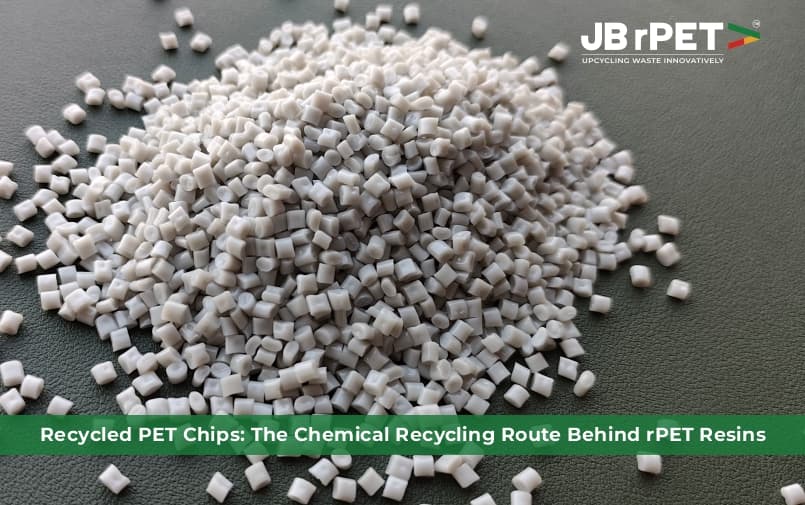
Buyers across spinning mills, packaging converters, strap producers, and masterbatch houses order the same material under a handful of different names. Some request recycled PET chips. Others raise purchase orders for rPET resin, rPET granules, rPET pellets, or simply dana. The material sitting behind each of these terms is one and the same: solid polyethylene terephthalate produced from recovered PET waste, ready to feed an extruder or a spinning line.
At JB rPET, we manufacture two of these material forms. We produce chemically recycled rPET resins from recovered PET and textile waste, and we produce rPET flakes from post-consumer PET bottles. Understanding what recycled PET chips are, where the naming comes from, and how the chemical recycling route builds them helps a procurement team specify with precision and compare offers on the parameters that carry real weight.
One Material, Several Names
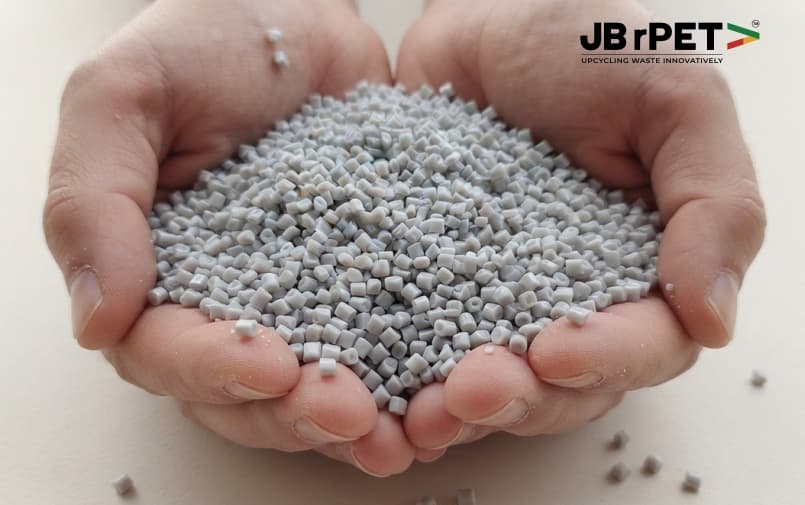
The word "chips" describes the physical form. When molten PET leaves the extruder, it solidifies and gets cut into small, uniform granular pieces. Depending on the cutting method and the buyer's regional convention, those pieces get called chips, pellets, granules, or dana. Each term points to the same solid resin ready for melting and forming.
"Resin" describes the material class. Polyethylene terephthalate is a thermoplastic polyester resin. When the resin comes from recycled feedstock, the industry adds an "r" for recycled, giving rPET. So rPET resin and recycled PET chips describe the same product from two angles: one names the polymer, the other names the shape it ships in.
The pellet-versus-granule distinction is a fine one. Both describe cut solid resin. Some buyers reserve "pellet" for cylindrical cuts and "granule" for irregular ones, though usage varies enough across regions that the two words are treated as interchangeable in most purchase orders. What the buyer receives depends on the specification rather than the noun.
"Dana" is the term many Indian converters and traders use in day-to-day sourcing. A spinning mill in Surat and a packaging converter in the Netherlands may reach for different words while describing an identical specification. The intrinsic viscosity, the moisture level, and the colour grade define what lands in the bag, regardless of the label printed on it.
For a procurement team, the practical takeaway is direct. When comparing quotes, read the specification behind the name. A supplier quoting "rPET granules" and one quoting "recycled PET chips" may be offering material for the same end use. The intrinsic viscosity, the feedstock origin, and the certification set carry the information that a purchase decision rests on.
Where Recycled PET Chips Begin
Every recycled PET chip starts as recovered PET waste. Two broad feedstock streams enter our facility. The first is post-consumer PET, primarily used beverage and packaging bottles collected after use. The second is PET-based textile waste, including pre-consumer fabric and yarn waste from garment and spinning operations.
The origin of the feedstock shapes the resin that results. Bottle-derived material offers a relatively consistent polymer input. Textile-derived material arrives with dyes, blended fibres, and finishes that call for a recycling route able to handle mixed and coloured inputs. Our chemical recycling process accepts both streams and harmonises them into resin with a defined specification.
This feedstock flexibility carries real weight for supply security. A recycler tied to a single narrow input competes for a limited pool of material and inherits every swing in that pool's availability and price. A route that accepts bottles alongside textile waste draws on a wider recovery base, which supports steadier output for converters who depend on regular deliveries against a production schedule.
Feedstock quality also sets the ceiling on output quality. Careful sourcing, sorting, and grading of incoming waste give the recycling process a cleaner starting point, which flows through to a more consistent finished chip. The discipline applied at the receiving end of the plant shows up in the material a converter runs weeks later.
The Chemical Recycling Route, Step by Step
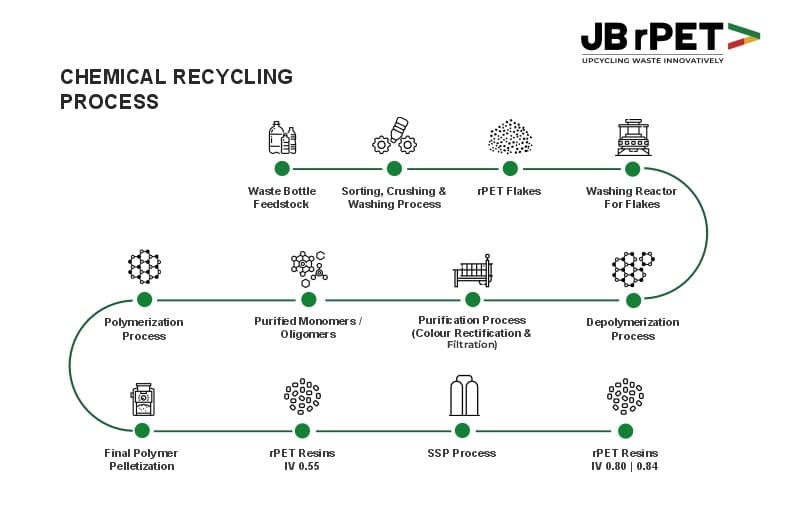
Chemical recycling rebuilds PET at the molecular level. Rather than softening and reshaping the existing polymer, the process breaks the polymer chains down into their building units and reassembles them. This molecular rebuilding is what allows mixed and coloured feedstock to yield resin with consistent properties.
The route begins with preparation. Incoming PET waste passes through sorting, and where the input calls for it, shredding, chopping, and agglomeration ready the material for feeding. This stage lifts out obvious contaminants and brings the feedstock to a uniform physical state that the process can handle predictably.
Depolymerization follows. Under controlled low-temperature conditions, the long PET polymer chains break down into shorter molecular units. Working at controlled low temperatures serves a clear purpose: it minimises thermal degradation of the material during breakdown, which protects the quality of the polymer that gets rebuilt later. During this stage, the intrinsic viscosity of the incoming material reduces toward zero. Bringing varied inputs to a common molecular baseline is what harmonises a batch built from several feedstock sources into one uniform starting material.
Purification comes next. High-efficiency filtration down to the 2 to 4 micron range removes fine contaminants from the depolymerised material. Because purification happens at the molecular scale, colours, additives, and impurities separate out more thoroughly than surface cleaning reaches. This is the stage that lets coloured and mixed feedstock produce resin with a clean, defined profile.
Repolymerization closes the loop. Controlled polymerization rebuilds the polymer chains, restoring polymer strength and bringing the material to a target intrinsic viscosity. The output is solid rPET resin with consistent IV from batch to batch, cut into the chip form that converters feed directly into their lines.
Because the route returns PET to its molecular building units, the resulting resin re-enters the same recycling stream at the end of its next life. Material rebuilt this way supports repeat recycling cycles, which is the mechanism behind a closed-loop supply model. For a brand or converter building a circular sourcing story, resin produced through molecular rebuilding offers a pathway that keeps PET in circulation across successive uses rather than settling into a single downstream product. This repeat-cycle capability is one reason converters with long-term sustainability commitments look toward chemically recycled resin for the applications where a durable circular claim carries weight.
This sequence answers the "PET chemical recycling process" question that many buyers research before placing a first order. The value of the route sits in its repeatability: harmonising varied inputs into a controlled output specification is what lets a converter run recycled resin through existing equipment and expect a predictable result each time.
From Chips to Application Grades
A recycled PET chip is a starting point that we tune toward an end use. The intrinsic viscosity, the colour, and the additive package shift depending on what the converter manufactures. Our chemically recycled resins span a range of grades built for specific downstream processes.
Textile-to-textile resin serves spinning and filament production, produced by recycling PET textile waste back into resin suited to fibre-grade manufacturing and circular fabric supply. Masterbatch-grade resin feeds colour and additive concentrate producers who need dependable dispersion behaviour. Strap-grade resin supports manufacturers of PET strapping used in industrial bundling and palletising, where tensile strength governs performance. Monofilament-grade resin serves producers of PET monofilament for brushes, filtration media, and industrial textiles.
These grades share a common origin in the chemical recycling route and diverge in their final specification. A strap producer calls for a higher intrinsic viscosity to hold tensile load. A masterbatch producer prioritises colour consistency and clean dispersion. A monofilament producer looks for uniform diameter behaviour through the die. Matching the grade to the process is where a manufacturer's process control earns its keep, and it is the reason grade selection deserves a conversation rather than a catalogue pick.
Our resins address flexible PET packaging, rigid PET packaging, and textile applications. Buyers specifying for these uses receive material documented against C-rPET resins specifications, with certification records supporting recycled-content and process claims that a converter can pass on to their own customers.
Washed rPET Flakes as Feedstock
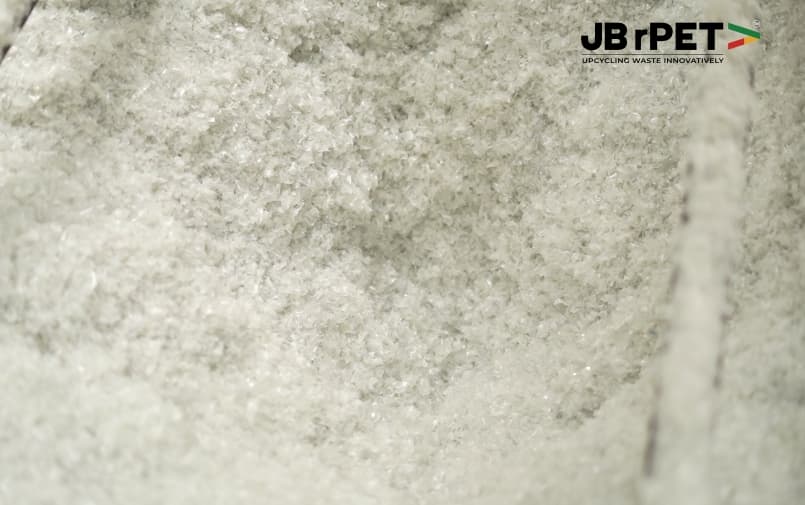
Alongside resin, we manufacture rPET flakes. Flakes sit at an earlier stage in the recycling chain, produced from post-consumer PET bottles and supplied as a clean feedstock for downstream processing.
Flake production runs through crushing, deep cleansing, and disinfection of collected PET bottles. Manual and automated sorting lifts non-PET materials out of the stream. Metal separation, drying, and a final sorting stage complete the sequence, yielding flakes with defined purity and low contamination.
Our washed flakes come in clear, green, and mixed-colour grades, each carrying its own purity and contamination profile. Downstream manufacturers use these flakes as feedstock across a range of PET applications, from sheet and film production through strapping and filament.
The value of a well-specified flake is traceability and consistency. A converter buying flakes as feedstock inherits whatever variability the flake carries into their own process, so purity grading and documentation at the flake stage protect the quality of everything produced from it. Clear grading at this point removes guesswork later in the chain.
How to Specify Recycled PET Chips
Reading past the name leaves a procurement team with the parameters that actually decide fitness for a process. A short set of specifications does most of the work.
Intrinsic viscosity heads the list. IV governs melt behaviour and mechanical strength, and each application sits in its own IV window. Confirming the IV range against the intended process avoids a mismatch that surfaces only on the line.
Feedstock origin comes second. Bottle-derived and textile-derived resins behave differently, and knowing the source clarifies what to expect from colour, consistency, and available grades. A supplier able to state the origin plainly gives the buyer a firmer footing.
Colour grade and moisture level round out the core set. Colour sets the visual starting point for the converter's output, and moisture affects drying requirements and processing stability. Contamination level, expressed against a defined grade, tells the buyer how much variability arrives in each lot.
Certification is the final check. Recycled-content and process certifications give a procurement team the documentary evidence to make recycled-content claims and satisfy customer and regulatory requirements. JB rPET holds ISCC PLUS, GRS, and OEKO-TEX certifications, and per-batch documentation ties the certified framework to the specific material a buyer receives.
Manufacturing at Scale
Specification and process count for little without the capacity to deliver reliably. JB rPET operates dedicated chemical recycling and flake manufacturing capacity, and the production record shows a clear ramp.
Installed capacity indicates the scale a producer can serve. JB rPET operates 28,800 MT per year of installed capacity for chemically recycled rPET resins and 18,600 MT per year for rPET flakes, for a combined 47,400 MT per year across both lines as on 31 March 2026. Capacity of this order signals a producer built to serve regular industrial volumes rather than occasional lots.
A feedstock base underpins both. JB rPET has drawn 258 crore PET bottles into its recycling stream from inception through fiscal 2026, alongside other PET and textile waste. Feedstock at that scale supports the steady input a continuous process depends on. The manufacturing base spans three land blocks totalling roughly 47,742 square metres, and the workforce grew to 593 people in fiscal 2026 from 408 the year before.
These are the markers a procurement team can ask any prospective manufacturer to demonstrate. Installed capacity, a multi-year production record, a feedstock base, and a physical plant with a workforce together describe a producer positioned to hold a supply commitment. A buyer weighing rPET manufacturers gains a clearer comparison by asking each candidate for the same signals.
These figures describe a manufacturer building recycled-content supply on affirmative technical and operational merits. For a procurement team weighing supply security, installed capacity, a rising production record, and a growing workforce are the signals that a supplier can hold to a delivery schedule across a long relationship.
Why Consistency Reaches the Converter
The reason a converter cares about the chemical recycling route comes down to what happens on the production line. Recycled resin earns its place in a manufacturing process when it runs with the predictability the operation depends on.
Consistent intrinsic viscosity across batches lets a converter hold machine settings steady from one delivery to the next, which reduces changeover time and trial runs. Molecular-level purification supports low contamination, which lowers the rate of defects and rejections during processing. Colour grading at both the flake and resin stage gives the buyer a defined starting point for their own output rather than a moving target.
Consistency also shows up on the cost side of a converter's operation. Every rejected part and every unplanned line stop carries a cost in material, energy, and labour. Resin that holds a steady intrinsic viscosity and a low contamination profile reduces the frequency of both, which lifts yield per tonne fed. Across a production run measured in hundreds of tonnes, a small improvement in reject rate compounds into a meaningful saving. Reliability of specification, then, reaches past quality assurance and into the economics that a plant manager tracks month to month.
Documentation ties it together. Certification records and per-batch parameters give a procurement team the evidence to specify recycled content with confidence and to meet their own regulatory and customer requirements. A resin that arrives with a clear specification and a traceable origin lowers the effort a converter spends confirming what they received, which is time returned to production.
Working with a Chemical Recycling Manufacturer
Recycled PET chips, rPET resins, pellets, granules, and dana all name the same family of material that a chemical recycling manufacturer builds from recovered PET. The name printed on the purchase order carries far less information than the specification behind it and the process that produced it.
JB rPET manufactures chemically recycled rPET resins and hot-washed rPET flakes, tuned across grades for packaging, strapping, masterbatch, monofilament, and textile applications. The chemical recycling route we operate harmonises varied PET waste into resin with consistent intrinsic viscosity and documented purity, backed by installed capacity and a production record that supports reliable supply for the manufacturers who build on it.
JB rPET. Upcycling waste, innovatively.