PET Bottle Resin: A Manufacturer's View on Grades, IV and Application Fit
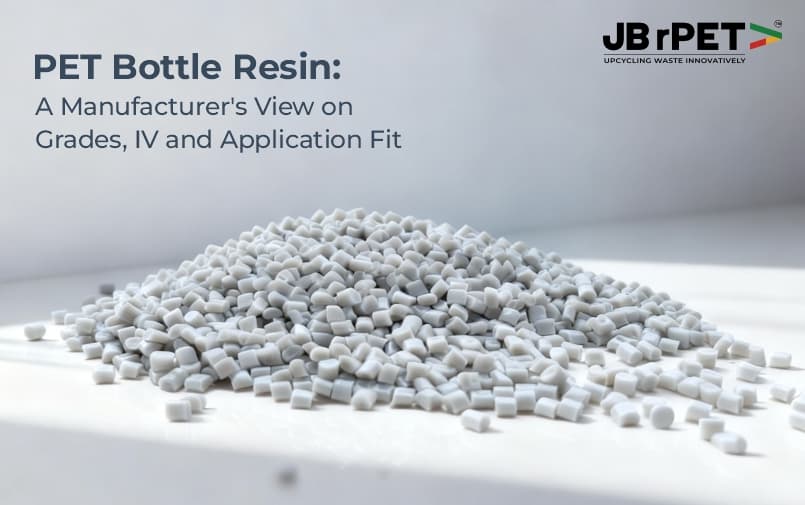
This post covers what we believe PET bottle resin means from a manufacturing standpoint, how PET resin grades differ in practice, what chemical recycling contributes to grade quality, and what buyers sourcing resin for non-food-grade bottle applications should evaluate before placing volume orders. We also cover the EU recycled content regulatory picture, since the PPWR thresholds now directly shape how converters and brand owners specify rPET resin.
Where we have published more detailed technical treatment on a topic, we link there rather than repeat the same ground.
What PET Bottle Resin Means for Manufacturers
PET bottle resin is polyethylene terephthalate in pellet or chip form, produced to a specific intrinsic viscosity range and color specification, intended for conversion into preforms and bottles through injection and blow processes. PET plastic resin, PET plastic granules, and PET pellets plastic all refer to variants of the same base polymer, differentiated by IV, color, additive package, and intended end us.
The distinction that matters first to us as a manufacturer is the source of the polymer. Virgin PET plastic resin is polymerized from purified terephthalic acid and ethylene glycol in a continuous melt phase, then brought to final IV through solid-state polycondensation. The resulting material sits at intrinsic viscosity between 0.70 and 0.85 dl/g, covering the range needed for both melt processability and solid-state mechanical performance across most bottle applications.
Recycled PET resin reaches comparable IV values through a different pathway. Post-consumer PET bottles are cleaned, converted into flakes, and reprocessed, either mechanically, which retains the polymer backbone, or through chemical depolymerization, which rebuilds the polymer from purified intermediates. The route determines the contamination profile, color behavior, and the degree of IV controllability in the finished resin.
PET plastic granules and PET pellets plastic are the physical form converters receive. Granule describes irregular strand-cut chip geometry. Pellet describes the cylindrical or spherical form from underwater pelletizing. For bottle-grade applications, chip geometry uniformity matters because inconsistent shapes cause bridging in hoppers and uneven residence time in the barrel, both of which affect melt homogeneity at the preform stage.

How PET Bottle Resin Is Made from Recycled Bottles
The path from collected PET bottles to usable PET plastic granules involves multiple quality-determining steps. Each one has downstream consequences on the resin that buyers eventually evaluate.
Collection and sorting come first. Post-consumer PET bottles arrive in mixed bales containing multiple colors, closure materials, labels, and contamination from prior use. Optical sorting systems separate clear, blue, and green streams. Color contamination at this stage shows up as b* shift in the final resin, which affects visual quality in blow-molded output.
Hot washing follows sorting. Size-reduced bottles are washed at elevated temperatures with alkaline solutions to remove adhesives, label fragments, residual product, and surface oils. Wash quality determines the baseline cleanliness of the flake entering reprocessing. Undissolved adhesive or label polymer passing through into the melt phase creates gels and black specks that cannot be eliminated downstream. Our bottle recycling plant operates a dedicated washing line calibrated to the contamination profiles of domestic post-consumer bales.
Flake quality after washing is the first commercial checkpoint. Clear hot-washed PET flakes can be characterized for IV, moisture, fines content, and color. These flakes then feed either mechanical reprocessing or chemical recycling.
In mechanical reprocessing, flakes are dried, extruded, filtered, and pelletized. The melt phase unavoidably degrades IV through thermal and hydrolytic chain scission. Solid-state polycondensation can rebuild IV to a target range, but the contamination profile of the input determines the ceiling on achievable color and clarity.
Chemical recycling takes a structurally different approach. It breaks PET down into its constituent monomers through controlled depolymerization, removing impurities at the molecular level rather than filtering them from the melt. The purified intermediates are then repolymerized under controlled conditions, producing PET plastic resin with IV, color, and molecular weight distribution characteristics that can be specified and held with precision. This is the route we operate at JB rPET. The process is covered in detail on our chemical recycling page.
PET Resin Grades and How They Differ
PET resin grades are defined primarily by intrinsic viscosity range, with secondary differentiation by color specification, additive package, and intended conversion process.
Intrinsic viscosity is a measure of average molecular weight in the polymer. Longer chains give higher IV and generally produce higher mechanical strength, better melt stability, and improved impact resistance. The practical consequence for bottle manufacture is that IV must be matched to the conversion process and the bottle geometry. Our detailed post on intrinsic viscosity covers the full IV range breakdown by application. The grade-level view relevant to bottle resin selection is below.
Fiber-grade PET plastic resin runs at 0.60 to 0.65 dl/g. This material passes through spinnerets at high throughput and does not require the chain length that bottle conversion demands. Fiber-grade resin used in a bottle application produces preforms with inadequate wall strength and poor orientation behavior during the blow stage.
Bottle-grade PET runs at 0.80 to 0.85 dl/g. Resin at this IV range feeds injection molding presses producing preforms, which are then heated and blown in stretch blow moulding machines. The IV range here provides the melt viscosity needed for stable injection into multi-cavity molds and the chain length needed for biaxial orientation during stretch blow moulding.
Higher-IV grades above 0.85 dl/g serve jerry cans, industrial containers, and strapping. Higher IV brings higher melt viscosity at equivalent processing temperature, which narrows the process window and requires careful temperature and back-pressure management to avoid shear degradation.
Strap-grade PET pellets plastic typically runs between 0.80 and 1.00 dl/g depending on the tenacity target. The orientation introduced during strapping extrusion relies on sufficient chain length to develop the crystalline structure that gives strap its mechanical performance.
Monofilament and technical fiber grades occupy specific IV bands that balance spinnability with tenacity. These are covered in the c-rPET resin section of our product range.
Color specification is a second differentiator across PET resin grades. The CIE Lab* system describes color precisely. Bottle-grade resin for clear applications requires high L* (lightness), near-zero a* (no red-green shift), and tightly controlled b* (yellowness). Mechanically recycled rPET characteristically shows elevated b* from thermal degradation in the melt phase. Chemical recycling, which rebuilds from purified intermediates, allows b* to be controlled more predictably across batches.
Additive packages vary by grade. Reheat additives appear in some bottle resins to improve preform heating efficiency in single-stage systems. Understanding the additive profile matters because certain downstream applications are sensitive to specific additive chemistries.

Core Properties Buyers Evaluate
When a converter sources PET bottle resin or PET plastic granules, the datasheet covers the formal specifications. What experienced buyers also examine is how those specifications hold across production batches, since single-sample test certificates do not reveal process variability.
Intrinsic viscosity consistency matters as much as the target value itself. IV variation batch to batch causes melt viscosity shifts that show up as weight variation in preforms, particularly at high cavitation. Chemical recycling routes using continuous polymerization give tighter IV distribution than batch processes because the reaction environment is held within a narrower parameter range throughout the run.
Moisture content is a processing-critical parameter. PET is hygroscopic. Resin above 30 ppm moisture at barrel entry undergoes hydrolytic degradation, losing IV through chain scission. Monitoring moisture carefully is relevant for rPET grades because the behavior of recycled resin in the dryer can differ from virgin material depending on the thermal history of the feedstock.
Contamination profile matters beyond what a datasheet captures. Black speck count, gel content, and suspended particulate level affect both the visual output and filter pack life at the blow molder. Chemical recycling with high-precision filtration gives a lower and more predictable contamination baseline than mechanical routes because impurities are separated at the monomer stage rather than filtered from the polymer melt.
Acetaldehyde behavior warrants attention even for non-food-grade applications. AA is generated during PET processing whenever chain scission occurs at elevated temperature. High AA in the resin entering the barrel means higher AA in the finished bottle, which can produce odor in bottles used for personal care or household chemical products even where food contact is absent.
PET Plastic Granules, PET Pellets Plastic and Conversion Behavior
The physical form of PET plastic granules affects line behavior before the resin reaches the barrel.
Chip geometry determines bulk density, flow uniformity in the dryer, and bridging risk in the hopper. Pellets from underwater pelletizing have a more uniform size distribution than strand-cut chips, which reduces variation in drying time and residence time distribution across the bed.
Crystallinity state of the incoming pellet matters for drying. Amorphous chips require a pre-crystallization step before entering the dryer to prevent agglomeration at drying temperatures. Crystallized PET pellets plastic can enter the drying bed directly. Buyers should confirm crystallization state when sourcing rPET from a chemical recycling route, since the thermal history of the repolymerization step affects the degree of crystallinity in the output chips.
Bulk density variation between batches affects the volumetric throughput of gravimetric blenders and loss-in-weight feeders. Converters running rPET blended with virgin resin at specific ratios need consistent bulk density across both components to maintain blend ratio accuracy.
Stretch Blow Moulding and Process Considerations
Stretch blow moulding is the conversion process for the large majority of PET bottle production. Understanding how resin behavior interacts with this process is central to grade selection.
The two-stage process separates preform injection from bottle blowing. Preforms are injection-molded, cooled, and transferred to the blow station as discrete parts. The blow station reheats the preform under infrared lamps, then stretches it axially with a stretch rod while simultaneously inflating it radially with high-pressure air.
Resin behavior during stretch blow moulding depends on IV and molecular weight distribution together. Two resins with identical intrinsic viscosity values can behave differently during blowing because IV reflects an average across the chain population. Processing stability depends on chain length uniformity, low oligomer content, and controlled degradation pathways. A resin with a broad molecular weight distribution stretches unevenly, producing wall thickness variation and bottom weight inconsistency in the finished bottle.
Preform reheat behavior also depends on the resin. In two-stage systems, preforms must reheat to the blow window uniformly across the wall. Resin with elevated AA entering the oven generates additional AA during reheat, which is why AA specification is relevant even for non-food-grade applications at high production speeds.
For non-food-grade bottle applications, the blow window and stretch ratios can differ from beverage bottle targets. Industrial containers often run at lower stretch ratios with thicker walls. The IV requirement at those specifications can be slightly lower than for thin-wall beverage preforms, which gives converters sourcing chemically recycled rPET resins additional flexibility in grade selection.

Food-Grade and Non-Food-Grade Bottle Applications: Understanding the Distinction
PET bottle resin is produced across a spectrum from food-grade to non-food-grade, and understanding where the boundary sits matters for sourcing decisions.
Food-grade bottle resin is subject to regulatory compliance requirements set by bodies including the FDA in the United States and EFSA in the European Union. For recycled PET to qualify as food-grade, the recycling process must demonstrate that it reduces contaminants in post-consumer input to levels below regulatory thresholds. This typically requires either a challenge test on the recycling process or direct approval of the specific process configuration. Acetaldehyde content is a key parameter, since AA migrates into packaged contents and is regulated in food contact materials.
Non-food-grade bottle resin operates under a different set of requirements. The specifications are set by the converter's product requirements and their packaging line parameters rather than by food-contact regulatory frameworks. For bottles containing personal care products, household chemicals, agrochemicals, and industrial lubricants, the relevant performance criteria are structural integrity, chemical resistance, visual consistency, and, depending on the product category, odor control.
JB rPET produces resin for non-food-grade bottle applications. Buyers requiring food-contact compliance should confirm regulatory applicability with their own legal and quality teams before specifying any rPET resin for food packaging. Our chemically recycled rPET resins are characterized and supplied against non-food-grade specifications.
Within non-food-grade applications, the performance requirements vary by end-use category. Industrial and agrochemical bottle converters evaluate drop impact resistance and top-load strength, which are governed by wall thickness at the stretch ratio used and by the molecular orientation in the finished bottle wall. Resin with consistent IV and narrow molecular weight distribution produces more predictable orientation across a run. Chemical resistance of the finished bottle is a function of both the polymer and the degree of orientation in the wall. Biaxially oriented PET provides resistance to many aqueous and alcoholic solutions. Compatibility should be evaluated by the converter for the specific product chemistry the bottle will contain.
For personal care applications, even without food-contact requirements, odor sensitivity of the end product creates a practical AA ceiling. Buyers sourcing rPET for personal care bottles in fragranced or sensitive product categories should specify and test AA behavior before committing to volume.
Chemical Recycling Routes for PET
Chemical recycling of PET breaks the polymer into molecular intermediates that are purified before repolymerization. This distinguishes it structurally from mechanical recycling, which reprocesses the polymer without breaking the backbone.
Some chemical recycling pathways for PET are glycolysis, methanolysis, hydrolysis, and aminolysis. Each depolymerizes PET into monomers or oligomers that serve as inputs for repolymerization. Route selection depends on the target intermediate, available reagent infrastructure, and the downstream product specification.
At JB rPET, we operate chemical recycling of PET. The specific route configuration of our plant is proprietary. What the process produces for buyers is resin with controlled IV, low b*, and a contamination profile that reflects purification at the monomer stage rather than filtration at the melt stage. Our rPET manufacturing operations and output specifications are described in our product documentation.
The practical implication for buyers is batch-to-batch consistency. When the polymer is rebuilt from purified intermediates under controlled repolymerization conditions, the distribution of chain lengths and IV are more controllable than in mechanical reprocessing, where feedstock variability propagates into the finished resin.
Recycled Content Regulations: What Buyers Sourcing rPET for Packaging Need to Know

Choosing the Right Grade for Your Use Case
Grade selection for PET bottle resin is a matching exercise between resin specification and conversion process requirements. Working through it systematically reduces sampling cycles and production waste.
Start with the process route. Two-stage stretch blow moulding with multi-cavity tooling needs bottle-grade resin at 0.80 to 0.85 dl/g with tight IV consistency. Single-stage injection stretch blow moulding systems for larger containers may operate within a narrower window at slightly different IV depending on preform design. Extrusion blow moulding for handleware or industrial containers requires resin with higher melt strength, typically branched or higher-IV formulations.
Define the application tolerance on color. Clear bottles for personal care require high L* and low b*. Tinted or opaque bottles for industrial or agrochemical applications may allow more latitude. Confirm whether the converter's colorant system is formulated for rPET, since some pigment systems interact differently with rPET than with virgin resin.
Specify the AA threshold. Even for non-food-grade applications, AA specification prevents odor complaints in sensitive product categories. Request AA data on the resin before barrel entry, and ask for the supplier's typical AA generation rate across their production range.
Evaluate the contamination profile. Request gel content and black speck data in addition to the standard IV and color datasheet. Gel content drives filter pack replacement frequency. If a supplier does not provide these values, that is a gap worth raising before placing volume.
Confirm the physical form. Check whether PET plastic granules are crystallized or amorphous as shipped. Confirm bulk density and chip geometry so the converter can validate hopper and dryer settings before the first production run.
Request batch data across multiple production runs. Grade selection based on a single representative sample does not reveal batch-to-batch variability. IV and color data across five or more recent batches shows whether the supplier's process control is consistent enough to support volume production.
For EU-market packaging, confirm the certification documentation. PPWR recycled content requirements are enforceable from 2030. Buyers who begin sourcing certified rPET now build the traceability documentation they will need, rather than retrofitting their supply chain against a compliance deadline.
FAQ
What is PET bottle resin?
PET bottle resin is polyethylene terephthalate in pellet or chip form, produced to a specific intrinsic viscosity range for conversion into preforms and bottles through injection and blow moulding processes. The term covers both virgin PET plastic resin produced from petrochemical feedstocks and recycled PET resin produced from post-consumer bottles through mechanical or chemical recycling.
What are the main PET resin grades and how are they defined?
PET resin grades are differentiated primarily by intrinsic viscosity. Fiber grade runs at 0.60 to 0.65 dl/g. Bottle grade runs at 0.80 to 0.85 dl/g. Higher-IV grades above 0.85 dl/g serve jerry cans, strapping, and industrial applications. Each grade has a specific IV range because the conversion process it feeds requires a defined melt viscosity and chain length. Color specification and additive package are secondary differentiators within each grade.
What is the difference between PET plastic granules and PET pellets plastic?
Both terms describe the pelletized physical form of PET resin. Granule typically refers to irregular strand-cut chip geometry. Pellet refers to the cylindrical or spherical geometry produced by underwater pelletizing. For bottle applications, uniform pellet geometry gives more consistent drying and more predictable residence time in the barrel.
Why does intrinsic viscosity matter in stretch blow moulding?
Stretch blow moulding requires the preform wall to develop biaxial orientation during blowing. IV determines chain length, and chain length determines how the polymer orients during stretching. Resin with IV that is too low produces thin spots and poor wall distribution. IV that is too high narrows the blow window and increases the risk of incomplete orientation. The correct IV depends on the preform geometry and the stretch ratios used for the specific bottle format.
What types of plastic resin are used in non-food-grade bottle applications?
PET is one of the primary resin type used for both food-grade and non-food-grade bottles, with grade differentiation determined by IV, color, and additive package rather than polymer type. Other bottle applications use HDPE and PP, but PET is preferred where clarity, mechanical stiffness, and chemical resistance are the primary design requirements.
What is chemical recycling of PET and how does it differ from mechanical recycling?
Chemical recycling depolymerizes PET into molecular intermediates through processes including glycolysis, methanolysis, or hydrolysis. The intermediates are purified before repolymerization, removing contamination at the monomer level. Mechanical recycling reprocesses the polymer without breaking the backbone, which limits the degree of purification achievable. Chemical recycling produces resin with specifications closer to virgin-grade material and better batch-to-batch consistency on IV and color.
Does JB rPET supply food-grade bottle resin?
JB rPET produces resin for non-food-grade bottle applications. Buyers requiring food-contact compliance should confirm regulatory applicability with their own legal and quality teams before specifying any rPET resin for food packaging.