Advanced Environmental Recycling: A Deep Dive into Chemical Depolymerization
Advanced environmental recycling is no longer a niche topic discussed only in policy rooms or research papers. It is now central to how the plastics industry, especially PET packaging and textiles, plans for compliance, supply stability, and real circularity. As recycled content mandates increase across global markets, the focus has shifted from simply collecting plastic waste to understanding how different recycling routes work together.
This is where chemical depolymerization enters the conversation. Not as a replacement for existing systems, but as a necessary extension of advanced environmental recycling, particularly for PET streams that can no longer be mechanically recycled without quality loss.
This article takes a detailed, practical look at chemical recycling of PET, with a specific focus on depolymerization of plastics, how it compares with mechanical recycling of plastic, and why both play distinct roles in a functioning circular economy.
Understanding Advanced Environmental Recycling in the PET Context
Advanced environmental recycling refers to recycling systems that go beyond traditional size reduction and remelting. In PET recycling, this typically means processes that break the polymer back into its chemical building blocks so it can be rebuilt with virgin-like performance.
Unlike conventional methods, advanced environmental recycling is designed to handle complexity. This includes multilayer packaging, heavily contaminated bottles, colored PET, textile waste, and material that has already gone through multiple mechanical cycles.
In the PET value chain, advanced environmental recycling focuses on restoring molecular integrity rather than preserving physical form. That difference matters when recycled PET is intended for high-spec applications like food contact packaging, fibers with strict tensile requirements, or B2B resins used across regulated markets.
Why Mechanical Recycling of Plastic Still Matters
Before diving into chemical depolymerization of plastic, it is important to clarify one thing. Mechanical recycling of plastic is not a problem to be solved. It is the backbone of PET recycling today.
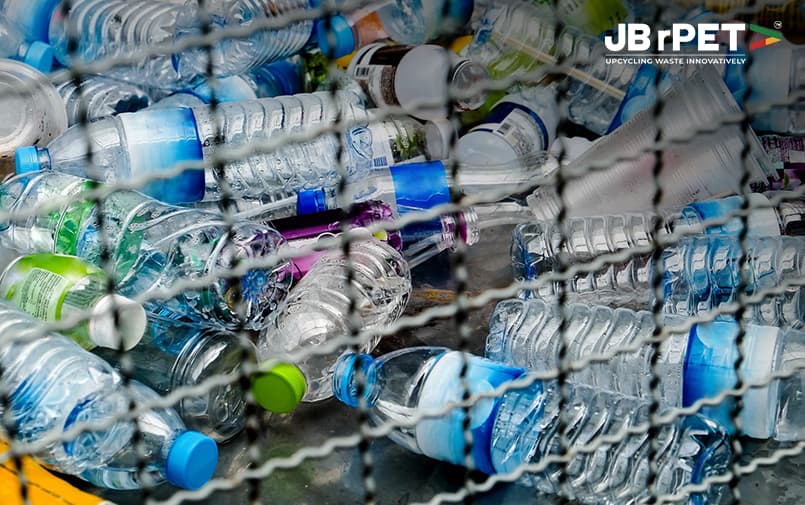
Mechanical recycling of plastic works best when the input material is clean, well-sorted, and largely transparent. Bottle-to-bottle recycling systems, especially in PET, rely on mechanical processes to convert post-consumer bottles into flakes and pellets efficiently and at scale.
For clear PET bottles collected through structured systems, mechanical recycling of plastic delivers strong environmental benefits with lower energy input. It also remains the most economical route for large volumes of food-grade rPET.
Advanced environmental recycling builds on this foundation. It steps in where mechanical systems reach their practical limits.
How Feedstock Quality Determines the Recycling Route
Not all PET waste enters the recycling system at the same quality level. In advanced environmental recycling, the choice between mechanical recycling of plastic and chemical depolymerization of plastic begins with feedstock evaluation.
Clean, transparent PET bottles with low contamination are best suited for mechanical recycling of plastic. These streams allow material to be processed efficiently while retaining polymer integrity for multiple life cycles.
More complex feedstock requires a different approach. Colored PET, multilayer packaging, heavily contaminated bottles, and post-consumer polyester textiles often fall outside the practical limits of mechanical systems. This is where chemical plastic recycling becomes critical.
By matching feedstock characteristics to the appropriate recycling route, advanced environmental recycling ensures higher overall recovery rates without forcing unsuitable material into inefficient processes.
Chemical Recycling of PET Explained
Chemical recycling refers to processes that chemically alter polymers to recover monomers or intermediate compounds. In PET, this typically involves breaking ester bonds that hold the polymer chain together.
When PET is chemically recycled, it no longer behaves as plastic waste. It becomes a chemical feedstock again.
Chemically recycled plastic produced through depolymerization can meet specifications that are difficult to achieve through repeated mechanical recycling. This is especially relevant for applications that demand consistent intrinsic viscosity, clarity, and regulatory compliance.
Chemical Depolymerization of Plastic: The Core Principle
Chemical depolymerization of plastic focuses on reversing polymerization. Instead of melting PET and reshaping it, depolymerization of plastics breaks PET down into monomers such as BHET, DMT, or PTA depending on the process used.
Once purified, these monomers can be repolymerized to produce PET with properties comparable to virgin resin. This is why chemical depolymerization of plastic is often described as molecular recycling.
In advanced environmental recycling systems, depolymerization allows PET to re-enter high-value applications even after multiple life cycles.
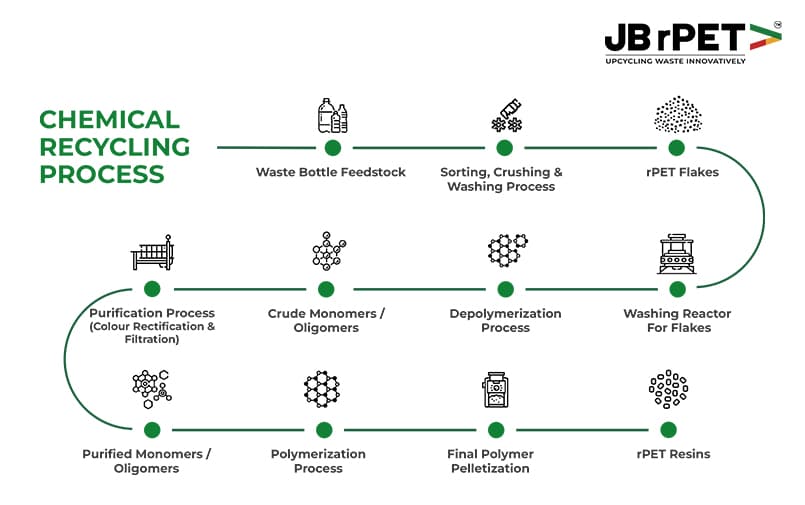
A Simplified View of the PET Chemical Recycling Process
At a high level, chemical recycling of PET follows a structured sequence:
- Collection and pre-sorting of PET waste
- Feedstock preparation and contamination management
- Chemical depolymerization of plastic using controlled reactions
- Purification of recovered monomers
- Repolymerization into PET resin or intermediate products
This structured flow allows chemically recycled plastic to re-enter manufacturing cycles with performance characteristics comparable to virgin material.
Solvolysis Plastic Recycling and How It Works
One of the most established approaches within chemical recycling is solvolysis plastic recycling. Solvolysis uses a solvent, such as glycol, methanol, or water, combined with heat and catalysts to depolymerize PET.
Common solvolysis plastic recycling methods include:
- Glycolysis
- Methanolysis
- Hydrolysis
Each method differs in operating conditions, energy requirements, and output purity. Solvolysis plastic recycling is particularly effective for PET textile waste, colored bottles, and multilayer materials that are unsuitable for mechanical recycling.
In advanced environmental recycling setups, solvolysis plastic recycling enables consistent recovery of PET monomers from mixed and lower-grade feedstock.
Comparing Chemical Recycling and Mechanical Recycling
Without Conflict It is tempting to frame chemical plastic recycling as superior to mechanical recycling of plastic. In practice, that comparison misses the point.
Mechanical recycling of plastic is efficient, scalable, and environmentally favorable for suitable PET streams. Chemical recycling of PET becomes essential when feedstock quality drops or application requirements increase.
Advanced environmental recycling integrates both systems. Mechanical recycling handles clean, bottle-grade material efficiently. Chemical recycling ensures that PET remains recyclable even when mechanical routes are no longer viable.
This complementary relationship is what makes full circularity possible.
Where Chemically Recycled Plastic Fits in B2B Supply Chains
Chemically recycled plastic plays a crucial role in B2B resin supply, particularly for converters and brands facing strict recycled content targets.
Because chemical depolymerization of plastic resets polymer quality at the molecular level, chemically recycled plastic can be tailored for:
- Food contact packaging
- High-performance films
- Engineering applications
- Consistent fiber production
In advanced environmental recycling systems, chemically recycled plastic offers predictability. That predictability is critical for manufacturers who cannot compromise on performance or compliance.
Output Quality in Chemical Recycling of PET
One of the defining advantages of chemical recycling lies in output consistency. Through chemical depolymerization of plastic, PET is broken down to its molecular components and rebuilt under controlled conditions.
This process allows chemically recycled plastic to achieve predictable intrinsic viscosity, clarity, and performance characteristics. Unlike mechanically recycled material, which reflects the quality of its previous life cycles, chemically recycled plastic starts fresh at the polymer level.
For applications where consistency is non-negotiable, such as regulated packaging or standardized B2B resins, chemical recycling provides a level of control that supports long-term manufacturing stability.
PET Textiles and the Role of Depolymerization of Plastics
One of the most impactful applications of chemical depolymerization of plastic lies in textile recycling. Polyester textiles are notoriously difficult to recycle mechanically due to dyes, blends, and finishing chemicals.
Depolymerization of plastics allows polyester garments to be broken down into reusable chemical components. This opens the door for textile-to-textile recycling, a key pillar of advanced environmental recycling strategies.
Without chemical recycling, most polyester textiles would remain outside the circular economy.
Environmental Considerations in Advanced Environmental Recycling
Advanced environmental recycling must be evaluated on more than just output quality. Energy use, solvent recovery, emissions control, and process efficiency all matter.
Modern chemical recycling plants are designed to:
- Recover and reuse solvents
- Minimize waste streams
- Integrate energy optimization systems
- Maintain regulatory compliance across regions
When implemented responsibly, chemical depolymerization of plastic can complement mechanical recycling of plastic without increasing environmental burden.
Scale, Cost, and Infrastructure Considerations
Advanced environmental recycling is shaped not only by chemistry, but also by economics and infrastructure readiness. Mechanical recycling of plastic continues to dominate high-volume PET recycling due to its established infrastructure and lower operational costs.
Chemical recycling systems, including solvolysis plastic recycling, require higher capital investment and technical control. These systems are most effective when integrated into broader recycling ecosystems rather than operating in isolation.
As capacity increases and processes mature, chemical depolymerization of plastic is becoming more scalable. In the interim, the most effective recycling networks balance mechanical and chemical routes based on material quality, volume, and end-use requirements.
Regulatory and Market Drivers Behind Chemical Plastic Recycling
Global regulations are accelerating the adoption of advanced environmental recycling. Recycled content mandates, extended producer responsibility frameworks, and brand sustainability commitments all contribute to rising demand.
Chemical plastic recycling helps bridge the gap between available high-quality recycled material and mandated targets. This is particularly true in markets where collection systems produce mixed or contaminated PET waste.
Advanced environmental recycling is no longer optional. It is becoming part of baseline infrastructure planning.
Traceability and Compliance in Advanced Recycling Systems
As recycled content requirements become more structured, traceability has become central to advanced environmental recycling. Both mechanical recycling of plastic and chemical recycling processes must demonstrate material origin, processing integrity, and output consistency.
In chemical plastic recycling, depolymerization allows clearer mass balance accounting at the molecular level. This supports compliance documentation for brands and converters operating across multiple regulatory frameworks.
Advanced environmental recycling systems increasingly rely on digital tracking, batch verification, and third-party audits to ensure transparency across the recycling value chain.
How Advanced Environmental Recycling Supports Long-Term Circularity
True circularity requires PET to remain recyclable indefinitely. Mechanical recycling alone cannot guarantee this. Chemical depolymerization of plastic ensures that PET does not degrade beyond usability after multiple life cycles.
By integrating mechanical recycling of plastic with chemical recycling routes, advanced environmental recycling creates a closed loop that adapts to material quality over time.
This layered approach protects investment, stabilizes supply chains, and aligns with long-term sustainability goals.
Choosing the Right Recycling Route for PET Waste
Not all PET waste should be chemically recycled. Not all PET waste should be mechanically recycled either.
Advanced environmental recycling is about decision-making, not replacement. Clean bottles belong in mechanical recycling streams. Complex, degraded, or textile-based PET belongs in chemical recycling systems.
When these routes are aligned correctly, overall recycling efficiency improves without compromising environmental outcomes.
The Future of Chemical Depolymerization of Plastic
As technology advances, chemical depolymerization of plastic will continue to improve in efficiency, scalability, and cost-effectiveness. Innovation is already reducing energy intensity and expanding feedstock compatibility.
In the long term, advanced environmental recycling will rely on tighter integration between collection systems, mechanical recycling plants, and chemical recycling facilities.
This is how PET moves from linear use to true circular performance.
Common Misconceptions Around Chemical Recycling
Chemical recycling is often misunderstood as a replacement for mechanical recycling of plastic. In reality, the two systems serve different but complementary roles.
Another common misconception is that all plastics should be chemically recycled. Advanced environmental recycling depends on selective use of chemical depolymerization of plastic only where mechanical routes are no longer efficient or viable.
When integrated correctly, chemical recycling expands the total recyclable PET pool rather than competing with existing recycling infrastructure.
A Systems View of Advanced Environmental Recycling
Advanced environmental recycling is not a debate between old and new technologies. It is a systems approach that recognizes the strengths and limits of each recycling route.
Mechanical recycling of plastic remains essential for clean, bottle-grade PET. Chemical recycling and depolymerization of plastics ensure that no PET is left behind when quality drops or complexity increases.
Together, these processes form a resilient, scalable, and realistic pathway toward circular PET use. That is the real promise of advanced environmental recycling, not as a single solution, but as an integrated framework for the future of plastics.