Chemical Recycling of Plastics: Waste Streams, Certification, and Recycled Content Claims
Two suppliers quote you recycled PET resin at similar prices. Both say the material contains recycled content. One of them can hand you a certificate number, name the chain of custody model behind it, and show you the batch data. The other says trust us.
Until recently that difference was a preference. As of 2026, food-contact PET packaging in India carries a 40% recycled content requirement, and the figure for rigid packaging climbs by ten points a year after that (Plastic Waste Management Rules). The certificate is now part of your compliance file, and so is the resin.
Chemical recycling of plastics enters that conversation largely because of what it does to feedstock other routes leave behind. This piece covers the ground a buyer has to walk: what the process does, which waste it can absorb, how the recycled content gets certified, and what to ask a supplier before you sign.
What Chemical Recycling of Plastics Actually Means
Chemical recycling of plastic waste breaks the polymer back into its chemical building blocks. Those building blocks get purified and then rebuilt into fresh polymer. The output behaves like newly made material because, at a molecular level, that is exactly what it is.
Mechanical recycling takes a different path. It washes, melts, filters and reshapes the plastic while keeping the polymer chain intact. Both routes produce recycled material. They simply solve different problems and suit different feedstocks.
The term you will see in datasheets and policy documents is advanced chemical recycling. Some documents use plastic chemical recycling technology or chemical recycling of polymers to describe the same broad category. For a buyer, the useful distinction sits below the label. What matters is which waste the process can absorb, and what proof travels with the resin.
How the Chemical Recycling Process Works in Four Stages
At a working level, chemical recycling of polymers moves through four stages.
Feedstock preparation. Collected plastic waste is sorted, cleaned and reduced to a size the reactor can handle. Shredding, chopping and similar steps prepare the input.
Depolymerization. The prepared feedstock is treated under controlled conditions that break the polymer chains apart. PET comes apart into monomers and shorter oligomers. Colour, additives and other carried-over material separate from the polymer at this stage rather than travelling forward with it.
Purification. The recovered material is filtered and cleaned to remove contaminants. Purity at this stage sets the ceiling on what the final resin can be used for.
Repolymerization. The purified building blocks are rebuilt into polymer chains under controlled conditions, producing resin to a defined specification.
The reagents, temperatures and catalysts used at the depolymerization stage vary by route. Those routes and their operating conditions are covered in detail on our chemical recycling process page.
Which Plastic Waste Streams Chemical Recycling Can Handle
Recycling systems are built first around clean, sorted, single-polymer streams. Clear PET bottles are the familiar example. They are straightforward to collect, to identify and to process.
Harder material sits outside that stream:
- Coloured and opaque plastics, where pigment carries through into the recycled output and limits where the resin can be used
- Multilayer and composite packaging, where several polymers are bonded together in one film.
- Post-consumer textile waste, where polyester fibre is mixed with dyes, finishes and other fibres
- Post-industrial trims and offcuts with adhesives, coatings or printed surfaces
- Heavily contaminated streams carrying labels, residues and organic matter
Chemical plastic recycling widens the window on several of these. Because the polymer is taken apart before it is rebuilt, colour and additives separate at the molecular stage rather than carrying forward into the output. That is the practical reason chemical routes draw attention for feedstock that sits beyond the reach of conventional lines.
This matters more each year, because the recycled content targets in Indian law apply across the packaging categories a producer places on the market. Meeting a rising target with feedstock drawn only from clean bottle streams becomes harder as the percentage climbs.
Why Polyester and PET Lead the Commercial Landscape
Chemical recycling applies to several polymer families. In India, PET is where the regulatory pressure and the buyer questions tend to land.
Part of the reason is chemistry. PET is built from ester linkages, which respond to controlled chemical breakdown. The monomers recovered from PET feed back into standard polyester production lines. The reactions involved are documented in published polymer research, and our chemical recycling process page cites the relevant literature.
Part of it is where the obligations sit. PET is used in beverage bottles, food packaging, films, straps and polyester fibre. Those are the categories carrying the recycled content requirements set out later in this piece. A producer working to a rising recycled content target in rigid PET packaging has a direct reason to ask how much feedstock a chemical route can bring into play.
The polyester fibre chain adds further pull. Spinning mills, POY producers and polyester staple fibre lines run on tight material tolerances. Resin that arrives with consistent intrinsic viscosity behaves predictably at the extruder, and predictability is what a mill buys.
Mechanical and Chemical Recycling of Solid Plastic Waste Work Together
A common misreading treats mechanical and chemical recycling of solid plastic waste as rivals. In practice they occupy different positions in the same system, and a working recycling economy needs both.
Mechanical recycling carries volume. It is an established route for clean, sorted PET bottle streams. It keeps the polymer chain intact, which holds energy input and processing cost down and allows it to run continuously at industrial throughput.
Chemical recycling extends range. By taking the polymer apart before rebuilding it, chemical routes bring in feedstock that sits outside the mechanical window. Coloured material, mixed streams and textile-derived polyester are examples.
Together the two routes reach more of the waste map than either reaches alone. A well-sorted PET bottle has an efficient mechanical answer. A bale of dyed polyester textile waste calls for a different one.
Both capabilities exist within the JB Group. JB Ecotex operates mechanical recycling for PET. JB rPET produces chemically recycled resin. Our rPET recycling process page sets out how the two relate.
For a buyer, the practical question is what your material actually requires. Clean bottle-to-bottle work has a mature mechanical answer. Complex feedstock and tight purity specifications point toward chemical routes.
How Recycled Content Claims Get Certified and Traced
Here is where many buyer conversations go wrong. A supplier says the resin contains recycled content. The buyer accepts it. Six months later an auditor asks for the evidence trail, and the claim has nothing behind it.
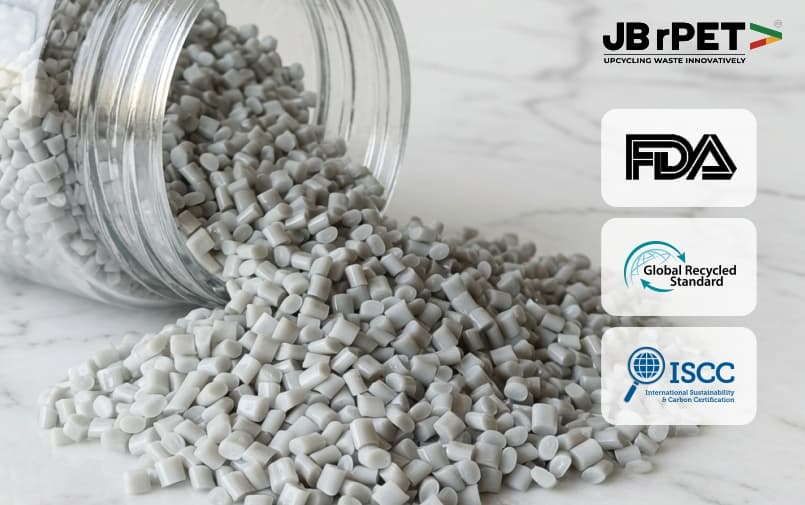
Certification exists to close that gap. Three schemes come up repeatedly in PET and polyester procurement.
ISCC PLUS certifies sustainable material along the supply chain and is used for chemically recycled feedstock. It supports a mass balance approach to chain of custody, where recycled and conventional inputs are tracked through a certified accounting system and allocated to output. The ISCC system documentation sets out how the chain of custody options work.
OEKO-TEX addresses tested substance limits in the finished material rather than recycled content itself. It answers a different question and often sits alongside the others.
Understanding mass balance is worth a minute of your time. Under a mass balance model, a certified site takes in a mix of recycled and conventional feedstock, tracks the recycled share through the process, and allocates that share to a defined quantity of output. The allocated output carries the claim. Physical segregation works differently, keeping recycled input physically separate all the way through.
The two models answer different needs. What matters is knowing which one your supplier uses, and confirming your own downstream customer accepts it. Some brands specify physically segregated recycled content in their own procurement policies. Establishing that before the order ships avoids an expensive surprise afterwards.
JB rPET holds ISCC PLUS and OEKO-TEX certifications. Details sit on our sustainability page.
What Indian Regulation Now Demands of Producers and Brands
The regulatory picture in India has moved quickly, and it drives a lot of current buying behaviour.
Under the amended Plastic Waste Management Rules, rigid plastic packaging (Category I) carried a 30% recycled content requirement for 2025-26. An amendment published in the Gazette of India on 31 March raised the target to 40% for 2026-27, with a further 10 percentage point increase in each of the two following years, reaching 60% in 2028-29. Flexible packaging (Category II) starts at 10% and rises to 20%. Multi-layered packaging (Category III) starts at 5% and rises to 10%.
Food-contact PET has its own track. The Ministry of Environment, Forest and Climate Change finalised guidelines requiring a minimum of 40% recycled content in food-contact PET packaging effective from 1 April 2026. Unfulfilled targets from 2025-26 may be carried forward for up to three consecutive year.
Traceability came with it. From 1 July 2025, plastic packaging must carry a QR code, barcode or unique identifier linking each batch to its registered producer, with data feeding into the CPCB portal. Producers, importers and brand owners register on that portal and file annual returns.
The practical effect for a resin buyer: your supplier's documentation is now part of your own compliance file. Buying recycled material without a verifiable paper trail leaves you exposed when the return is due.
What Buyers Should Ask Chemical Plastic Recycling Companies
Use this as a working checklist when evaluating chemical plastic recycling companies:
- Which certifications do you hold, and are they current? Ask for certificate numbers and expiry dates rather than logos on a website.
- Which chain of custody model applies to my order? Mass balance or physical segregation. Get it in writing.
- What feedstock goes into this grade? Post-consumer bottle, post-industrial, textile-derived. This affects both your claim and your material performance.
- What technical documentation travels with the shipment? A certificate of analysis, batch test reports and an MSDS should be standard.
- What are the specified IV, colour and contamination values, and what is the tolerance across batches? Consistency across lots matters as much as the headline number.
- Can the documentation support my end market? Food contact, EU export and Indian EPR reporting each ask for different evidence.
A supplier that answers these clearly is a supplier you can build a compliance file around.
Why Polyester and PET Lead the Commercial Landscape
Chemical recycling in a circular economy for plastics plays a specific role. It keeps carbon atoms inside the material system that would otherwise leave it. Waste that lacks a mechanical route ends up landfilled, incinerated or leaked into the environment. A chemical route gives some of that material another turn.
The honest framing is a portfolio, rather than a single winning technology. Better collection and sorting feed everything. Mechanical recycling carries the volume. Chemical recycling extends the range. Design for recyclability reduces the difficulty of the whole task.
For a buyer, circularity becomes real at the level of a purchase order. It shows up as a resin grade with a defined specification, a certificate that survives an audit, and a supply relationship that can hold both across many batches.
JB rPET manufactures C-rPET resin through depolymerization and repolymerization of post-consumer PET, supplying bottle-to-bottle and textile-to-textile applications. To discuss grade requirements or documentation, get in touch.
Frequently Asked Questions
What is chemical recycling of plastics?
Chemical recycling of plastics breaks polymer chains back into their chemical building blocks. Those building blocks are purified and rebuilt into fresh polymer. The resulting material behaves like newly produced resin because it has been reassembled at the molecular level from recovered monomer.
How is chemical recycling different from mechanical recycling?
Mechanical recycling washes, melts and reshapes plastic while keeping the polymer chain intact. Chemical recycling takes the chain apart and rebuilds it. Mechanical routes suit clean, sorted streams. Chemical routes extend recycling to coloured, mixed and textile-derived waste.
Is chemically recycled plastic food-grade?
Chemically recycled PET can meet food-contact requirements when produced under appropriate certification. Buyers should ask for FDA, FSSAI or EFSA documentation specific to the grade and application, along with a certificate of analysis for the batch being supplied.
What is mass balance in recycled content certification?
Mass balance is a chain of custody model where a certified site tracks recycled and conventional feedstock through production and allocates the recycled share to a defined quantity of output. That allocated output carries the recycled content claim under audit.
Which plastics can be chemically recycled?
Several polymer families can be chemically recycled. PET and polyester draw frequent attention from Indian buyers, because PET ester linkages respond to controlled breakdown and because recovered monomers feed back into existing polyester production lines with minimal redesign.
What recycled content does Indian regulation require?
Under the amended Plastic Waste Management Rules, rigid plastic packaging must reach 40% recycled content in 2026-27, rising by 10 percentage points annually to 60% by 2028-29. Flexible and multi-layered categories carry lower phased targets.
How do I verify a supplier's recycled content claim?
Ask for current certification numbers, the chain of custody model applied to your order, a certificate of analysis, batch test reports and an MSDS. Confirm the documentation satisfies your own end market and reporting obligations before ordering.