Chemically Recycled PET Resins for Textiles
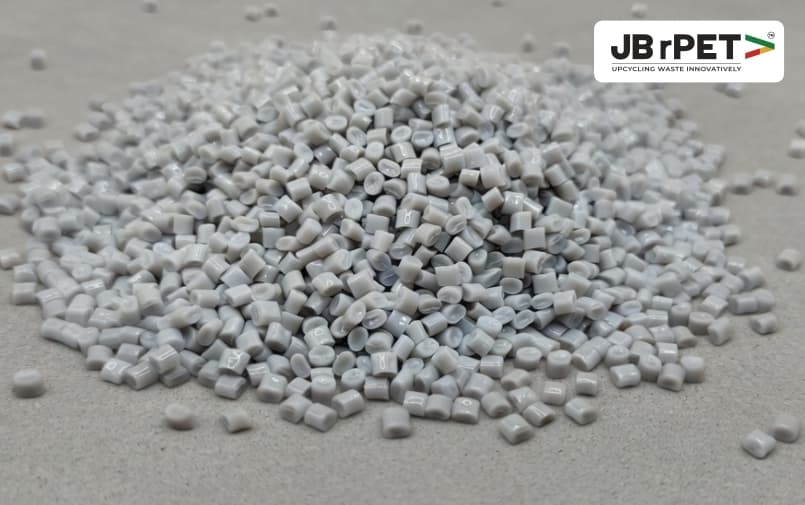
JB rPET produces chemically recycled PET resins for textile applications from post-consumer PET bottles. The process is full depolymerization and repolymerization: polymer rebuilt from monomers, IV-targeted for spinning, certified through the chain. ISCC PLUS. GRS. OEKO-TEX. FDA.
What Textile Fiber Spinning Requires from a Resin
Textile fiber spinning tolerates very little variation in raw material. A procurement manager sourcing resin for a PSF line or a POY plant is asking one question: will this run consistently on our equipment, batch after batch, without adjustment?
The answer comes down to three parameters.
Intrinsic Viscosity in the 0.60–0.65 dl/g range
Fiber spinning requires a narrow IV window. Below this range, filament tenacity suffers. Above it, melt viscosity rises beyond what the spinning equipment is set to handle. For staple fiber, POY, DTY, and filament yarn production, the target band is 0.60–0.65 dl/g. Chemical recycling allows this to be set precisely during repolymerization, rather than estimated from the feedstock going in. Our detailed guide to intrinsic viscosity in PET covers IV ranges by application, how it is tested, and what batch-to-batch variation actually costs at the spinning stage.
Clean melt with low contamination
Dye remnants, PVC traces, and oligomers present in post-consumer waste cause filament breaks and spinneret clogging. Our process uses 2–3 micron filtration after repolymerization. The melt reaching your spinning machine carries contamination levels comparable to virgin material.
Color consistency for dyeable fiber
Apparel and garment-grade fibers require consistent whiteness so downstream dyeing hits specification. We test every lot for color parameters.
Our Products
Bottle-to-Textile C-rPET
Post-consumer PET bottles are the feedstock. Bottles collected from the Indian waste stream are sorted, hot-washed, and depolymerized at our Gujarat facility. Monomers are purified, repolymerized to textile-grade IV, and chipped. PET bottles are a well-characterised waste stream with predictable polymer composition. Depolymerization removes what the bottle life cycle introduces, colorants, labels, cap resins, residual beverage contact, and rebuilds clean polymer from that base. The certified recycled content claim is bottle-origin, supported directly by GRS and ISCC PLUS documentation.
Textile-to-Textile C-rPET
Post-consumer polyester textile waste is the feedstock. Garment-stage polyester waste, collected and sorted by fiber type, enters depolymerization through a separate processing line. The same molecular breakdown and repolymerization process applies, but the recycled content claim is textile-origin.
For buyers supplying EU brands with extended producer responsibility obligations or Digital Product Passport requirements under ESPR, textile-to-textile recycled content carries a distinct value. It closes the loop within the textile system. Some brand sustainability frameworks and green claims verification programs specifically weight this pathway.
The resulting resin meets the same IV and color specifications as bottle-origin material and carries ISCC PLUS and GRS certification on the textile feedstock chain.
Which pathway suits your application?
For most PSF, POY, and filament yarn producers, resin performance is equivalent between the two grades. The choice typically comes down to what your customer or certification framework requires you to claim. Share your end-use requirement and certification need when you enquire and we will confirm grade availability and documentation.
For a full overview of where both grades are used across spinning, technical textile, and film applications, see applications of rPET by end-use segment.
Who These Resins Are Produced For
Polyester Staple Fiber (PSF) manufacturers C-rPET chips feed directly into existing melt-spinning equipment. IV control to 0.60–0.65 dl/g supports consistent denier and stable drawing without equipment reconfiguration.
POY and filament yarn producers Partially oriented yarn production is sensitive to molecular weight consistency. C-rPET repolymerized to controlled IV produces POY suitable for texturizing into DTY for apparel and home textiles. Both bottle-to-textile and textile-to-textile grades are available for this application.
Nonwoven manufacturers Technical nonwovens for automotive interiors, hygiene products, and filtration fabrics require clean, consistent polymer with predictable melt flow. C-rPET from depolymerization delivers this across both feedstock pathways.
Garment manufacturers and fabric converters sourcing certified recycled content For exporters supplying EU brands with ESPR or GRS documentation requirements, the certification trail matters as much as the resin quality. ISCC PLUS and GRS certified material provides the chain of custody that brand auditors require. Textile-to-textile grade is particularly relevant for buyers whose customers specify fiber-origin recycled content.
Masterbatch producers Masterbatch production requires a carrier resin with predictable melt behavior and low residual contamination. Grade selection and IV specifications for masterbatch applications are covered on our resinsfor PET masterbatch page.
Monofilament producers Filtration, rope, netting, and industrial textile monofilament applications require resins with specific IV and melt stability characteristics. Full specifications are available on our resinsfor PET monofilament page.
From Post-Consumer Waste to Textile-Grade Chip
JB rPET operates as a rPET manufacturer with a fully integrated chemical recycling facility in Gujarat. The process runs from waste collection through to chipped resin, with in-house testing at each stage.
Step 1 — Sorting and hot washing Bottles or textile waste are sorted by material type and processed through our in-house hot-wash line. Adhesives, labels, surface residues, and contaminants are removed before the material enters depolymerization. Hot-washed PET flakes are also available as a standalone product for buyers running their own downstream conversion.
Step 2 — Depolymerization PET polymer chains are broken down to monomer intermediates through controlled chemical processes. Color bodies, dyes, and chemical residues that are present in post-consumer feedstock are separated at this molecular stage before repolymerization begins.
Step 3 — Purification and filtration Intermediates are purified and filtered at 2–3 micron precision. This produces the clean monomer stream that feeds the polymerization plant.
Step 4 — Repolymerization with IV control Continuous polymerization rebuilds polymer chains to a target IV. For textile applications, we produce at 0.60–0.65 dl/g. Batch parameters are controlled through in-house testing on GC-MS-HS, ICP-MS, DSC, IV Bath, and Spectrophotometer equipment.
Step 5 — Chip production and QC Polymer is pelletized into uniform chips and validated against IV, color (L, a, b), moisture, and contamination specifications before dispatch. A Certificate of Analysis ships with every lot.
The full process, from depolymerization through continuous polymerization, is described in detail on our chemical recycling process page.
Certifications — What Each One Enables for Your Supply Chain
Certifications function as procurement documents. Here is what each one enables for your operation.
ISCC PLUS (International Sustainability and Carbon Certification) ISCC PLUS applies a mass balance approach to chemically recycled content. This is the certification framework accepted by European brands and required under several EU regulatory mechanisms. If your customer asks for third-party verified recycled content for ESPR compliance or brand sustainability reporting, ISCC PLUS is the relevant credential. It covers both our bottle-to-textile and textile-to-textile grades.
GRS (Global Recycled Standard) GRS provides chain of custody certification from post-consumer input through to finished product. For buyers in the textile and apparel supply chain, GRS certification means the recycled content claim is independently verified and auditable at each point in the supply chain.
OEKO-TEX Standard 100 Our material is tested against OEKO-TEX's restricted substances list. This matters for fiber going into direct-contact apparel, childrenswear, or home textiles where end-brand specifications require substrate-level safety documentation.
FDA Documentation is available on request for applicable end-use scenarios.
For buyers producing fiber-grade material destined for apparel or technical textile end-uses, our fiber-grade polyester resin page covers grade-specific parameters and application fit in detail.
Questions Buyers Ask Before Sourcing C-rPET Resin For Textiles
What is chemically recycled PET resin for textiles?
Chemically recycled PET resin for textiles is a polyester chip produced by breaking down post-consumer PET — from bottles or textile waste — into its molecular building blocks, purifying those intermediates, and repolymerizing them into fresh polymer. The resulting chip is produced to specific IV and color targets for fiber spinning applications including PSF, POY, filament yarn, DTY, and nonwovens.
What is the difference between bottle-to-textile and textile-to-textile C-rPET?
Both grades go through the same depolymerization and repolymerization process and meet the same IV and color specifications for textile spinning. The difference is feedstock origin. Bottle-to-textile uses post-consumer PET bottles as the input. Textile-to-textile uses post-consumer polyester garment waste. The feedstock origin determines the recycled content claim your downstream customer can make and which certification framework applies. JB rPET holds ISCC PLUS and GRS certification across both grades.
What intrinsic viscosity do textile-grade C-rPET chips have?
For staple fiber and filament yarn applications, the standard IV range is 0.60–0.65 dl/g. This range delivers the melt viscosity and molecular weight needed for stable spinning without placing excess load on equipment. JB rPET produces to this target through controlled repolymerization and validates every batch through in-house IV testing before dispatch. Our intrinsic viscosity guide explains how IV is measured, what affects it, and what the right range means for different spinning applications.
Which textile applications can use chemically recycled PET resin?
C-rPET chips at textile grade are used in polyester staple fiber (PSF) production, partially oriented yarn (POY), draw textured yarn (DTY), fully drawn yarn (FDY), filament yarn for apparel and home textiles, and nonwoven fabrics for technical and industrial applications. Masterbatch producers use it as a carrier resin. Monofilament producers use it for filtration and industrial textile grades. The applications of rPET page covers each end-use in detail.
Is chemically recycled PET resin accepted under EU sustainability regulations like ESPR?
ISCC PLUS certified chemically recycled PET is aligned with the mass balance methodology recognised under EU frameworks including the Ecodesign for Sustainable Products Regulation (ESPR). Brands and manufacturers sourcing material for EU market compliance need mass balance certified recycled content and an auditable chain of custody. ISCC PLUS certification from a supplier provides that documentation trail. Textile-to-textile grade is additionally relevant for buyers whose customers specify fiber-origin recycled content under the EU Green Claims Directive or Digital Product Passport requirements.
What is the minimum order quantity for textile-grade C-rPET resin from JB rPET?
Minimum order quantities and dispatch logistics are confirmed based on the specific grade, feedstock pathway, IV target, and buyer location. Indian domestic buyers and export customers can share their application details, required IV, and volume through the enquiry form and we will confirm grade availability and MOQ.
How does depolymerization remove contaminants that affect fiber quality?
During depolymerization, PET polymer chains are broken down to monomer or oligomer intermediates. At this molecular stage, contaminants present in the original waste stream — dye remnants, plasticizers, PVC traces, adhesive residues — are separated through purification and 2–3 micron filtration before repolymerization begins. The clean monomer stream this produces is what allows C-rPET to deliver spinneret performance and filament uniformity comparable to virgin material. The chemical recycling process page covers each stage in detail.
Can chemically recycled PET resins be used in garment production intended for export?
Yes. For garment exporters supplying brands in the EU or other markets with recycled content requirements, C-rPET certified under ISCC PLUS and GRS provides both the material performance and the documentation chain that brand compliance teams require. Fiber produced from C-rPET chips can carry certified recycled content claims through the supply chain, supported by the Certificate of Analysis and chain of custody records at each stage.
What quality documentation ships with each lot of C-rPET chips?
Every batch dispatched from JB rPET includes a Certificate of Analysis covering IV, color (L, a, b values), moisture content, and contamination parameters. ISCC PLUS and GRS certification documentation is available to buyers who require it for compliance or brand reporting. Technical data sheets with full resin specifications are shared at the enquiry stage.
Disclaimer: All data presented is on a consolidated basis for JB Ecotex Limited and its wholly owned subsidiary, JB RPET Industries Private Limited, as of 31 March 2026.
Request Specifications
Share your application details and we will respond with the relevant resin grade, feedstock pathway, IV range, color parameters, and minimum order information
Send Enquiry