Turning PET Bottle Waste into Fiber-Grade Polyester Resins for Circular Textile Manufacturing
The textile industry runs on polyester.
From sportswear and carpets to home furnishings and automotive fabrics, polyester has become the backbone of modern textile production. It is durable, versatile, and scalable. But it also relies heavily on virgin petrochemical feedstock.
At the same time, billions of PET bottles are produced every year for beverages and packaging. After a single use, a large portion of these bottles enter the waste stream.
This is where a new opportunity for circular manufacturing emerges.
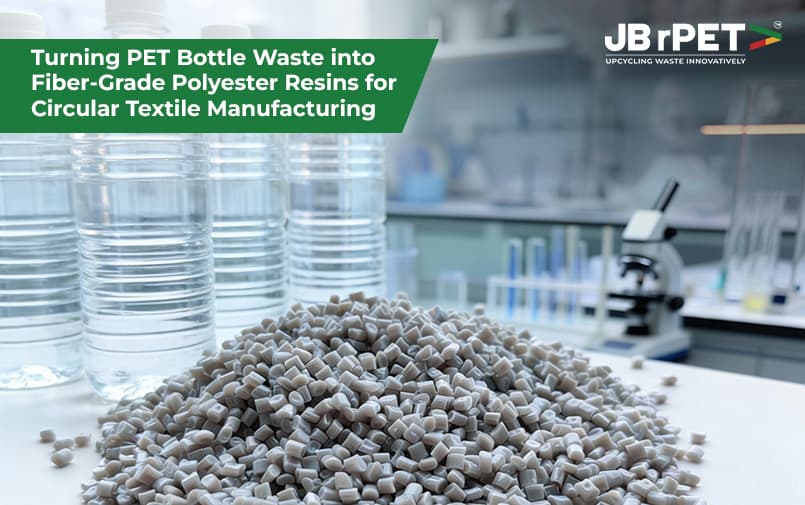
PET bottles and polyester textiles are chemically similar materials. With the right recycling technologies, discarded bottles can be converted into recycled polyester resin that can then be used to produce fiber-grade polyester for textile manufacturing.
Instead of treating plastic bottles as waste, they can become a valuable industrial feedstock for textile production.
This shift is gradually redefining how polyester is manufactured and how textile supply chains think about raw materials.
How PET Bottles Become Raw Material for Circular Textile Manufacturing
Turning plastic bottle waste into polyester fiber feedstock is now an important pathway for creating circular textile raw materials. The process connects plastic recycling with textile production and allows existing waste streams to re-enter manufacturing.
The transformation from bottle waste to textile fiber typically follows several stages:
- Collection and sorting of post-consumer PET bottles
- Cleaning and processing into PET flakes
- Conversion through mechanical or chemical recycling
- Production of high-quality recycled polyester resin
- Melt processing and spinning into polyester fibers
- Use in textile manufacturing such as yarns, fabrics, and technical textiles
Through this pathway, recycled PET for textile fibers becomes a viable alternative to virgin polyester feedstock, helping textile manufacturers integrate recycled materials into their production systems.
The Growing Demand for Recycled Polyester Resin in Textile Manufacturing
The textile sector is facing increasing pressure to rethink its material sourcing.
Brands, regulators, and consumers are now paying closer attention to how fabrics are produced and what happens to materials at the end of their life cycle. Polyester remains essential to the industry, but the traditional model of producing it from virgin petrochemicals is becoming harder to justify.
This has accelerated interest in recycled polyester resin as a replacement for virgin polyester feedstock.
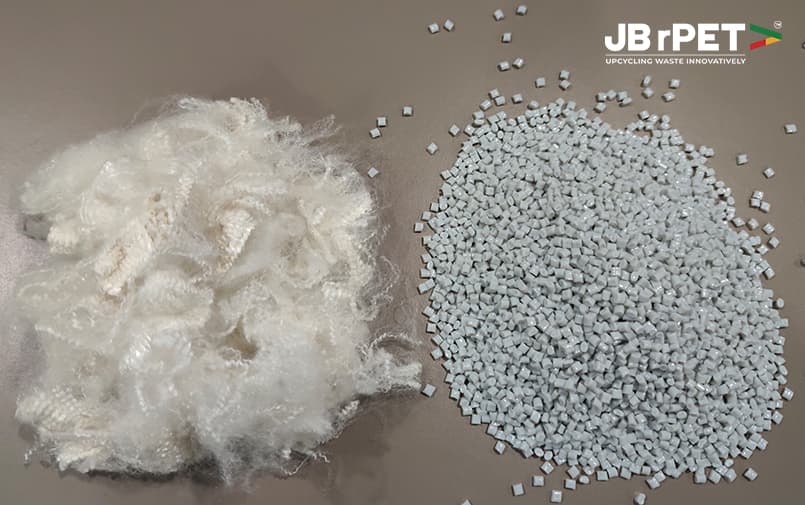
When PET bottles are recovered and processed correctly, they can be converted into high-quality polymer resins suitable for fiber spinning. These resins allow manufacturers to produce polyester yarns and fabrics while reducing dependence on fossil-based raw materials.
The concept is simple but powerful.
Instead of extracting new petroleum to produce polyester, existing plastic waste becomes the starting point for textile production.
This approach is helping the industry move toward more circular textile raw materials, where waste streams are reintegrated into manufacturing rather than discarded.
Why PET Bottles Are Suitable for Textile Recycling
Polyethylene terephthalate (PET) is widely used in beverage packaging because of its clarity, strength, and barrier properties. Interestingly, the same polymer is also used to produce polyester fibers.
This shared chemical structure allows PET bottles to be transformed into polyester suitable for textiles.
The process involves collecting, sorting, cleaning, and reprocessing bottles into polymer resins that can later be spun into fibers. Once converted, these materials become recycled PET for textile fibers, enabling the production of yarns, fabrics, and technical textiles.
However, converting bottle waste into textile-grade polymer requires precise processing. Contaminants must be removed, polymer quality must be restored, and the resulting resin must meet strict viscosity and purity standards required for fiber spinning.
Two main recycling pathways are used to achieve this: mechanical recycling and chemical recycling.
Chemical Recycling: The Next Evolution in Recycled Polyester Resin Production
Chemical recycling approaches PET waste differently from mechanical recycling.
Instead of simply melting and reshaping the polymer, chemical recycling breaks PET down into its original molecular building blocks. These building blocks can then be purified and repolymerized to produce new polyester.
This process allows manufacturers to regenerate recycled polyester resin that is chemically comparable to virgin polyester.
Chemical recycling can address several limitations of mechanical recycling.
For example:
- Contaminants can be removed at the molecular level
- Polymer quality can be fully restored
- Mixed or lower-quality waste streams can sometimes be processed
- The recycled material can be repeatedly recycled without degradation
These advantages make chemical recycling particularly valuable for producing rPET resin for fiber spinning, where polymer purity and viscosity control are critical.
Step-by-Step Process: Converting Bottles into Recycled Polyester Resin
The conversion of PET bottles into fiber-grade polymer involves a structured recycling workflow that ensures the material meets the quality requirements needed for textile manufacturing.
1. Collection and Sorting
Post-consumer PET bottles are collected from municipal waste streams and recycling systems. Advanced sorting technologies separate PET from other plastics, labels, and contaminants.
2. Flake Production
The bottles are washed and shredded into PET flakes. At this stage, impurities such as caps, adhesives, and residues are removed to improve material purity before further processing.
3. Polymer Processing
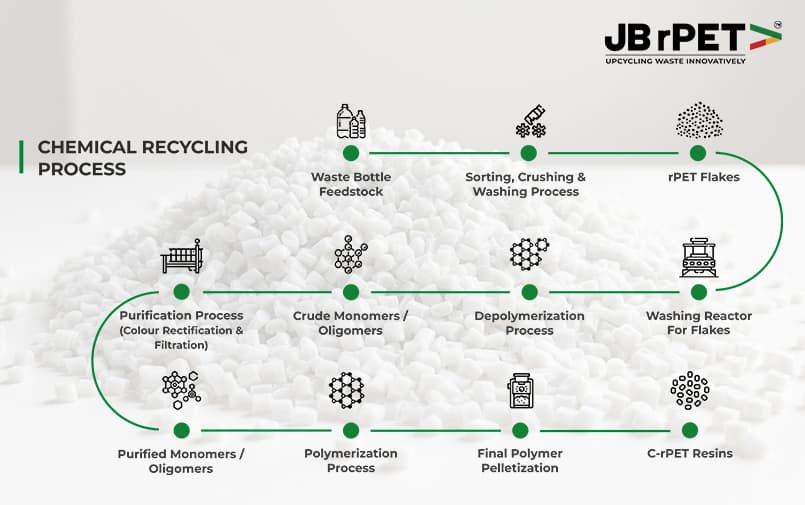
The PET flakes can then be processed through bottle to polyester resin recycling routes. Mechanical recycling melts the flakes and converts them into polymer pellets, while chemical recycling breaks the material down into its molecular building blocks for purification and repolymerization.
4. Resin Production
Once purified and polymerized, the material is converted into recycled polyester resin suitable for industrial applications. These resins are engineered to maintain the polymer consistency required for textile processing.
5. Fiber Spinning
The resin is melted and extruded through spinnerets to produce polyester filaments or staple fibers. At this stage, the material becomes rPET resin for fiber spinning, ready for textile manufacturing.
Through these steps, plastic bottles that would otherwise enter the waste stream can become valuable circular textile raw materials for polyester production.
How Chemical Recycling Converts Bottles into Fiber-Grade Resin
Chemical recycling technologies typically use depolymerization processes to break PET into monomers or intermediate compounds.
Several chemical routes exist, including:
- Glycolysis
- Methanolysis
- Hydrolysis
Each method uses specific chemical reactions to split the PET polymer chain into smaller molecules such as BHET (bis-hydroxyethyl terephthalate), dimethyl terephthalate (DMT), or terephthalic acid (TPA).
Once these intermediates are obtained, they undergo purification steps to remove contaminants and impurities.
The purified molecules are then repolymerized to form new polyester polymer chains.
The final result is high-quality polymer resin suitable for producing recycled PET for textile fibers.
This regenerated resin can be processed using conventional polyester fiber spinning systems, allowing textile manufacturers to integrate recycled feedstock into existing production infrastructure.
Because the polymer structure is rebuilt during repolymerization, chemical recycling enables sustainable polyester manufacturing without compromising fiber performance.
Why Chemical Recycling Matters for Circular Textile Manufacturing
The concept of circular textiles depends on maintaining material quality across multiple life cycles.
Mechanical recycling alone cannot always achieve this because polymer degradation accumulates over repeated cycles.
Chemical recycling provides a pathway to regenerate polyester at the molecular level.
This allows the material to be reused repeatedly in textile applications without significant quality loss.
For the textile industry, this creates the possibility of long-term circularity, where polyester garments and plastic bottles can continuously re-enter the production cycle.
As a result, chemical recycling is increasingly viewed as a key technology for enabling circular textile raw materials.
By recovering high-quality polyester from waste streams, manufacturers can produce fibers that meet the technical requirements of modern textiles while reducing dependence on virgin petrochemicals.
Quality Requirements for rPET Resin Used in Fiber Spinning
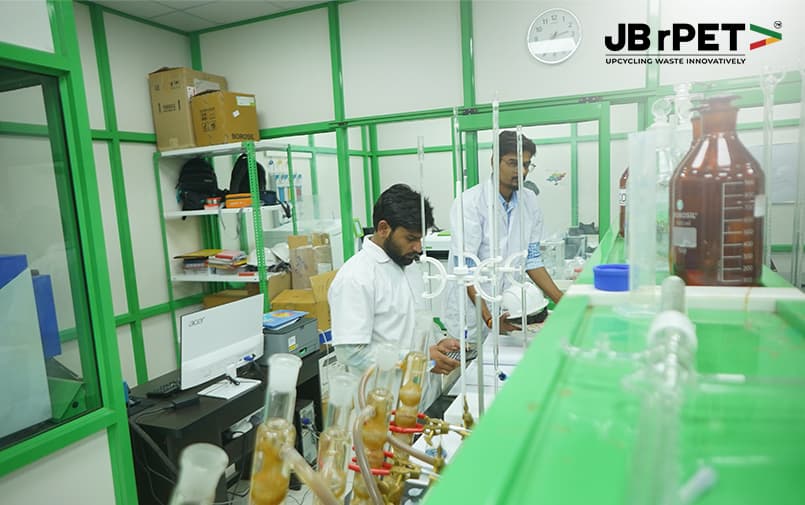
Producing polyester fibers from recycled materials requires careful control of polymer properties. Textile manufacturers rely on resin quality to ensure stable spinning performance and consistent fiber characteristics.
For rPET resin for fiber spinning, several parameters are particularly important.
Intrinsic viscosity control
Polymer viscosity influences fiber strength, spinnability, and processing
stability. Maintaining the correct intrinsic viscosity ensures that the
recycled polymer performs similarly to conventional polyester feedstock.
Contamination management
Foreign particles, dyes, or additives present in waste streams must be
removed during recycling. Proper purification is necessary to ensure that the
final resin meets textile manufacturing requirements.
Thermal stability during processing
Polyester resins used in fiber spinning must maintain stability during melting and extrusion processes. This helps prevent polymer degradation during fiber formation.
Polymer chain consistency
In chemical recycling processes, polymer chains are rebuilt during
repolymerization. This allows recycled PET for textile fibers to
maintain consistent material properties suitable for spinning.
Meeting these requirements is essential for producing recycled polyester resin that textile manufacturers can reliably process into yarns and fabrics.
Applications of Fiber-Grade Recycled Polyester Resins
Fiber-grade polyester resins produced from recycled PET can be used across a wide range of textile applications.
Some of the common uses include:
Polyester Staple Fiber Production
One of the largest applications of recycled polyester is staple fiber manufacturing. These fibers are used in apparel, home textiles, and industrial fabrics.
Using rPET resin for fiber spinning, manufacturers can produce polyester staple fibers suitable for:
- Yarn spinning
- Blended textile fabrics
- Non-woven materials
These fibers can then be incorporated into clothing, upholstery, and technical textiles.
Filament Yarn Manufacturing
Recycled polyester resins can also be used to produce filament yarns.
These yarns are widely used in:
- Sportswear and activewear
- Fashion garments
- Technical fabrics
The ability to convert bottle waste into high-performance yarns demonstrates the value of bottle to polyester resin recycling in supporting modern textile supply chains.
Technical Textile Applications
Recycled polyester fibers are also used in technical and industrial textiles.
Examples include:
- Automotive interior fabrics
- Geotextiles
- Industrial filtration fabrics
- Carpet fibers
In these applications, recycled PET for textile fibers provides durability while helping manufacturers incorporate recycled content into their products.
Non-Woven Textile Manufacturing
Non-woven textiles used in hygiene products, insulation materials, and packaging can also be produced using recycled polyester fibers.
These materials are part of the broader shift toward sustainable polyester manufacturing, where recycled raw materials replace virgin inputs wherever possible.
Supporting Textile Circularity with Advanced Recycled Polyester Resin Production
As demand for recycled materials grows, textile manufacturers increasingly require reliable sources of high-quality recycled polyester resin that can be integrated into fiber production.
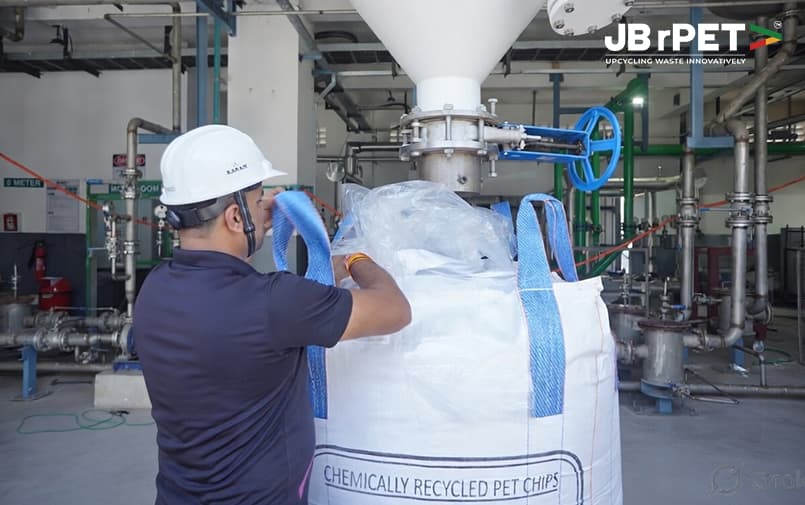
JBrPET focuses on converting PET bottle waste into fiber-grade polyester resins through advanced recycling processes designed for industrial textile applications. By processing recovered PET materials through controlled recycling systems, the resulting resins can support polyester fiber production across a variety of textile sectors.
The resulting rPET resin for fiber spinning can be used in applications such as:
- polyester staple fiber manufacturing
- filament yarn production
- nonwoven textile materials
- technical textile applications
By transforming discarded bottles into polymer feedstock for textile manufacturing, bottle to polyester resin recycling helps create a more circular supply chain where plastic waste can re-enter industrial production as circular textile raw materials.
This approach contributes to the broader shift toward sustainable polyester manufacturing, where recycled materials increasingly complement conventional polyester production.
Challenges in Scaling Circular Polyester Production
Although recycling technologies are advancing, several challenges still affect large-scale adoption.
Waste Collection and Sorting
Reliable supply of clean PET waste is essential for producing high-quality recycled polyester.
Inefficient collection systems can introduce contamination that complicates processing.
Quality Consistency
For textile manufacturers, resin quality must remain consistent across batches.
Variations in polymer viscosity or contamination levels can affect fiber spinning performance.
Technology Investment
Chemical recycling facilities require significant capital investment and specialized equipment.
Scaling these technologies requires collaboration between recycling companies, textile manufacturers, and policymakers.
Market Demand for Recycled Content
Brands and textile manufacturers must actively incorporate recycled materials into their products to create demand for recycled resins.
Without consistent demand, recycling infrastructure may struggle to scale.
Why Textile Manufacturers Are Moving Toward Circular Polyester Supply Chains
Across the global textile industry, manufacturers and brands are exploring ways to reduce reliance on virgin petrochemical feedstocks.
One approach gaining momentum is the integration of recycled PET for textile fibers into polyester production. Because PET bottles and polyester fibers share the same polymer structure, plastic packaging waste can become an important source of circular textile raw materials. Textile waste management is gaining importance as another source.
Several factors are driving this shift.
Sustainability commitments from textile brands
Many apparel and textile companies are increasing the use of recycled
materials to meet internal sustainability targets.
Growing recycling infrastructure
Advances in both mechanical and chemical recycling are making it possible
to produce higher quality recycled polyester resin suitable for textile
applications.
Circular economy initiatives
Governments and industry groups are encouraging systems where materials
remain in use for longer and waste streams are reintegrated into manufacturing.
These developments are encouraging textile manufacturers to explore sustainable polyester manufacturing models that incorporate recycled raw materials alongside conventional polyester production.
The Role of Recycled Polyester Resin in the Future of Textiles
The textile industry is at a turning point.
Polyester will continue to remain one of the most widely used fibers globally. However, how it is produced is likely to change significantly.
Recycling technologies are enabling polyester to be produced from existing waste streams rather than virgin fossil resources.
Through both mechanical and chemical processes, PET bottle waste can be transformed into high-quality recycled polyester resin suitable for fiber production.
As recycling infrastructure improves and technologies mature, these materials will become an increasingly important part of textile manufacturing.
By converting waste into circular textile raw materials, the industry can reduce environmental impact while maintaining the performance and scalability that polyester provides.
The transition toward sustainable polyester manufacturing will depend on continued innovation in recycling technologies, improved waste collection systems, and stronger collaboration across the plastic and textile value chains.
What was once considered waste is gradually becoming a valuable resource.
And for the textile industry, that shift may define the next era of polyester manufacturing.
Frequently Asked Questions About Recycled Polyester Resin
What is recycled polyester resin used for in textiles?
Recycled polyester resin is used as a raw material for producing polyester fibers, filament yarns, and nonwoven fabrics. These materials are then used in apparel, home textiles, automotive fabrics, and technical textile applications.
How are PET bottles converted into polyester fiber?
PET bottles are collected, cleaned, and processed through recycling systems that convert them into recycled polyester resin. This resin is then melted and extruded through spinnerets to produce polyester fibers.
What is bottle to polyester resin recycling?
Bottle to polyester resin recycling refers to processes that convert discarded PET bottles into polymer resins suitable for industrial use, including polyester fiber production.
Is recycled PET suitable for textile manufacturing?
Yes. When properly processed, recycled PET for textile fibers can be used to produce polyester yarns and fabrics used across many textile applications.
Why is chemical recycling important for polyester recycling?
Chemical recycling breaks PET down into its molecular components and rebuilds the polymer during repolymerization. This process can help produce high-quality rPET resin for fiber spinning suitable for textile manufacturing.