PCR rPET: What Post Consumer Recycled PET Means and How Buyers Verify It
Short answer: Post consumer recycled PET, often shortened to PCR rPET or PCR PET, is polyester made from PET products that people have already used and discarded, such as drinking water and soft drink bottles. The "post-consumer" part describes where the material came from. It tells a buyer the feedstock completed a full life in the market before it entered recycling. That origin is what separates it from pre-consumer recycled content, which comes from waste generated inside factories before a product ever reaches an end user.
The term shows up on specification sheets, sustainability reports, packaging briefs and procurement forms. It also gets used loosely. Some suppliers say "PCR" when they mean any recycled input, and some buyers treat "recycled" and "post consumer recycled" as the same thing. They describe different materials, and the difference matters for claims, certifications and compliance.
The Post-Consumer Recycled Definition, in Plain Terms
The commonly referenced definitions come from ISO 14021, the international standard on self-declared environmental claims. In summary, it describes two kinds of recycled material.
Post consumer material is material generated by households, or by commercial, industrial and institutional facilities acting as end users of a product, once that product has reached the end of its intended use. Returns of material from the distribution chain are also included.
Pre consumer material is material diverted from the waste stream during a manufacturing process. The standard excludes rework, regrind and scrap that can be reclaimed within the same process that generated it.
ISO 14021 counts only these two categories as recycled content. So a factory feeding its own trimmings straight back into the same line is carrying out good housekeeping, and that material stays outside a recycled content claim.
A few everyday examples make the distinction easier to hold on to:
- A used water bottle collected from a household bin is post consumer waste.
- A PET container discarded by an office canteen after use is also post consumer waste, because the canteen was the end user.
- Offcuts from a sheet extrusion plant sold to a separate recycler are pre consumer material.
- Edge trim that an extrusion line grinds and feeds back into its own hopper is regrind, and it falls outside recycled content.
What Is PCR Resin?
PCR resin is the processed form of post consumer material. Collected bottles and containers are sorted, cleaned and reprocessed into pellets or chips that manufacturers can run on their lines. Post consumer recycled resin, PCR PET resin and PCR rPET all describe this same family of material when the base polymer is PET.
The same logic applies across PCR plastics more broadly. A PCR material might be PET, HDPE or PP, and each polymer has its own collection streams and recycling routes. When a specification simply says "PCR," it is worth confirming the polymer, the grade and the recycling route behind it.
The short form "rPET" means recycled PET. On its own, it leaves open whether the recycled input was pre-consumer or post consumer. Adding "PCR" narrows that down. For a broader introduction to recycled PET as a material, see our guide on what recycled PET is.
Post Consumer vs Pre Consumer Recycled Content
Both categories are legitimate forms of recycled content. They serve different purposes, and each tells a buyer something different.
Where the material comes from. Post consumer PET bottles come through collection systems: households, waste pickers, aggregators, municipal systems and material recovery facilities. Pre consumer recycled content comes from manufacturing waste streams, such as off-specification production or process scrap sent to an outside recycler.
How consistent the input is. Pre-consumer material usually has a known history. It comes from a single process, often with a known grade and colour. Post consumer PET bottles arrive from many brands, many bottle designs, and many first uses. That variety is why sorting, washing and quality control carry so much weight in PCR production.
What the claim communicates. A post consumer recycled content claim tells the market that the product helped keep used items out of the waste stream after they served their purpose. Many brand owners and regulators give this category particular attention for that reason.
Terminology. Post industrial recycled plastic is another name commonly used for pre consumer material. The SCS Recycled Content Standard, for example, treats "post-industrial material" as a synonym for pre-consumer material. When a document uses "post industrial," read it as pre-consumer.
A practical point for buyers: pre consumer recycled content and post consumer recycled content should be reported separately. A single blended "recycled content" figure makes it hard to know what share came from each source.
How Post Consumer PET Bottles Become Resin
The route from a discarded bottle to usable post consumer recyclate follows a common sequence, with variations depending on the recycling technology.
Collection. Used bottles move from households and institutions through collection networks to recycling facilities. Our article on PET bottle recycling looks at how this collection chain works in India.
Inspection and sorting. Incoming bottles are checked and sorted to separate non-PET materials, coloured bottles, labels, caps and foreign contaminants.
Size reduction and washing. Sorted bottles are crushed into flakes and washed to remove adhesives, dirt and residues, then dried.
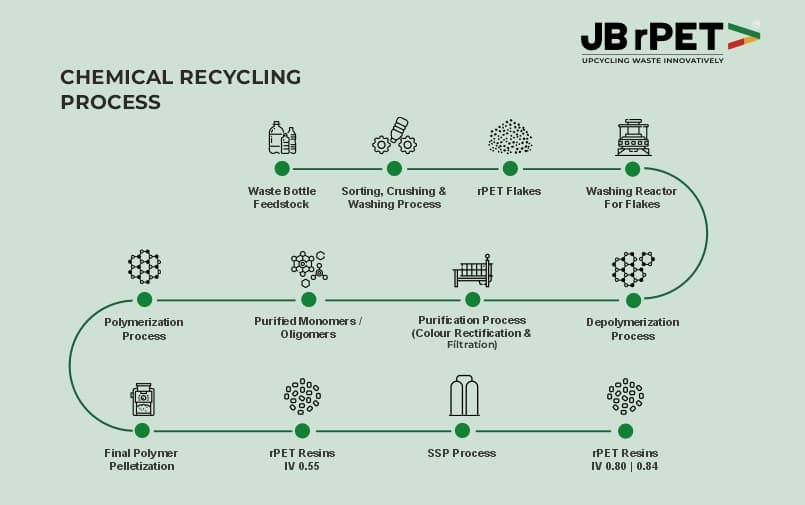
Reprocessing. Clean flakes are converted back into resin. This can happen through mechanical recycling, which remelts and reshapes the existing polymer, or through chemical recycling, which breaks the polymer down into intermediate constituents, purifies them and rebuilds the chain. Both routes can start from post consumer feedstock.
Our own chemically recycled resin line begins with 100% post-consumer PET bottles, which we procure from approved collection networks. Every incoming lot goes through quality inspection before we sort it automatically and manually, crush it, and put it through intensive hot washing and drying. We then take the resulting flakes through multi-stage depolymerization, high-precision 2 to 4 micron filtration, colour rectification, polymerization and pelletization. You can read more about each stage on our chemical recycling process page.
Why the Origin of Recycled Content Matters
A recycled content figure on its own gives only part of the picture. Knowing whether that content is post consumer or pre consumer helps in several areas of a buyer's work.
Sustainability reporting
Brands reporting on packaging or product circularity often break down recycled inputs by source. Post consumer recycled content is a common metric in these reports because it connects directly to material recovered from use. Suppliers that can document origin make this reporting simpler and more defensible.
Regulation
Some regulations specify which recycled material counts. Under the European Union's updated method for single-use PET beverage bottles, for example, only plastic derived from post-consumer waste may be counted toward recycled content targets. In India, the Plastic Waste Management (Amendment) Rules, 2026 set phased recycled content obligations for plastic packaging, with Category I rigid packaging rising from 30% in 2025–26 to 60% from 2028–29. Buyers should confirm with their compliance advisors how each applicable rule defines eligible recycled material for their product.
Product claims
Marketing language such as "made with post consumer recycled plastic" or "contains PCR content" is an environmental claim. It needs documentation behind it, including the percentage, the basis of calculation, and the source of the recycled inputs.
Material performance
Origin also affects how much processing the material needs. Post consumer feedstock varies considerably, so the recycling process has to handle that variety before the resin reaches a converter. This is where sorting discipline, washing, purification and testing show their value.
PCR Packaging and Other Applications
PCR packaging is a highly visible use of post consumer recycled PET, including bottles, containers, sheets and films. Buyers sourcing PCR resin for any packaging that contacts food or beverages should confirm the specific regulatory approvals that apply to that use with their own legal and quality teams.
Beyond packaging, post consumer recycled PET finds its way into a wide range of products. The chemically recycled PET resin we manufacture goes into textiles for filament yarns, micro-denier yarns and high-tenacity yarns for apparel manufacturing. Our customers also use it in films, sheets, strapping products, carpets, pillows and cushions, quilts and curtains, soft toys, car interiors, industrial filters, geotextiles, insulation materials, furniture and sports equipment.
For a closer look at how recycled PET performs across these segments, see our overview of rPET applications.
How Buyers Verify Post Consumer Recycled Content
A PCR claim is only as strong as the evidence behind it. When buyers come to us, we recommend building confidence through four layers of checks, and we apply the same layers to our own material.
1. Feedstock documentation
Ask the supplier where the recycled input comes from and how it is sourced. A credible answer names the type of waste, such as post consumer PET bottles, and the collection channels used. Records of incoming material and inspection support this.
2. Third-party certification
Certification schemes verify recycled content claims and track material through the supply chain. We hold ISCC PLUS, GRS and OEKO-TEX certifications. When reviewing any supplier's certificate, including ours, check the scope, the site covered, the validity dates, and the document that accompanies your specific shipment.
For more on how certification connects to different waste streams, see our article on chemical recycling certification.
3. Laboratory testing
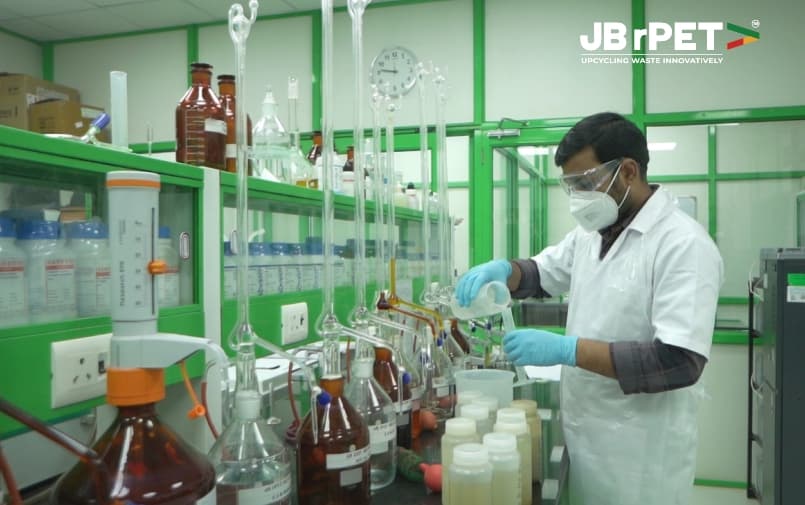
Testing confirms that a resin performs to specification and can help flag inconsistencies. We evaluate our finished products for intrinsic viscosity, colour, chemical composition, purity and process consistency. Our lab uses automated Type IV viscometry, HunterLab spectrophotometric colour analysis, PerkinElmer gas chromatography for DEG, IPA and by-product monitoring, and process-wide batch testing.
IPA testing in particular is often discussed in the context of recycled PET authenticity. Our article on IPA testing explains how it is used, and our guide on verifying recycled PET covers other checks buyers can apply.
4. Consistent paperwork across the chain
The claim on the final product should match the documentation at every step: the recycler's records, the resin supplier's certificate, the converter's records and the brand's declaration. Gaps between these documents are where recycled content claims often run into trouble.
Reading a PCR Specification Sheet
When a PCR resin specification arrives, a few lines deserve a closer read. These are the lines we suggest buyers ask every supplier for, ourselves included.
Recycled content statement. Look for a clear percentage and a clear source. "Contains recycled content" gives far less information than a statement that names post consumer PET bottles as the input and explains how the figure was calculated.
Grade and IV. Intrinsic viscosity tells you how the resin will behave in the melt and which process it suits. Fibre, filament, sheet and strapping lines each work within their own ranges. Our article on intrinsic viscosity explains how IV connects to processing.
Colour values. Post consumer PET bottles arrive in many shades, so colour data shows how well the recycling process manages that variation. Semi dull, bright and super bright grades each carry their own colour expectations.
Chemical composition. Values for DEG and IPA indicate how the polymer will behave during processing, and they form part of a consistent quality record.
Batch references. Each figure should tie back to a batch number, so results from one shipment can be compared with the next.
Certification reference. The specification or its accompanying documents should point to the certificate that covers the product, so the recycled content claim and the quality data sit together in one traceable package.
Reading these lines together gives a far clearer picture than any single figure. A buyer who asks for them early usually shortens qualification time and avoids surprises once volume orders begin.

Questions to Ask a PCR Resin Supplier
Before approving a post consumer recycled resin, we encourage buyers to put these questions to any supplier, including us:
- What is the feedstock? Confirm that the recycled input is post consumer, and ask what kinds of products it comes from.
- How is the feedstock collected and inspected? Approved collection networks and incoming inspection add confidence.
- Is any other recycled material used on the same line? If pre consumer or other processed waste also enters the line, ask how the supplier accounts for each source.
- Which recycling route is used? Mechanical and chemical recycling handle feedstock differently, so match the route to your application.
- Which certifications cover the product? Confirm scope and ask for shipment-level documentation.
- What is tested, and how often? Ask for IV, colour and chemical composition data across several recent batches.
- What grades are available? Our chemically recycled resins span an IV range of 0.60 to 1.10, across semi dull, bright, super bright, SSP bottle grade and high IV SSP grades.
Common Misunderstandings About PCR
"Recycled" and "PCR" are interchangeable. Recycled content can be pre consumer or post consumer. PCR refers only to the post consumer share.
Regrind counts as recycled content. Under ISO 14021, rework, regrind and scrap reclaimed within the same process sit outside recycled content.
Post industrial is a separate third category. In many standards, post industrial is simply another name for pre consumer.
A PCR label settles every question. A label describes origin. Buyers still need to confirm grade, performance, certification scope and regulatory suitability for their specific use.
Bringing It Togethe
Post consumer recycled PET gives used bottles a second life as raw material for textiles, packaging and industrial products. The term carries real meaning: it points to material recovered after use, and that origin shapes how the material is collected, processed, certified and claimed. For buyers, the value of a PCR specification comes from the evidence behind it, including clear feedstock records, recognised certifications, and consistent test data.
To explore our grades, visit our chemically recycled rPET resins page or get in touch with our team.
Frequently Asked Questions
What does PCR mean in plastics?
PCR stands for post consumer recycled. It describes plastic made from products that end users have already used and discarded, such as bottles and containers.
What is post consumer recycled PET?
Post consumer recycled PET is polyester made from used PET products, commonly bottles, after they have been collected, sorted, cleaned and reprocessed into resin.
What is the difference between pre consumer and post consumer recycled content?
Pre consumer recycled content comes from manufacturing waste diverted before a product reaches an end user. Post consumer recycled content comes from products that end users have already used and discarded.
Is post industrial recycled plastic the same as PCR?
Post industrial recycled plastic is generally another name for pre consumer material. PCR refers to post consumer material.
Does regrind count as recycled content?
Under ISO 14021, rework, regrind and scrap reclaimed within the same process that generated them are excluded from recycled content.
What is post consumer recyclate?
Post consumer recyclate is the recycled material, such as flakes or pellets, produced from post consumer waste.
How can buyers verify PCR content?
Buyers can review feedstock documentation, third-party certifications, laboratory test data, and consistent paperwork across the supply chain.