Why Textile Waste Recycling Fails Without Chemical Recycling of Textile
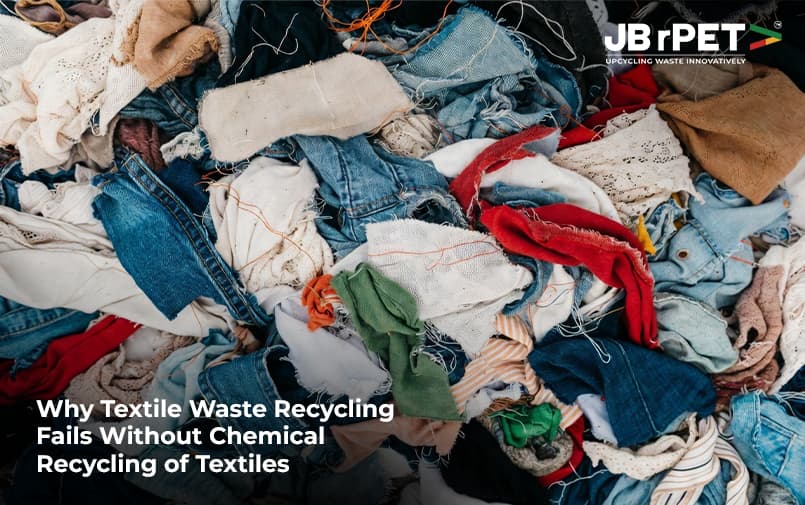
India generates roughly 7.07 million tonnes of textile waste annually. More than 70% of it is diverted through some form of recycling, upcycling, downcycling, or reuse, which sounds like a strong number until you look at what that figure actually covers. A significant share of that "recycled" material becomes industrial wipers, stuffing fibre, and low-grade fill. Very little of it goes back into textile production as a usable raw material at specification.
That gap between what gets collected and what actually re-enters supply chains as quality material is the structural problem that textile waste recycling faces. And the reason it exists comes down to the chemistry of what textiles are made from.
The Feedstock Problem That Volume Alone Cannot Solve
Post-consumer textile waste is almost never a single material. Global fibre production in 2022 broke down to roughly 54% polyester, 22% cotton, and 5% polyamide, with the remainder split across other synthetics, wool, and regenerated fibres. In finished garments, the dominant combination is polycotton: polyester and cotton interwoven at the yarn level, often with spandex (elastane) content added for stretch.
This blend structure is the core technical obstacle in textile waste recycling. The fibres are intricately entangled during fabric formation. They cannot be physically sorted from each other once a garment is made. You cannot pull polyester out of a polycotton T-shirt with any mechanical process.
What this means in practice: any recycling pathway that relies on physical processing alone can only handle garments of a single fibre composition. Single-fibre polyester, single-fibre cotton, single-fibre nylon: these can all be processed mechanically with reasonable results. But blended fabrics, which account for a significant share of post-consumer textile waste by volume, require a different approach.
Chemical recycling of textiles is the approach that can actually handle this feedstock.
What Happens Chemically When You Recycle Polyester from Textiles
Polyester in textiles is the same polymer as PET (polyethylene terephthalate) in bottles: chains of ethylene glycol and terephthalic acid units linked by ester bonds. The difference is that textile-grade polyester has been processed through spinning, weaving or knitting, dyeing, and finishing. It carries residual dyes (which include heavy metal compounds in some cases), finishing chemicals, and is structurally entangled with whatever other fibres are in the blend.
Chemical recycling breaks the polymer back to its monomer building blocks through depolymerization. For PET, the main routes are glycolysis (reaction with ethylene glycol to produce BHET; bis-hydroxyethyl terephthalate), hydrolysis (producing TPA and MEG), and methanolysis (producing DMT and MEG). Each route produces recoverable monomers that can be repolymerized into virgin-equivalent PET.
The critical difference between chemical recycling of bottle-derived PET and chemical recycling of textile-derived PET is what needs to happen before the depolymerization step. Textile PET arrives with dyes, flame retardants, UV stabilizers, and other finish chemicals that can interfere with depolymerization chemistry or contaminate the monomer output. Research published in Science Advances in 2024 found that UV-resistant and fire-resistant textile finishes negatively affected glycolysis chemistry by increasing hydrophobicity and introducing contaminants into the reaction. Pre-treatment to remove these is an active area of process development.
For polycotton specifically, the depolymerization approach needs to be selective: degrading the polyester fraction while leaving the cotton fraction intact (or vice versa), then separating and recovering both. Research groups have demonstrated this using acid hydrolysis, alkaline hydrolysis, hydrothermal treatment, and enzymatic approaches. A 2025 study in Nature Communications demonstrated a scalable acid hydrolysis process that recovered 75% molar glucose yield from cotton while leaving the polyester fraction intact for downstream processing.
Why Polycotton Blends Have Been a Dead End for Standard Recycling Elastane is worth singling out. Even at 2–4% content in a fabric, elastane interferes with recycling processes. It clogs mechanical processing equipment and is difficult to degrade in standard depolymerization conditions without affecting other components. Removing elastane from blended fabrics before processing is a pre-treatment step that adds cost and complexity. This is why post-consumer textile waste from polycotton garments ends up downgraded into non-textile uses: as insulation fill, industrial wipers, padding, or in the worst cases, landfill. The fibre value is lost. The raw material (both the polyester component and the cotton component) is not recovered into a usable form for textile manufacturing. Chemical recycling of textiles is designed to recover that value. The depolymerization of the polyester fraction produces monomers that can be repolymerized into rPET resin with properties equivalent to resin made from bottle-derived feedstock. The cotton fraction, if separated cleanly, can be regenerated into cellulosic fibre.
rPET Resin Production from Textile Waste: Where It Stands Today
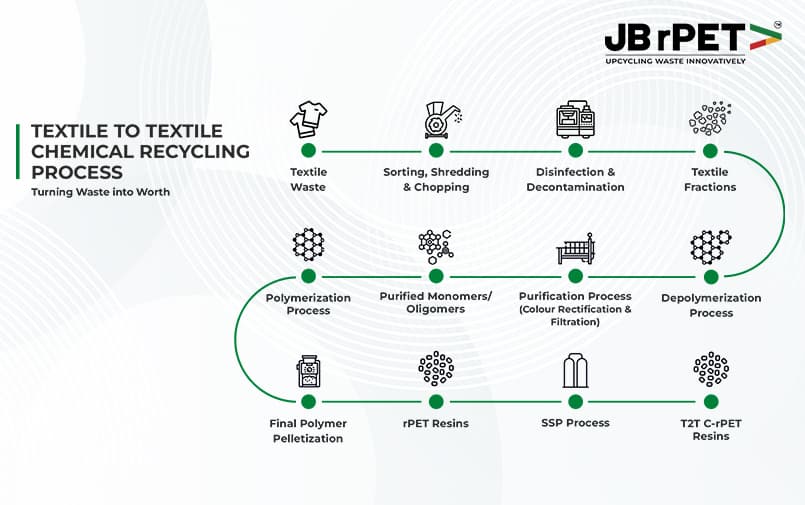
The pathway from collected textile waste to usable rPET resin for textile manufacturing runs through several steps, each of which adds cost and process complexity compared to bottle-derived feedstock.
Collection and sorting are the first constraints. Unlike PET bottles, which arrive at recyclers already sorted by material (they are a single-polymer product in a known condition), post-consumer textiles arrive as a mixed, coloured, multi-component stream. Near-infrared (NIR) spectroscopy and AI-assisted sorting technologies are improving blend identification, but the accuracy on mixed-composition garments is lower than on single-material items.
Pre-treatment (removing zips, buttons, labels, and non-textile components, and ideally separating fibre types before depolymerization) adds a labour-intensive step that does not exist in PETbottle recycling.
The depolymerization chemistry itself is established. Glycolysis, hydrolysis, and methanolysis all work on textile polyester. The challenge is running these processes economically at scale on a feedstock that is variable in dye content, blend composition, and finish chemistry.
The output from successful depolymerization is the same BHET or TPA/MEG monomers that come from bottle depolymerization. These can feed directly into the same repolymerization reactor that produces rPET resin from bottle-derived feedstock. The resin produced, if the purification steps are adequate, can meet the same IV specification and colour targets as bottle-derived C-rPET.
This is the supply chain connection that makes textile waste recycling important for rPET resin producers: as post-consumer textile collection infrastructure develops in India, it represents a second feedstock stream alongside PET bottles, feeding the same repolymerization process and producing the same certified rPET resin.
JB rPET Industries currently produces C-rPET resin from post-consumer PET bottle feedstock. The chemical recycling infrastructure and the certified chain of custody we operate is directly relevant to the textile waste feedstock pathway as that supply chain develops.
The Regulatory Timeline That Is Forcing This Issue.
The EU Ecodesign for Sustainable Products Regulation (ESPR) entered into force in July 2024. Textiles and apparel are identified as a top priority product group in the ESPR Working Plan 2025-2030. Delegated acts setting specific requirements for textiles, including mandatory recycled content requirements and design-for-recyclability standards, are scheduled for adoption in 2027. These requirements apply equally to EU-produced goods and imports, meaning Indian exporters are subject to the same rules as European manufacturers.
The Digital Product Passport (DPP) for textiles, which will require machine-readable data on recycled content, fibre composition, and end-of-life handling, is expected to be required for garments sold in the EU from around 2027. A garment cannot have a valid DPP with a recycled content claim unless the recycled content is traceable through a certified chain of custody back to verified recycled feedstock.
There is a specific point worth noting from the ESPR framework: the regulation distinguishes between rPET from plastic bottles and fibre-to-fibre recycled content. For textile applications sold into the EU market, the expectation is that recycled content certification traces to textile-origin feedstock over time, not exclusively bottle-derived material. This is the regulatory signal that is driving investment in textile-to-textile chemical recycling infrastructure globally.
The EU Green Claims Directive, currently in final legislative stages, will require that any environmental claim made in marketing, including "made from recycled polyester", is backed by third-party verified certification. ISCC PLUS and GRS are the certification frameworks that meet this requirement. Without certified rPET resin input, the downstream claim does not hold.
For Indian textile exporters, the practical question is: which of your raw material inputs carry certification today, and what is the plan for inputs that do not?
What "Sustainable Textile Recycling" Actually Requires at the Supply Chain Level
The language of sustainable textile recycling is used loosely. What it requires in practice, for a manufacturer who needs to substantiate a recycled content claim that survives brand audit and EU regulatory scrutiny, is specific.
The raw material input, whether rPET resin, recycled polyester staple fibre, or recycled polyester filament, must come from a supplier with ISCC PLUS or GRS certification that covers the full chain of custody from the waste input through to the resin or fibre output.
For bottle-derived rPET, this chain of custody is well-established. Certified bottle collection, certified flake processing, certified repolymerization, certified resin output. JB rPET Industries operates this full certified chain for C-rPET resin.
For textile-derived rPET, the same chain of custody structure needs to exist, but the collection and sorting steps are complex because the waste stream is variable.
This is the gap that creates the current dependency on bottle-derived rPET as the primary source of certified recycled polyester resin for the Indian textile industry. It is not a permanent state: as post-consumer textile collection infrastructure and chemical recycling capacity for textile waste develops, the feedstock base for rPET resin production will broaden. But the chemistry, the certification infrastructure, and the supply chain discipline required for textile waste to become a usable rPET resin feedstock are all prerequisites that take time to build.
The Practical Takeaway for Textile Manufacturers
If you are a spinning mill, yarn manufacturer, or fabric producer with EU export exposure, the question of how your recycled polyester input is sourced and certified is no longer a marketing department question. It is a supply chain compliance question.
The EU ESPR Delegated Acts for textiles are due in 2027. The Digital Product Passport requirement for textiles follows shortly after. The Green Claims Directive enforcement timeline means that unsubstantiated recycled content claims in EU-market products carry legal risk, not just reputational risk.
The certified rPET resin that meets these requirements today comes from chemically recycled post-consumer PET bottles. That is the available supply of certified, virgin-equivalent recycled polyester resin at the IV specifications that textile extrusion processes require.
JB rPET Industries produces C-rPET resin with ISCC PLUS, GRS, OEKO-TEX, and FDA certifications from our Gujarat facility. For grade specifications, IV targets, and supply terms, contact us through jbrpet.in.