How to Choose the Right PET Resin Suppliers for Your Manufacturing Needs
Most PET resin qualification cycles fail in the same place. The spec sheet looks fine, the certification PDFs check out, the first sample runs through the line without obvious trouble. Three months in, a batch comes through with IV variance the spinning team can feel by the second shift, or a brand customer in Europe asks for a Transaction Certificate the supplier turns out to be slow at producing. The relationship survives or breaks based on what was missed during qualification, rarely on what was negotiated on price.
Choosing between PET resin suppliers is not just about finding the cheapest credible quote and also about pressure-testing the supplier against the failure modes that surface six months later. The chemistry of the resin, the depth of the certification scope, the discipline of the QC documentation, and the commercial mechanics all sit inside that question.
The sections below cover what to actually inspect when evaluating PET resin suppliers, with focus on chemically recycled rPET as one of the fastest-growing segment of the supply base and the one where supplier capability varies the widest.
What a "PET Resin Supplier" Actually Delivers In 2026
The phrase "PET resin supplier" covers three distinct production routes, and the differences matter to the buyer.
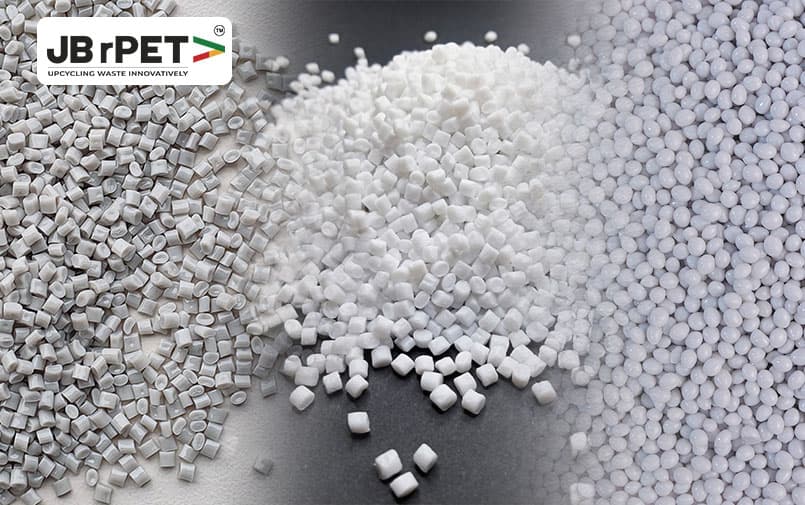
Virgin PET resin is produced from petrochemical feedstock through polycondensation of purified terephthalic acid and monoethylene glycol. Mechanically recycled PET resin is produced by washing, sorting, melting, and re-extruding post-consumer PET flakes into pellets. Chemically recycled PET resin is produced by breaking PET waste into its monomers through solvolysis routes, purifying those monomers, and repolymerizing them into new resin. PET can be chemically recycled into its original raw materials, destroying the polymer structure completely, or mechanically recycled into a different form without destroying the polymer. A detailed walkthrough of the solvolysis routes and what each recovers sits in this overview of the chemical recycling process.
Each route produces a polymer that performs differently in downstream conversion. A monofilament producer drawing fine deniers needs tight intrinsic viscosity control and very low contamination. A POY spinner running fiber-grade chip can tolerate a different specification window. A packaging converter making PET strap or sheet has its own IV target. When you evaluate PET resin suppliers, the first question is whether the producer can hold your specification consistently across batches, regardless of which production route they operate.
The Chemistry Behind the Spec Sheet
The single most important parameter on a PET chip spec sheet is intrinsic viscosity. Buyers familiar with the polymer treat it as the gating number before anything else gets reviewed.
Intrinsic viscosity measures the average molecular weight of the polymer chains.
Two implications follow for the buyer evaluating PET resin suppliers. First, the intrinsic viscosity of PET polymer needs to match the application, and the supplier should be able to hold the specified range with low batch-to-batch variation. Second, the supplier should run IV measurement on every batch with documentation available before shipment. A PET resin producer unable to share its IV testing protocol or recent batch data is a procurement risk regardless of price.
Which Grade for Which Application
Procurement teams often receive a spec sheet with an IV range but no guidance on whether that range actually fits their line. The translation from polymer grade to process requirement:
PSF (Polyester Staple Fiber): Fiber-grade IV in the 0.54–0.64 dL/g range. Colour consistency and low DEG are the primary quality drivers alongside IV. Batch-to-batch colour variation shows up directly in the dyed fabric:
POY and FDY filament: Textile-grade IV typically 0.62–0.68 dL/g. Melt viscosity stability across a production run matters more than a single IV reading. Ask for the standard deviation across batches, not just the mean.
PET strap: Higher IV in the 0.80–0.95 dL/g range to support the tensile strength demands of industrial strapping. Contamination tolerance is lower here than in fiber because inclusions create stress concentration points in the drawn strap.
Masterbatch carriers: Lower IV grades are generally workable but the resin needs to be spectrally clean. Residual colour or haze in the base resin will shift the final masterbatch colour unpredictably.
Monofilament: IV of 1.00 dL/g and above. This is the tightest IV window in the table, and suppliers able to hold it consistently across batches are fewer. In-house SSP (solid-state polymerization) capability at the supplier's plant is a prerequisite for this grade.
BOPET film: IV typically 0.62–0.72 dL/g, with acetaldehyde control being equally important as IV for film-grade applications.
The intrinsic viscosity page covers how IV is measured and how it correlates to molecular weight and downstream processability across these grades.
What Chemically Recycled PET Resin Adds to The Supplier Conversation
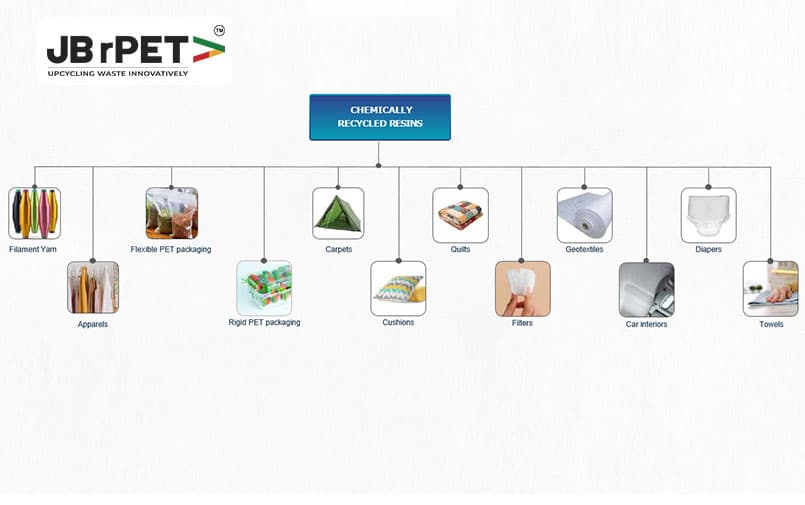
The growth of chemically recycled resin as a category reflects a specific capability rather than a positioning claim. Chemical PET recycling depolymerizes the polymer back to its constituent monomers through solvolysis, which can then be purified and repolymerized. Various chemical recycling methods have been demonstrated, including glycolysis, hydrolysis, methanolysis, and ammonolysis. Alcoholysis is a process that utilizes alcohol as a solvent to depolymerize PET into monomer.
The molecular-level reset that defines chemical PET recycling has consequences for what kind of feedstock the process can handle and what kind of output it can produce. Because the polymer is broken all the way down to monomers and purified at that stage, contaminants introduced by the feedstock can be removed before repolymerization begins. This widens the feedstock pool that a chemical recycler can work with. Difficult-to-recycle PET waste streams, including multilayer trays, coloured bottles, and post-consumer textiles, have been evaluated, with PET conversion rates of 91.3–97.1% documented across solvolysis processes.
The practical implication for buyers: chemical PET recycling creates supply pathways that extend the raw material loop beyond what clean, sorted bottle flake alone can support. This is what enables routes like textile-to-textile recycling at scale. JB rPET's positioning of bottle-to-resins and textile-to-resins supply lines reflects this feedstock range.
The output side also matters. Because the polymer is rebuilt from purified monomers, chemically recycled PET resin can reach IV and purity levels suited to high-performance applications including fiber spinning, BOPET film, and food-contact packaging. The chemistry gives the resin producer greater control over the final specification than a re-melt process allows. The chemical vs mechanical recycling decision for a procurement team therefore turns on what feedstock streams the buyer wants to source from, what specification window the downstream process requires, and what certification claims the brand or export market demands.
Both recycling routes serve distinct and legitimate roles in the rPET supply chain. Mechanical recycling continues to handle large volumes of clean PET bottles efficiently and forms the backbone of most rPET markets globally. Chemical recycling extends that system by bringing difficult feedstocks back into the polymer loop. A discussion of how the two routes work together appears in the JB rPET piece on advanced environmental recycling and in this overview of rPET pellets and chemical recycling.
Production Capability You Can Verify
A certification scope tells you what the supplier is authorized to claim. Production capability tells you whether they can actually deliver against your order book. The two need to match.
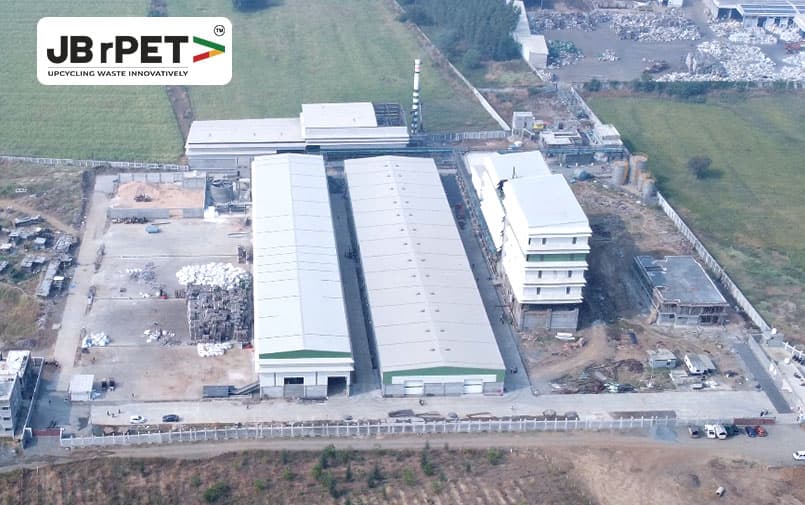
A chemically recycled rPET producer of meaningful scale operates a continuous depolymerization-purification-repolymerization line with in-house feedstock processing, monomer purification, and polycondensation. The integration matters because each handover point between operators is a point where contamination, IV variation, or documentation gaps can creep in. JB rPET's facility in Surat, Gujarat, runs an 80 metric-tonnes-per-day production line, with the entire process managed in-house from feedstock washing through to pelletization.
Equipment to inspect or ask about during qualification: the feedstock washing and sorting line, since contamination at this stage carries forward into the resin; the depolymerization reactor and the catalyst system used, which determines monomer purity and process control; monomer purification capacity, especially for the terephthalic acid and ethylene glycol recovery; continuous polycondensation reactors with IV management capability; crystallization and solid-state polymerization (SSP) where bottle-grade IV is required; and pelletization, drying, and packaging lines that protect resin moisture content during shipment.
In-house testing infrastructure is a second pillar to verify. Advanced testing methods including GC-MS-HS, ICP-MS, DSC, and IV measurement systems should be present. Each batch should undergo detailed testing for colour, AA levels, moisture content, and intrinsic viscosity. A PET resin producer sending samples to third-party labs for every routine parameter is operating on a longer feedback loop than one running the full panel internally, and that delay becomes your delay when a batch needs to be cleared for a tight delivery window.
Process control documentation is the third pillar. SOPs, batch traceability records, deviation logs, and CAPA records exist in serious operations and can be reviewed during a plant audit. Their absence is itself information.
Quality Control Documentation That Should Accompany Every Shipment
A credible PET resin supplier delivers more than a bag of chip with a packing list. The shipment-level documentation defines what the buyer can claim, what the buyer can audit, and what recourse the buyer has if downstream conversion fails.
Every shipment should come with a verification of analysis, batch test reports, and material safety data sheets. Technical specs including IV, color, heavy metals, and contamination profiles should be provided up front for client assurance.
The trace data behind these documents matters. A buyer making a recycled content claim downstream needs to be able to prove the chain back to certified feedstock if challenged by an auditor or a brand customer. The supplier's ability to produce the underlying records on request is part of what you are buying. The JB rPET overview of the chemical recycled rPET resins range covers what documentation accompanies each product grade.
Commercial and Operational Fit
Technical qualification establishes whether a supplier can produce what you need. Commercial and operational fit determines whether they can do it on the terms your business runs on.
The questions that separate suppliers at this stage: capacity reservation against your annual offtake, since a supplier running near full capacity may struggle to scale with a growing customer; lead time consistency, which depends on feedstock availability for chemically recycled producers; specification flexibility, given that orders often deviate from stock grades, and a supplier able to adjust IV or colour targets to your process is more valuable than one shipping a fixed grade; sample availability and the speed of the technical service conversation when a downstream issue emerges; logistics from plant to port to factory, with resin protected from moisture throughout; payment terms, currency, and Incoterms that match how your finance team operates; and minimum order quantities alongside batch size economics.
For buyers sourcing PET resin manufacturers in india for domestic conversion or for export-bound finished goods, geographical fit matters. Surat and the broader Gujarat region carry a concentration of polyester, textile, and packaging capacity. That concentration reduces inbound freight time and supports faster technical iteration when a specification adjustment is needed. Local PSF, POY, and packaging clusters mean that PET resin manufacturers in india serving these industries can move samples and small trial quantities quickly compared with overseas supply.
The Indian Supplier Landscape
The domestic supply base for PET resin producers in India is mixed. Virgin PET producers operate alongside mechanical recyclers of varying scale, a growing set of chemical recyclers, and the trading layer that moves both Indian and imported resin into the converting market.
Discovery happens through several channels. B2B marketplaces dominate initial discovery for many buyers, though the depth of technical and certification information available on those platforms is uneven. Direct supplier websites carry more substantive specification and certification content where the supplier has invested in digital presence. Industry bodies, trade shows, and personal networks remain important for shortlisting before any RFQ goes out.
When a buyer specifically wants recycled PET resin with chemical-recycling credentials, the shortlist of PET resin manufacturers in india narrows considerably. The capital intensity of a depolymerization-repolymerization line, the certification investment required, and the technical complexity of running monomer purification at scale mean that only a handful of operators run integrated chemical recycling capacity domestically.
PET flakes feed the chemical recycling process as one of the main input streams, and flake quality shapes the consistency of the final resin across every batch. The role of rPET flakes in feeding the depolymerization line is one of the upstream variables worth asking about during plant qualification, since a supplier with tight control over incoming flake quality has one fewer source of downstream variation to manage.
What Drives Recycled PET Resin Pricing
Buyers comparing quotes across PET resin suppliers without understanding the cost structure will optimize for the wrong variable. Recycled PET resin pricing is driven by several factors that vary by supplier type and production route.
Feedstock collection and sorting cost. Post-consumer PET bottles and textile waste must be collected, sorted, and cleaned before entering the recycling process. The cost and quality of this upstream work varies considerably by geography and supplier infrastructure. A producer with an integrated feedstock collection and washing line has a different cost base than one buying open-market flake.
Recycling route. Chemical recycling carries higher process costs than mechanical recycling due to reactor capital, monomer purification steps, and energy input. This is reflected in the per-kilogram price of chemically recycled rPET relative to mechanically recycled material. The specification and certification advantages of chemically recycled resin justify this difference for buyers in regulated or high-performance segments.
IV grade. Higher IV grades require longer polycondensation time or solid-state polymerization steps. Monofilament and strap-grade resin costs more to produce than standard fiber-grade chip from the same feedstock.
Volume and tenure. Spot purchases of small quantities carry a premium over annual offtake agreements. Buyers who can commit to quarterly or annual volumes with defined specifications will access more competitive pricing and more reliable capacity allocation.
Currency and logistics. For Indian buyers sourcing from Gujarat-based PET resin manufacturers in india, domestic logistics costs and currency exposure are substantially lower than for imported resin. This narrows the effective price gap between Indian chemically recycled rPET and imported alternatives.
A Practical Evaluation Framework For Procurement Teams
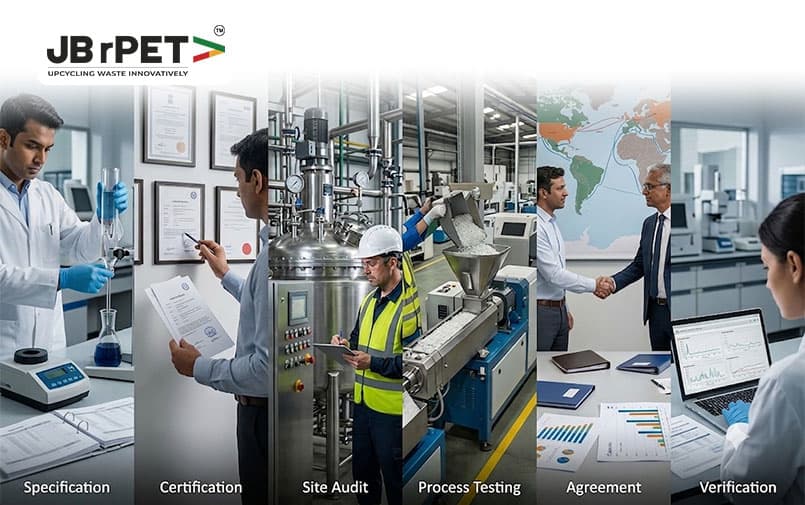
Procurement managers running a structured supplier selection process for PET resin suppliers can compress the considerations above into a working framework.
Step one: technical specification. Define your target IV, colour values, AA limit, moisture, DEG, and heavy metals thresholds before any supplier conversation begins. Match these to your downstream process. A spinning mill running fine deniers has different tolerances than a packaging converter producing PET strap.
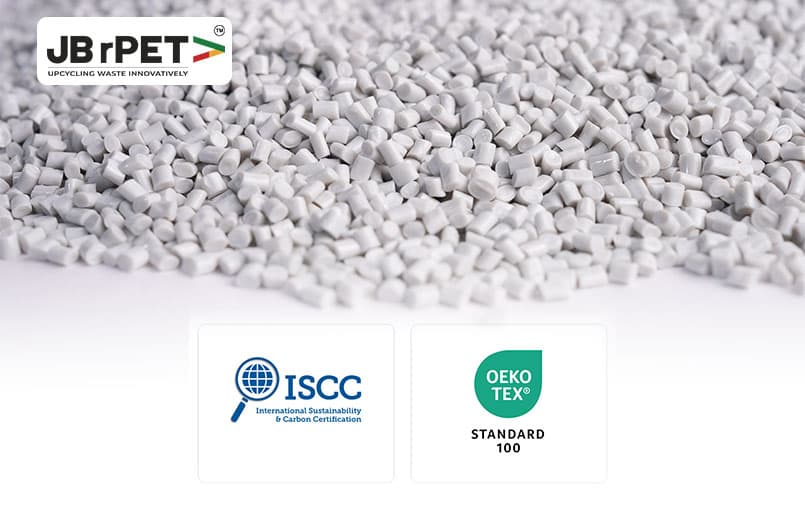
Step two: certification scope. Identify which certifications your end market demands. EU brand customers will require ISCC PLUS with valid Transaction Certificates. Indian domestic customers may have lighter certification requirements but increasingly ask for traceability documentation when their own brand customers audit them.
Step three: plant qualification. Request a plant visit. Ask to see the depolymerization line, the monomer purification section, the polycondensation reactors, and the in-house testing lab. Review batch records, deviation logs, and recent customer trial reports. Verify in-house IV, AA, and contaminant testing capability.
Step four: sample qualification. Run trial quantities through your actual conversion process before committing volume. Pay attention to spinning continuity, dye uptake, melt stability, and defect rate change against your incumbent supply. The chemical vs mechanical recycling choice often resolves itself at this stage based on what your process actually accepts.
Step five: commercial alignment. Capacity, lead time, payment terms, MOQ, and logistics need to fit your operational model. A technically sound supplier with misaligned commercial terms fails as a workable procurement relationship.
Step six: documentation pack. Confirm the supplier will deliver a COA, MSDS, sustainability declaration, Transaction Certificate where applicable, and food contact documentation where relevant, with every shipment.
Step seven: audit trail mechanics. Establish before the first PO how you will verify ongoing certificate status, how you will track batch-level variation against the agreed specification, and how the supplier handles deviations, complaints, and CAPA workflows.
What The Buyer Is Actually Choosing Between
Stripped to essentials, the question of how to choose between PET resin suppliers comes down to three trade-offs the buyer has to make explicit.
The first is feedstock origin versus specification window. A virgin PET resin producer will hit any specification at premium pricing. A mechanically recycled supplier delivers competitive economics for clean bottle-stream feedstock at standard textile and packaging grades. A chemically recycled rPET producer can serve high-purity specifications and difficult feedstock streams, with the trade-off of process complexity and capacity constraints in a still-expanding segment.
The second is certification depth versus cost. Each additional certification a supplier holds raises their compliance overhead, which shows up in pricing. Buyers without an ISCC PLUS requirement can source from lower-overhead suppliers. Buyers serving EU brands or food-contact packaging will pay for certification depth because their end customers require it.
The third is integration versus flexibility. An integrated PET resin producer running the full chain from feedstock to pellet inside one facility delivers consistency and traceability at scale. A trader-led supply arrangement may offer commercial flexibility but adds a layer between the buyer and the production process. For procurement teams that need to audit and qualify their supply chain end-to-end, integration tends to win.
The supplier that fits will produce recycled PET resin at the IV and purity your conversion process accepts, carry the certifications your end market demands, run process control discipline you can verify on site, deliver the documentation pack with every shipment, and operate on commercial terms that match how your business runs. Working through the framework above with a shortlist of three or four candidates will surface the right answer for any given application.
Frequently Asked Questions
What is chemically recycled PET resin?
Chemically recycled PET resin is polyethylene terephthalate produced by depolymerizing post-consumer PET waste down to its base monomers through solvolysis processes, purifying those monomers to remove contaminants, and repolymerizing them into new resin. Chemical recycling completely depolymerizes PET into its base molecules, allowing removal of all contaminants, whereas mechanical recycling physically processes the plastic. The result is a polymer rebuilt from the ground up rather than re-melted from existing chains, which allows chemically recycled PET resin to reach purity levels suited to fiber spinning, food packaging, and other high-performance applications. JB rPET produces chemically recycled rPET resins across bottle-to-textile, bottle-to-bottle, and textile-to-textile supply lines
What is the difference between chemical and mechanical recycling of PET?
Mechanical recycling washes, sorts, and re-melts post-consumer PET flakes into pellets. It is efficient for clean, well-sorted feedstocks and handles large volumes of post-consumer bottle material. Chemical recycling breaks the polymer all the way down to monomers through a solvolysis process, purifies those monomers, and rebuilds the polymer through repolymerization. The chemical vs mechanical recycling distinction matters to buyers because chemically recycled resin can be produced from a wider range of feedstocks, including coloured bottles and post-consumer textile waste, and can reach purity specifications comparable to virgin resin. Both routes contribute to PET circularity and serve different segments of the supply chain. The bottle to resins pathway at JB rPET is one application of chemical recycling at industrial scale
What intrinsic viscosity of PET polymer should I specify for my application?
The right IV specification depends entirely on the downstream application. Fiber grade PET runs at 0.40–0.70 dL/g, textile grade at 0.72–0.98, film grade at 0.60–0.70, bottle grade for flat water at 0.70–0.78, carbonated soft drink grade at 0.78–0.85, and monofilament and engineering plastic grades at 1.00 and above. The intrinsic viscosity page on the JB rPET site covers how IV is measured and how specification windows translate to downstream processing behaviour. When evaluating a PET resin supplier, confirm they can hold your target IV range with low batch-to-batch variance and share IV data at the batch level with every shipment.
How do I evaluate PET resin manufacturers in India for chemically recycled resin specifically?
Start with process verification. A genuine chemically recycled rPET producer operates a full depolymerization-purification-repolymerization line, with in-house feedstock processing and in-house testing. Ask to visit the plant and review the depolymerization section, the monomer purification stage, and the in-house testing lab. Confirm IV, colour, AA, and heavy metals are tested internally on every batch. Then verify the certification stack: ISCC PLUS and OEKO-TEX at minimum for textile or packaging buyers with EU exposure. Request sample material and run it through your actual conversion process before committing to volume. PET resin manufacturers in india with genuine chemical recycling capacity are a shorter list than the total rPET supplier market, which makes the qualification more manageable.
What is the role of rPET flakes in chemically recycled resin production?
rPET flakes are the primary feedstock for the chemical recycling process. Post-consumer PET bottles are collected, sorted, and processed into hot-washed flakes before entering the depolymerization line. The quality of those flakes, in terms of contamination level, colour, and moisture, directly affects the purity of the monomers recovered and, downstream, the consistency of the resin produced. A supplier with tight control over incoming flake quality has fewer sources of variation in the final product. The role of rPET flakes in the production chain is one of the first upstream variables worth asking about when qualifying a chemically recycled rPET producer.
What documentation should accompany each shipment of recycled PET resin?
Every shipment from a credible PET resin producer should include a Certificate of Analysis with batch-specific IV, colour values, acetaldehyde, moisture, melting point, ash, and DEG content. A Material Safety Data Sheet, a sustainability declaration for ISCC PLUS certified material, a Transaction Certificate for certified material, and food contact compliance documentation where applicable should also accompany the shipment. Technical specs including IV, color, heavy metals, and contamination profiles should be provided up front for client assurance, with batch test reports and MSDS included as standard. Buyers making recycled content claims downstream will need this documentation trail to hold up under brand customer audits.
Can chemically recycled PET resin be used for textile fiber spinning?
It can, and textile fiber is one of the primary application areas for chemically recycled rPET. The resin is produced to fiber-grade or textile-grade IV specifications depending on the application, and the purity achievable through monomer-level purification makes it suitable for fine-denier spinning where contaminant sensitivity is high. JB rPET produces resin for fiber spinning applications across both the bottle-to-resins and textile-to-resins supply chains. The fiber grade polyester resins page covers the specification parameters relevant to spinning mills evaluating the material.