Chemical Recycling of Contaminated PET: Can Labels, Dyes, Adhesives and Mixed Waste Be Recovered?
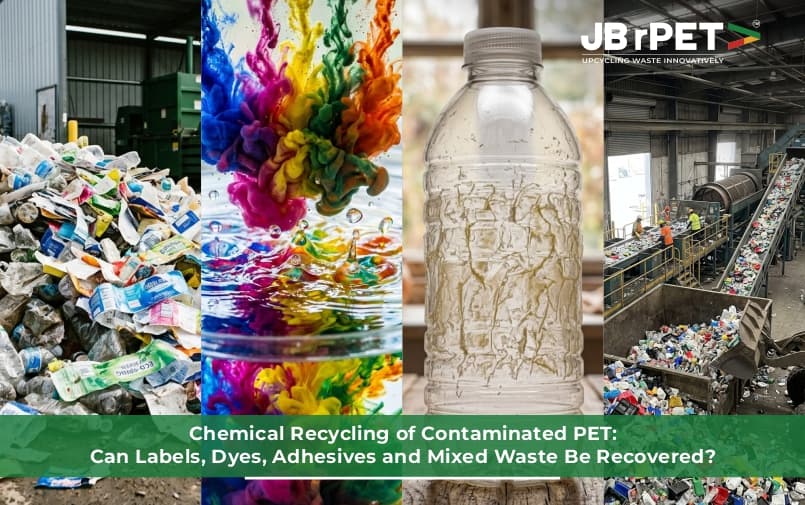
Short answer: In contaminated PET recycling, the PET is the material that gets recovered. Labels, adhesives, dyes and mixed non-PET waste are separated and removed at different stages of the process so that the polymer can return as resin. Some contaminants leave at sorting, some leave during washing, and the ones that sit inside the polymer itself are addressed during depolymerization, filtration and colour rectification. Chemical recycling works on PET. It depends on good upstream separation to do that work well.
People who ask about contamination usually want one of two things. Some want to know whether a bottle with a sleeve, a glued label or a tinted body still has value. Others want to know whether a recycled resin made from that bottle will run cleanly on their spinning line, film line or strapping line. Both questions lead to the same place: the path each contaminant takes through the plant.
What Counts as Contamination in PET Waste?
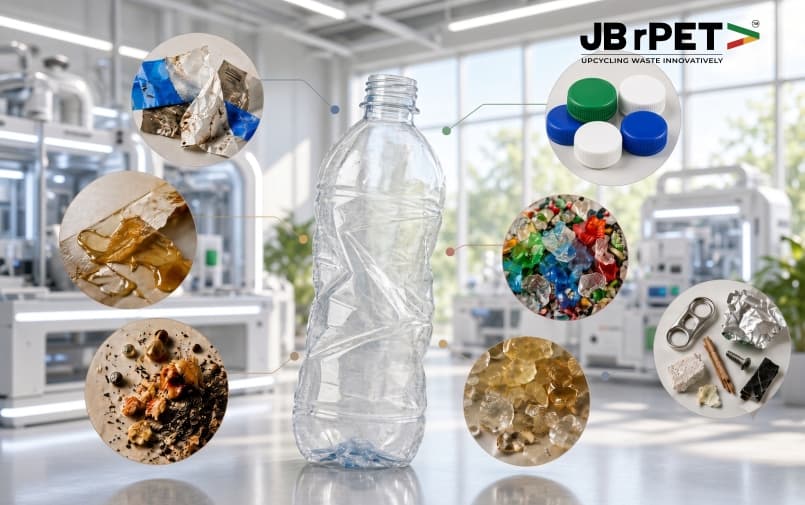
Anything in the feedstock other than the PET polymer is contamination from a recycler's point of view. On a typical intake of post-consumer bottles, that list includes:
- Labels and sleeves made from paper, polypropylene, PVC or PETG films
- Caps and closures, usually polyolefins such as HDPE or PP
- Adhesives that hold labels in place, often hot-melt or pressure-sensitive formulations
- Colourants and dyes in tinted bottles, plus colour bodies that form as the polymer ages or is reheated
- Food and beverage residue, dirt, sand and moisture
- Degradation products that build up in the polymer during its first life.
- Foreign materials such as metal, glass, other plastics and mixed municipal waste
The useful way to think about recycled PET contamination is by location. Surface contaminants sit on the outside of the material. Physical contaminants are separate objects mixed in with the bottles. Embedded contaminants sit inside the polymer matrix. Each group needs a different removal method, and a recycling plant is really a sequence of methods arranged in the right order.
For background on how bottles move from collection points to recycling units, our overview of PET bottle recycling covers the collection side in detail.
Why Contamination Matters So Much for Recycled PET
PET is sensitive to foreign material during melt processing. Small quantities of the wrong polymer or residue can show up downstream as haze, specks, colour shift, filter clogging or breaks in filament spinning. A converter running fine-denier yarn or thin film feels these effects quickly.
Contamination also affects intrinsic viscosity (IV). IV reflects the average chain length of the polymer, and chain length governs how the resin behaves in the melt. Moisture and certain residues can shorten chains during reheating. When IV drifts, a converter has to keep adjusting process settings, and that costs time and output.
This is why the conversation around contaminated PET flakes is really a conversation about consistency. What buyers want to know is whether the finished resin arrives with stable, measurable properties batch after batch.
Stage One: Sorting Removes the Physical Contaminants
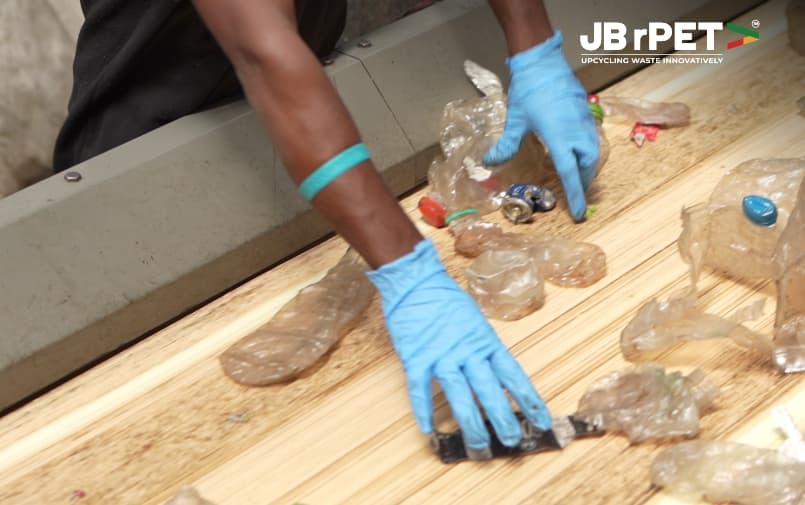
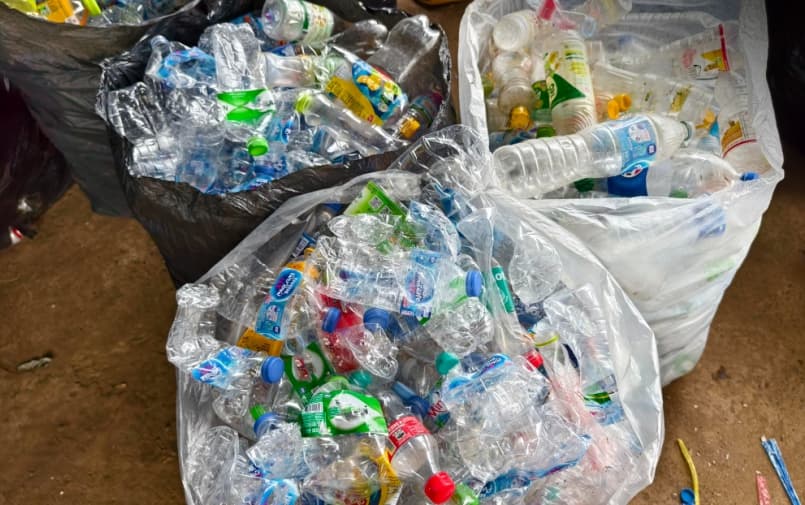
The first and most important defence is separation before anything is melted or reacted. At our facility, collected post-consumer bottles go through automatic and manual sorting to remove non-PET materials, coloured bottles, labels, caps and foreign contaminants. Only then are the bottles crushed into flakes of uniform size.
Sorting matters for a simple reason. Chemical recycling of PET is designed around the chemistry of PET. Polyolefin caps, PVC labels and glass fragments follow different chemistry, and they come out most easily while they are still whole objects that machines and trained sorters can identify.
Can PET labels be removed completely?
PET label removal happens in layers. Loose and sleeve-type labels are largely removed during sorting. Label fragments that remain attached after crushing are addressed during intensive washing and rinsing. Fine suspended impurities that travel further are targeted later by high-precision filtration. At each of these points, label material leaves the PET stream, and the PET continues forward on its owm.
A practical note from the intake side: label design has a real effect on how smoothly this goes. Labels that separate cleanly in water and adhesives that release under heat make every later stage easier. Brand owners who design packaging with recycling in mind help the entire chain.
Stage Two: Washing Takes on Adhesives and Surface Residue
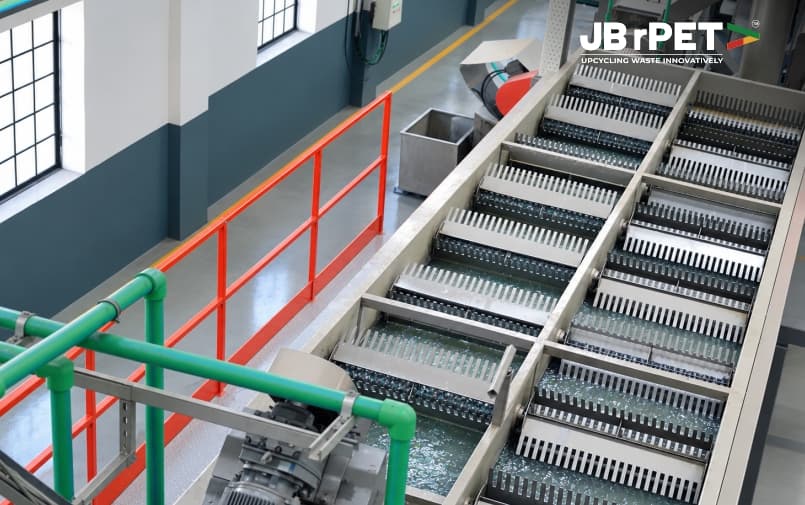
After crushing, the flakes go through intensive washing, rinsing and drying. This stage targets adhesives, dirt, moisture and residual contaminants, and it produces clean, high-quality flakes suitable for chemical recycling.
How are PET adhesives handled in recycling?
PET adhesives recycling is mostly a washing challenge. Label glues tend to soften and release at elevated temperatures, which is why washing is used ahead of chemical recycling. Once released, adhesive residue leaves with the wash stream instead of travelling forward with the flakes.
Drying matters just as much as washing. Moisture carried into later heating stages can affect polymer quality, so the flakes are dried before they move on. The result is a flake with consistent particle size, high cleanliness and uniform quality, which is the starting point for efficient molecular regeneration.
If you want a closer look at how washed flakes are graded and used, see our piece on the role of rPET flakes across industries.
Stage Three: Depolymerization Addresses What Washing Can Reach Only Partly
Washing cleans surfaces. Some contaminants, though, sit within the polymer. Colour bodies, degradation products and impurities that accumulated during the bottle's first life travel with the PET itself. This is the point where chemical recycling contaminated plastic feedstock becomes relevant.
In our process, the cleaned flakes enter multi-stage depolymerization at controlled temperatures. Depolymerization breaks the PET polymer down into molecular constituents. Once the long chains are opened up, impurities, degradation products and colour bodies become accessible for removal.
It helps to understand what depolymerization changes. Mechanical recycling reshapes the existing polymer through melting and extrusion, and it performs well with clean, well-sorted input. Chemical recycling takes the polymer back to its building blocks first, purifies them, and then rebuilds the chain. The two routes serve different needs within the same ecosystem, and our comparison of the rPET recycling process walks through where each fits.
Stage Four: The PET Purification Process
The PET purification process is where much of the quality work happens. After depolymerization, the regenerated material goes through high-precision filtration in the 2 to 4 micron range, along with colour rectification. Filtration at this level targets suspended impurities and supports polymer clarity, purity and consistent IV.
Can dyes be removed from PET through chemical recycling?
PET dye removal happens in two ways in a bottle-based process. First, coloured bottles are separated during sorting, which keeps most tinted material out of the stream from the start. Second, colour bodies that remain in or form within the polymer are addressed during depolymerization and the colour rectification step of purification.
The aim of this stage is colour consistency. Converters producing semi dull, bright or super bright products need a resin whose colour behaves predictably, and consistent colour depends on managing colour bodies before the polymer is rebuilt.
Textile waste brings its own set of dyes and finishes, and it follows a separate path. Our article on textile waste management covers how polyester textiles enter recycling systems.
Stage Five: Rebuilding the Polymer
Once the intermediates are purified, they are polymerized under precisely controlled conditions to rebuild the PET molecular chain. This stage sets the intrinsic viscosity and molecular weight of the finished resin. The regenerated melt is then cooled and pelletized into granules of uniform size, which supports good flow characteristics and ease of downstream processing.
Because the chain is rebuilt under control, IV can be targeted to suit the application. Our chemically recycled rPET resins span an IV range of 0.60 to 1.10 across semi dull, bright, super bright, SSP bottle grade and high IV SSP grades.
Why Feedstock Preparation Shapes the Final Resin
Every stage described above builds on the one before it. Clean, dry flakes of uniform size make depolymerization more efficient. Efficient depolymerization gives purification a more consistent material to work with. Consistent purified intermediates allow polymerization to hit a targeted IV with less variation.
This chain effect is the reason incoming feedstock goes through quality inspection at the very start. Procurement from approved collection networks, followed by inspection on arrival, helps ensure the polymer quality entering the line suits chemical recycling. A recycler that invests in preparation reduces the load on every later stage, and the converter receives the benefit in the form of steadier processing.
What About Mixed Plastic Waste Recycling?
Mixed plastic waste recycling is a broad field, and it is worth being precise about where PET chemical recycling fits within it.
A mixed stream contains several polymer families. Each family behaves differently under heat and chemistry. Depolymerization routes used for PET are built around PET's specific structure, so a PET line performs most reliably when the incoming material has already been separated into a PET-rich fraction. Polyolefins, PVC and other polymers are taken out upstream through sorting.
In our line, the main feedstock is cleaned rPET flake from post-consumer bottles. Other processed PET waste is also fed into the chemically recycled resin line alongside the flakes, while ensuring the desired product specifications and quality are met. The key word there is "processed." The PET waste has already been prepared before it joins the line.
So the honest answer to "can mixed waste be recovered?" is this: the PET fraction within mixed waste can be recovered once it has been separated and processed. The other polymers in that stream need their own recycling routes.
For a broader look at how different waste streams and certifications interact, see our article on chemical recycling of waste streams.
How Do You Verify That Contamination Has Been Addressed?
Removal steps only matter if the result can be measured. Buyers evaluating recycled PET should ask what a supplier tests and how often.
At JB rPET, finished products are evaluated for intrinsic viscosity, colour, chemical composition, purity and process consistency. The testing set includes:
- Automated Type IV viscometry to confirm intrinsic viscosity
- HunterLab spectrophotometric colour analysis to track colour values
- PerkinElmer gas chromatography to monitor DEG, IPA and by-products
- Process-wide batch testing to confirm molecular consistency across production
Each of these checks connects back to a contamination question. IV testing shows whether residues or moisture have affected chain length. Colour analysis shows whether colour bodies have been managed. Gas chromatography tracks chemical composition, including DEG and IPA levels, which influence how the resin behaves in processing. Batch testing ties it together so that a converter receives predictable material from one shipment to the next.
What Buyers Should Ask About Contaminated PET Recycling
If you source recycled resin and want confidence in how contamination was handled, these questions tend to produce useful answers:
- What is the feedstock? Ask whether it is post-consumer bottle waste, other processed PET waste, or a mix, and how it is sourced.
- How is sorting done? Automatic and manual sorting together catch different kinds of contamination.
- Is washing done hot? Heat plays a central role in adhesive release.
- What filtration level is used? Filtration fineness influences clarity and consistency.
- How is colour managed? Look for both upstream colour sorting and a colour rectification step.
- What is tested on every batch? IV, colour and chemical composition data should be available.
- Which certifications apply? JB rPET holds ISCC PLUS, GRS and OEKO-TEX certifications, which relate to traceability and material standards.
For more on what to look for in a supplier, our guide to choosing a resin manufacturer goes deeper into the evaluation process.
Where Recovered PET Ends UP
Resin produced through this route serves a wide range of uses. In textiles, it goes into filament yarns, micro-denier yarns and high-tenacity yarns for apparel manufacturing. It is also used in flexible and rigid PET packaging, films, sheets, strapping products, carpets, pillows and cushions, quilts and curtains, soft toys, car interiors, industrial filters, geotextiles, insulation materials, furniture and sports equipment.
The range of applications reflects why contamination control matters. Each of these end uses places its own demands on IV, colour and purity, and consistent resin makes it easier for converters to meet them. Manufacturers working with bottle-derived feedstock for textiles can read more in our article on bottle-derived polyester resins.
The Bigger Picture: Contamination Is a Shared Responsibility
After years around recycling lines, one pattern stands out. The cleanest resin comes from a chain where every link does its part. Consumers who empty bottles and separate caps help. Collectors who keep PET apart from other waste help. Packaging designers who choose washable labels and releasable adhesives help. Recyclers then apply sorting, washing, depolymerization, filtration and testing to bring the polymer back.
Chemical recycling extends what can be done with PET that has picked up colour bodies and degradation products during its first life. It delivers the most value as part of a system that also values good collection and good sorting. The right expectation is a precise tool for regenerating PET, applied to PET that has been properly prepared.
That is the practical meaning of our line, Upcycling Waste Innovatively: bringing post-consumer PET back as consistent resin through a controlled, measurable process.
Frequently Asked Questions
What is contaminated PET recycling?
Contaminated PET recycling is the process of recovering PET polymer from waste that contains labels, caps, adhesives, colourants, residue or other materials. The contaminants are separated and removed through sorting, washing, and in chemical recycling, depolymerization and purification.
Can chemical recycling handle contaminated plastic?
address contaminants that sit within the polymer, such as colour bodies and degradation products. Physical contaminants like caps and other plastics are removed beforehand through sorting, since PET chemistry is specific to PET
How are labels removed from PET bottles?
PET label removal starts with sorting, continues through washing and rinsing, and is supported by fine filtration later in the chemical recycling process.
Are adhesives a problem for PET recycling?
Adhesives are mainly handled during washing. Heat helps glues soften and release from the flakes, and the residue leaves with the wash stream.
Can dyes be removed from recycled PET?
In bottle-based chemical recycling, coloured bottles are separated during sorting, and remaining colour bodies are addressed during depolymerization and colour rectification.
Can mixed plastic waste be chemically recycled into PET resin?
Only the PET fraction of mixed plastic waste can become PET resin. Other polymers are separated upstream and follow their own recycling routes.
What are contaminated PET flakes?
Contaminated PET flakes are crushed bottle pieces that still carry label fragments, adhesive, dirt or moisture. Washing, rinsing and drying convert them into clean flakes ready for chemical recycling.
How is recycled PET contamination measured?
Through testing of intrinsic viscosity, colour, chemical composition and purity. At JB rPET, this includes Type IV viscometry, HunterLab colour analysis and PerkinElmer gas chromatography for DEG, IPA and by-products, along with process-wide batch testing.